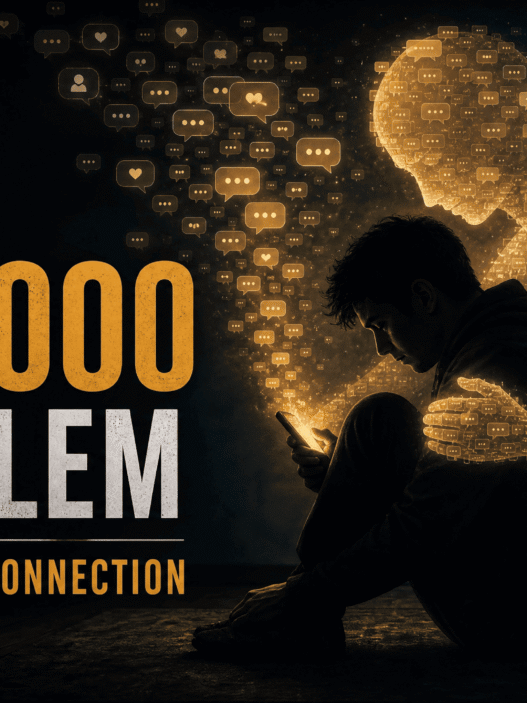








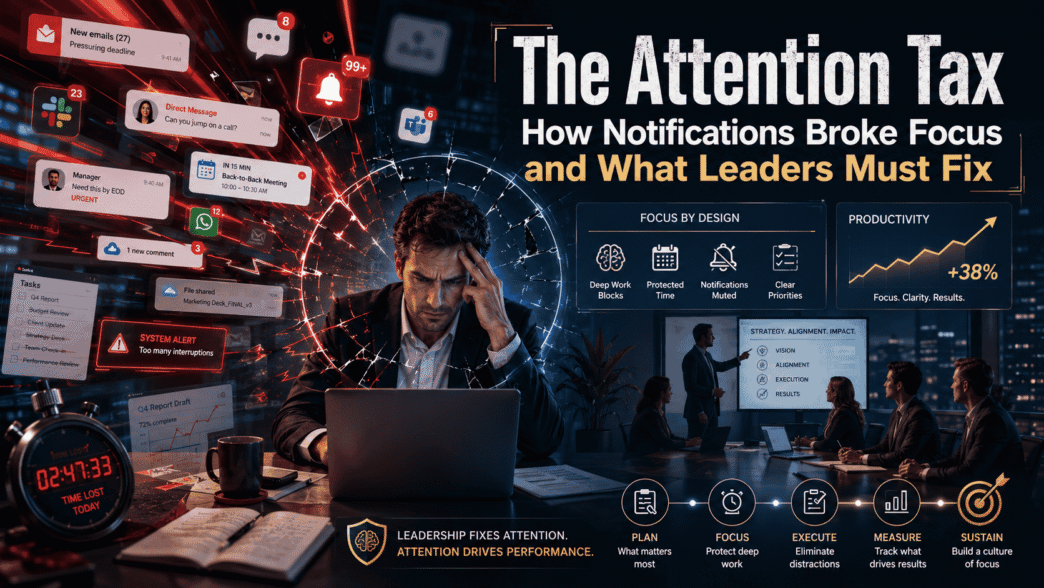
In 2026, the phrase attention tax ” entered everyday management language. It names a simple truth: every notification, ping, and interrupt costs more than the time it takes to glance at a screen. The real cost is cognitive — the time to reorient, the loss of flow, and the accumulation of unfinished mental work. For teams and organizations, those costs compound into missed deadlines, lower creativity, and burnout.
This article explains how the attention tax formed, why it scaled, the signals at its peak, the human and organizational aftermath, and a practical playbook for product teams, managers, and individual contributors who want to reclaim focus without sacrificing collaboration.
Part 1: The Trigger
The attention tax began as a design choice and evolved into a business model. Notifications were useful: calendar reminders, urgent alerts, and time‑sensitive messages. Over time, product teams discovered that engagement metrics — opens, clicks, session length — improved when users were nudged back into apps. Notifications became growth levers.
Three converging trends turned nudges into a tax.
1. Metricized engagement. Companies optimized for measurable short‑term signals. Notifications are easy to measure and A/B test. When growth teams discovered that a well‑timed push increased retention, the nudge became a default.
2. Platform proliferation. Workers now juggle dozens of apps: email, chat, project tools, CRM, social feeds, and mobile alerts. Each app assumes its notifications are important, and the aggregate volume rose faster than human capacity to process interruptions.
3. Hybrid work rhythms. Remote and hybrid work blurred boundaries between work and life. Notifications followed people everywhere, turning evenings and weekends into fragmented work time and eroding recovery.
The trigger was not malicious. It was the rational outcome of product incentives, cheap compute, and a cultural shift toward constant availability. The result is a tax paid in attention, creativity, and well-being.
Part 2: The Amplification Engine
Why did a handful of pings become an organizational crisis instead of a minor annoyance? Three amplification engines explain the escalation.
Product incentives and growth loops
Notifications are a lever growth teams can tune. A small increase in push frequency often yields measurable gains in daily active users. That short‑term win masks long‑term costs. When every team treats notifications as a growth channel, the ecosystem becomes saturated. The result is a race to the bottom: more pings, more noise, less signal.
Social and managerial norms
Managers reward responsiveness. Quick replies are visible signals of engagement and reliability. In hybrid teams, visibility often substitutes for presence. People who answer fast get noticed; those who protect deep time risk being perceived as disengaged. That social pressure turns notifications into a performance metric.
Cognitive science and context switching
Human attention is not fungible. Each interruption imposes a switching cost — the time and mental energy required to return to the original task. Research in cognitive psychology shows that even brief interruptions fragment working memory and reduce accuracy on complex tasks. Multiply that across a team and the productivity loss is substantial.
These engines interact. Product teams push more notifications; managers reward responsiveness; individuals fragment their time to signal availability. The attention tax becomes self‑reinforcing.
Part 3: The Numbers at Peak
Quantifying the attention tax requires translating cognitive costs into organizational metrics. Several consistent patterns emerged across companies that measured the phenomenon.
- Meeting inflation and context switching. Teams reported more, shorter meetings and higher meeting overlap. Meeting density rose as asynchronous work failed to replace synchronous coordination.
- Task completion latency. Average time to complete deep tasks increased as workers were pulled into shallow work. Teams saw longer cycles for design, analysis, and writing.
- Error rates and rework. Fragmented attention led to more mistakes in complex work, increasing rework and reducing throughput.
- Wellbeing signals. Pulse surveys showed rising exhaustion and lower psychological safety scores in teams with high notification volumes.
A practical example from a mid‑sized software company: after instrumenting notification volume and task metrics, the company found that each additional 10 notifications per day correlated with a 7 percent increase in task completion time and a 12 percent rise in self‑reported cognitive fatigue. Those numbers are not universal, but they illustrate how small, repeated interruptions scale into measurable organizational drag.
Part 4: The Aftermath
The attention tax produces predictable winners and losers, and a set of unintended consequences that ripple across culture and product design.
Winners
- Teams that institutionalize deep work. Groups that protect blocks of uninterrupted time and design async workflows see higher creativity and faster completion of complex projects.
- Products that reduce noise. Tools that prioritize signal over frequency — digest emails, batched notifications, and intelligent summarization — gain trust and long‑term engagement.
- Leaders who model boundaries. Managers who set norms for response times and respect offline hours reduce churn and improve retention.
Losers
- Reactive cultures. Organizations that equate responsiveness with commitment create burnout and shallow output.
- Individuals who equate busyness with value. People who respond to every ping become less strategic and more replaceable.
- Products that monetize attention. Apps that prioritize engagement over user outcomes face churn and reputational risk as users seek quieter alternatives.
Unintended consequences
- Psychological safety erosion. When people are constantly interrupted, they have less bandwidth to raise concerns or reflect. That reduces the space for candid feedback and repair.
- Inequity in visibility. Office‑first or always‑online employees gain visibility; those who protect deep time are penalized in informal evaluations.
- Skill atrophy. Deep thinking skills — long-form writing, complex problem solving — atrophy when workers rarely experience extended focus.
The aftermath is not inevitable. It is a design problem with organizational levers.
Part 5: The Playbook Reclaiming Focus Without Sacrificing Collaboration
The attention tax is reversible. The following playbook is practical, prioritized, and designed for teams that must balance responsiveness with deep work.
1. Measure the tax
Start with simple instrumentation. Track notification volume per person, meeting density, and task completion latency. Use pulse surveys to capture cognitive fatigue. Measurement creates accountability and surfaces hotspots.
Quick metric: average notifications per person per day; correlate with time to complete priority tasks.
2. Redesign notification policy
Create a company‑wide notification taxonomy. Not all pings are equal. Define categories and delivery rules.
Example taxonomy:
- Critical: outages, safety, legal — immediate push.
- Operational: task assignments, approvals — batched hourly.
- Informational: updates, announcements — daily digest.
- Social: kudos, non‑urgent chat — opt‑in.
Implement defaults that favor batching and let individuals opt into higher frequency for specific channels.
3. Protect deep work windows
Institutionalize focus blocks. Encourage teams to reserve 90–120-minute blocks for complex work and mark them on shared calendars.
Tactics: company‑wide focus hours, meeting‑free afternoons, and protected writing days for product and design teams.
4. Change managerial norms
Managers must model delayed response and reward outcomes, not immediacy. Make response time expectations explicit.
Manager script: “I’ll respond within 24 hours for non‑urgent items. If you need faster help, use the Critical channel.”
5. Build async-first workflows
Design processes that reduce synchronous coordination. Use short async updates, clear decision records, and lightweight signoffs.
Tactics: structured async standups, decision logs, and short recorded walkthroughs instead of meetings.
6. Invest in tooling that reduces noise
Adopt tools that summarize, prioritize, and batch. Use AI to surface only the most relevant items and to create concise digests.
Tactics: daily email digests, chat snooze defaults, and AI meeting notes that reduce the need to attend every call.
7. Audit for equity and visibility
Ensure that people who protect deep time are not penalized. Make promotion criteria explicit and audit for bias in visibility and recognition.
Tactics: anonymized performance reviews, outcome‑based KPIs, and manager calibration sessions.
8. Teach attention hygiene
Offer short training on attention management: Pomodoro techniques, context switching costs, and how to craft async updates that reduce follow‑ups.
Tactics: 30‑minute workshops, micro‑lessons in onboarding, and manager coaching.
Frequently Asked Questions
1. Will banning notifications kill collaboration No. Thoughtful rules preserve urgent channels while reducing noise. Collaboration improves when interruptions are meaningful rather than habitual.
2. How do we handle urgent work across time zones? Define clear escalation paths and rotate on‑call responsibilities. Use Critical channels sparingly and document expectations.
3. What about customer‑facing alerts? Customer alerts must be immediate. Separate internal noise from external urgency and automate routing to on‑call teams.
4. How long before we see benefits? Teams often notice improved focus and lower fatigue within 4–8 weeks of consistent rules and protected focus time.
5. Can product teams reduce notification dependency without hurting metrics? Yes. Measure long‑term retention and satisfaction, not just short‑term opens. Products that respect attention build trust and sustainable engagement.
Conclusion
The attention tax is the invisible fee modern organizations pay for convenience and growth optimization. It is not a moral failing of individuals but a predictable outcome of product incentives, managerial norms, and hybrid work rhythms. The good news is that it is fixable. Leaders who measure the tax, redesign notification policies, protect deep work, and align incentives will reclaim creativity, reduce burnout, and build teams that produce higher‑quality work with less noise.
Start small: pick one team, measure notifications, and run a four‑week focus pilot. The results will show whether the attention tax is a cost you can afford to keep paying or a problem worth solving now.