








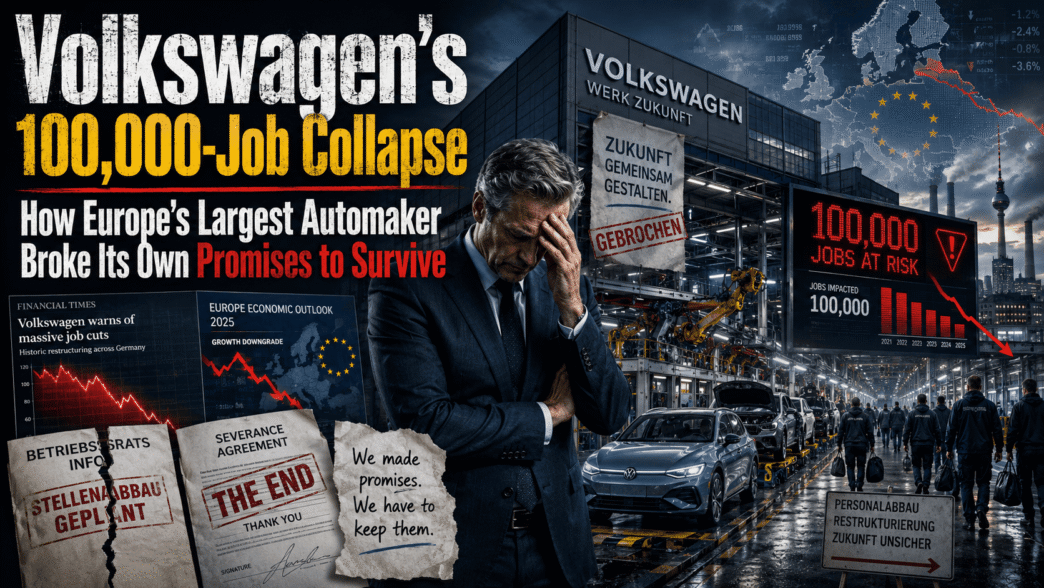
On June 26, 2026, Volkswagen CEO Oliver Blume walked into a management board meeting and presented a restructuring plan so severe it made the company’s previous round of cuts look like a rounding error. One hundred thousand jobs. Four German factory closures. A 15 percent reduction in a workforce that once symbolized Germany’s industrial supremacy. And a quiet but unmistakable act of corporate desperation: breaking a union agreement signed less than two years earlier that had promised no plant closures and no compulsory redundancies through 2030. This is not a story about one bad quarter. This is the structural collapse of an 89-year-old business model that ran out of road at the exact moment the road started to change beneath it.
Part 1 — The Trigger: A Broken Promise That Revealed Everything
To understand why June 26 matters, you need to go back to late 2024. After months of brutal negotiations with IG Metall — Germany’s most powerful industrial union — Volkswagen signed an agreement guaranteeing job security through 2030. No plant closures. No forced redundancies. It was presented as a hard-won compromise, a signal that VW’s leadership had found a path through the turbulence without tearing the company apart.
Less than eighteen months later, that agreement is effectively void.
According to Reuters, VW’s new restructuring plan doubles down on cuts that go far beyond what the 2024 deal permitted. The four factories now slated for closure — Hanover, Zwickau, Emden, and Audi’s Neckarsulm facility — directly employ more than 45,000 workers. When support roles, supplier networks, and regional economies are factored in, the human scale of this collapse is almost incomprehensible for a single corporate decision.
What makes this a genuine inflection point, not just a headline, is the signal it sends about corporate agreements in distressed industries. When a company breaks its own legally negotiated deal this quickly, it tells you something precise: the situation deteriorated faster than even the executives who were inside the numbers could have predicted. That is not spin. That is fear made visible in organizational behavior.
Why Zwickau and Emden Are Symbolic
Zwickau was supposed to be VW’s EV flagship. The plant was retooled at enormous cost to produce only electric vehicles — a bet that VW was all-in on electrification. Emden similarly underwent conversion investment. Closing these plants doesn’t just cut costs. It signals that the EV transformation VW publicly staked its future on did not generate the volume or margin needed to justify the infrastructure. That is a different and more damaging story than a simple cost-cutting exercise.
Part 2 — The Amplification Engine: Three Structural Forces Hitting Simultaneously
The Volkswagen job cuts collapse did not happen because of one bad strategic decision. It happened because three independent structural forces converged on the same company at the same time, each one serious enough to cause pain alone, all three together creating a crisis that outpaced management’s ability to respond.
Force One: The Chinese Market Implosion
For decades, China was Volkswagen’s profit engine. VW sold more cars in China than anywhere else on earth, and those margins subsidized everything from R&D to European labor agreements. Then BYD happened. Then Nio. Then Geely’s portfolio of brands started winning on price, software integration, and EV range in ways that VW’s German-engineered vehicles simply could not match at equivalent price points in the Chinese domestic market.
VW’s China sales volumes — once a reliable bulwark — have declined significantly as local EV competitors captured segments that European brands historically dominated. The company invested heavily in joint ventures and local production, but the market shifted faster than product cycles allowed. When your highest-margin geography turns into a competitive graveyard, every other assumption in the business model gets repriced.
Force Two: U.S. Tariff Pressure Destroying Margin Assumptions
According to Euronews, U.S. tariffs are costing Volkswagen approximately €4 billion annually. That is not an abstraction — that is the difference between a functioning cost structure and a structural loss-maker in a critical export market. VW’s financial models for the American market were built on a different tariff environment. When that environment changed sharply, the company faced an immediate margin compression it had no short-term operational lever to offset.
In Q1 2026, net profit slumped 28 percent to €1.56 billion while revenue fell 2 percent to €75.7 billion. For a company of VW’s scale, a 28 percent profit decline in a single quarter is not a blip. It is a structural signal that the cost base and the revenue reality have decoupled in a way that incremental fixes cannot address.
Force Three: The EV Transition Cost That Didn’t Convert
Volkswagen committed to one of the most expensive industrial transformations in automotive history. The company directed tens of billions toward electrification — retooling plants, developing battery platforms, building charging infrastructure partnerships, and launching the ID. series of vehicles. The original investment thesis assumed that EV adoption in Europe and North America would accelerate fast enough to absorb those transition costs through volume and premium pricing.
That assumption proved optimistic. European EV adoption, while growing, has not moved at the pace that justified the speed of VW’s retooling. Meanwhile, the Chinese competitors who entered Western markets brought cost structures that VW’s unionized, high-overhead German manufacturing base simply cannot match. A €12.5 billion investment reduction — cutting from an original €130 billion plan — is now planned over five years, per CNBC. That is a company acknowledging that its forward bets were sized for a market that didn’t materialize on schedule.
Part 3 — The Numbers at Peak
To appreciate the scale of what is being unwound, you need to understand what Volkswagen looked like at its operational height — and how fast the numbers have moved in the wrong direction.
- 657,000 employees globally before the current restructuring — the target of 100,000 cuts represents approximately 15 percent of the entire workforce.
- Stock down 25 percent year-to-date as of mid-2026, and down roughly 60 percent since Oliver Blume became CEO four years ago, according to reporting by Electrek — a collapse in market capitalization that reflects sustained investor doubt about the company’s strategic direction.
- Four German factories targeted for closure: Hanover, Zwickau, Emden, and Audi’s Neckarsulm plant — together representing some of the most significant industrial real estate in European manufacturing history.
- €4 billion in annual tariff costs from U.S. trade policy alone — a recurring structural drag that compounds every quarterly result.
- €1.56 billion net profit in Q1 2026 — a 28 percent decline year-over-year, on revenue of €75.7 billion.
The contrast with VW’s peak years is stark. This was a company that once generated enough Chinese market profit to fund aggressive global expansion, pay premium German wages above sector averages, and still return capital to shareholders. The machine has not just slowed — the underlying economics have inverted in key markets.
Manager Magazin, which first reported the 100,000-job target, noted that the figure represents a doubling of the 50,000 cuts that had previously been agreed and communicated to the market. The escalation of the target within such a compressed timeframe is itself a data point: the situation is moving faster than management’s public communications have acknowledged.
Part 4 — The Aftermath
Breaking a union agreement of this magnitude does not happen quietly in Germany. IG Metall represents some of the most organized and politically connected workers in Europe. The labor relations fallout from VW’s reversal will play out across multiple dimensions simultaneously.
The Legal and Political Exposure
German labor law gives works councils significant blocking power over plant closures and mass redundancies. The 2024 agreement was not simply a handshake — it had contractual weight. VW’s decision to move beyond those terms will almost certainly trigger legal challenges, government intervention, and political pressure from regional governments whose economies are built around the affected plants. Saxony, Lower Saxony, and Baden-Württemberg are not passive bystanders to the closure of Zwickau, Hanover, and Neckarsulm.
The Talent Signal
When a company of VW’s reputation executes cuts at this scale, it changes who wants to work there — and who can be recruited in the future. Germany’s automotive talent ecosystem is already under pressure from software-first competitors. Engineers who were building EV platforms at VW will now evaluate their options. Some of the best minds in the organization will not wait for the redundancy notice. The human capital erosion that follows visible distress is often more damaging to long-term competitiveness than the immediate headcount reduction itself.
The Supplier Chain Effect
VW’s supply base is not a passive recipient of these decisions. German tier-one and tier-two automotive suppliers — many of whom built capacity assumptions around VW’s production volume — will face their own restructuring pressure as factory closures reduce order volumes. The industrial ripple from 100,000 VW job cuts extends well beyond VW’s own payroll.
For a broader look at how brand trust collapses during industrial crisis, see our analysis of major brand collapse case studies and how companies have navigated existential operational threats.
Part 5 — The Transferable Lesson
Volkswagen’s crisis contains a lesson that applies far beyond German automotive manufacturing. It is a lesson about the structural risk of betting on transition timelines you do not control.
Your Cost Structure Is a Bet on the Future
VW’s labor agreements, factory footprint, and investment plan were all calibrated to a specific version of the future: one where EV adoption moved at a certain pace, where Chinese market share remained accessible, and where tariff environments remained relatively stable. When all three of those assumptions proved wrong simultaneously, the company’s cost structure — which took decades to build and cannot be unwound quickly — became a liability rather than an asset.
This is the legacy automaker trap in precise form. Heavy fixed costs, long capital cycles, union agreements, and political obligations to regional economies create an organization that is fundamentally inflexible. When the market moves fast — as it has with Chinese EV competition and geopolitical tariff shifts — inflexibility is existential.
Agreements Made in Compromise Become Liabilities in Crisis
The 2024 union deal was celebrated as responsible stakeholder management. Eighteen months later, it is the document VW has to publicly abandon in order to survive. This is not hypocrisy — it is a structural lesson about the risk of making long-duration commitments when operating in high-uncertainty environments. Agreements that look like stability mechanisms in good times become anchors in bad ones.
The EV Transition Penalty Is Real and Underpriced
The broader automotive industry has watched VW pour capital into electrification while losing ground to Chinese competitors who built EV-native cost structures from scratch. The incumbency disadvantage in a platform transition is severe: legacy manufacturers carry the overhead of what they were while trying to fund what they need to become. VW is the clearest case study in that penalty so far — but it is unlikely to be the last.
For more on how platform transitions destroy incumbent advantages, explore our breakdown of platform autopsy case studies across tech and industrial sectors.
What happens next at Volkswagen will be watched by every major industrial company navigating a technology transition. The question is no longer whether VW can avoid pain. The question is whether it can restructure fast enough to remain a meaningful global competitor — or whether the cuts themselves accelerate the talent and brand erosion that makes recovery harder. That tension has no clean answer. And that ambiguity is exactly what makes this collapse so important to understand.
Frequently Asked Questions
What is the Volkswagen job cuts collapse about?
The Volkswagen job cuts collapse refers to VW’s June 2026 plan to eliminate approximately 100,000 jobs — 15 percent of its global workforce — and close four German factories, doubling previously agreed targets and breaking a 2024 union agreement. It represents the most significant restructuring in the company’s 89-year history.
Why is Volkswagen cutting so many jobs?
VW is cutting jobs due to three converging pressures: declining profitability in the Chinese market where local EV brands like BYD have taken a significant share; U.S. tariffs costing approximately €4 billion annually; and an expensive EV transition that has not generated the sales volume needed to cover its costs.
Which Volkswagen factories are closing?
According to reporting, four German facilities are targeted: the Hanover plant, the Zwickau EV factory, the Emden plant, and Audi’s Neckarsulm facility. Together, these directly affect more than 45,000 workers, with broader supplier chain impacts extending further.
How has Volkswagen’s stock performed during this crisis?
VW’s stock was down approximately 25 percent year-to-date as of mid-2026 and down roughly 60 percent since CEO Oliver Blume assumed leadership four years ago, reflecting sustained investor concern about the company’s strategic direction and competitive positioning.
Did Volkswagen break its union agreement?
Yes. In late 2024, VW signed an agreement with IG Metall guaranteeing no plant closures and no compulsory redundancies through 2030. The June 2026 restructuring plan goes significantly beyond those terms, effectively voiding the agreement and creating significant legal and political exposure in Germany.
What does the Volkswagen collapse mean for other automakers?
VW’s crisis is a warning for all legacy automakers navigating the EV transition. It demonstrates the structural risk of high fixed-cost manufacturing bases, long-duration labor agreements, and capital-intensive platform transitions undertaken at the same time that Chinese EV competitors are entering global markets with fundamentally lower cost structures.