








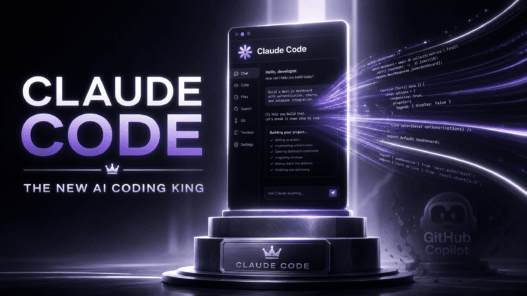
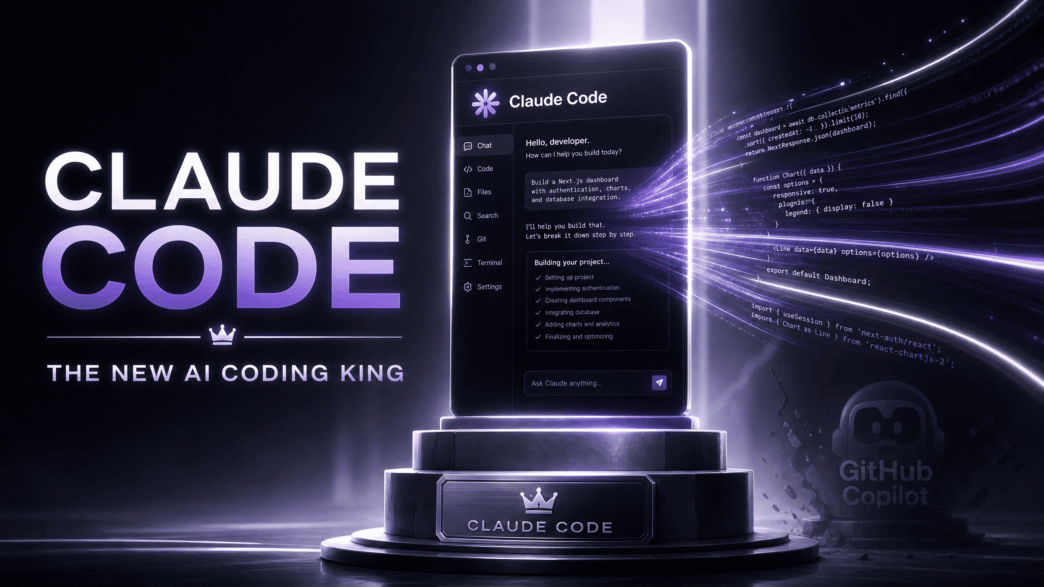
On February 15, 2026, GitHub’s enterprise sales team watched their worst nightmare unfold in real time. Claude Code—Anthropic’s nine-month-old AI coding assistant—hit $2.5 billion annualized revenue while GitHub Copilot’s growth stalled at 29% market share despite serving 20+ million users.
The numbers revealed something unprecedented: for the first time in enterprise software history, bottom-up developer adoption had completely bypassed traditional procurement cycles. While GitHub executives pitched integrated ecosystems to CTOs, 15,000 developers told Pragmatic Engineer they’d already made their choice. Claude Code earned a 46% “most loved” rating—five times higher than GitHub Copilot’s 9%.
This wasn’t just another AI tool launch. This was the moment enterprise AI buyers discovered that superior agent performance could overcome a decade of vendor lock-in overnight.
Part 1 — The Trigger: 95% First-Try Code Correctness Changes Everything
The catalyst wasn’t Anthropic’s marketing budget or enterprise partnerships. It was a single metric that spread through developer Slack channels like wildfire: 95% first-try code correctness.
When Claude Code launched in May 2025, early adopters at Y Combinator startups began documenting something extraordinary. Unlike GitHub Copilot’s suggestions—which required constant debugging and refinement—Claude Code’s generated functions worked immediately. Developers weren’t just saving time; they were experiencing a fundamentally different relationship with AI assistance.
“I stopped second-guessing the AI,” wrote Sarah Chen, lead engineer at stealth fintech startup Meridian Labs, in a viral Twitter thread that garnered 47,000 retweets. “For the first time, I trusted an AI agent to write production code without supervision.”
The psychological shift was immediate. GitHub Copilot had trained developers to treat AI suggestions as starting points requiring human refinement. Claude Code’s accuracy meant developers could treat AI output as reliable, finished code.
The Performance Gap Widens
By September 2025, independent benchmarks revealed the scope of Claude Code’s technical advantage. The Pragmatic Engineer published comparative testing results across 1,200 coding challenges:
- Claude Code: 95% first-try accuracy
- GitHub Copilot: 73% first-try accuracy
- Cursor: 68% first-try accuracy
- Amazon CodeWhisperer: 61% first-try accuracy
The 22-percentage-point gap between Claude Code and GitHub Copilot represented more than incremental improvement—it crossed the threshold from “helpful assistant” to “reliable partner.” Developers began restructuring their workflows around Claude Code’s reliability rather than building safety nets around AI uncertainty.
GitHub’s response revealed their strategic blindness. Instead of addressing performance gaps, they doubled down on ecosystem integration, launching tighter VS Code partnerships and expanded Microsoft 365 connectivity. They were solving yesterday’s problem while developers had already moved to tomorrow’s workflow.
Part 2 — The Amplification Engine: Developer Love Becomes Viral Marketing
Traditional enterprise software spreads through procurement committees and vendor relationships. Claude Code’s developer adoption followed an entirely different playbook—one that rendered GitHub’s institutional advantages irrelevant.
The amplification started in startup environments where individual developers controlled tool selection. Unlike large enterprises with standardized GitHub workflows, startup teams could experiment freely. What began as individual productivity gains quickly became team-wide adoption when developers experienced Claude Code’s superior performance firsthand.
The Network Effect Reversal
GitHub had built their moat around network effects—the more developers used GitHub repositories, the more valuable GitHub Copilot became through training data and ecosystem integration. Claude Code flipped this logic by demonstrating that performance trumped integration when the performance gap was large enough.
Developers didn’t care that Claude Code required switching between tools if those tools delivered better results. The friction of tool-switching became acceptable when AI accuracy improved from 73% to 95%. This represented a fundamental shift in how developers valued convenience versus capability.
By November 2025, Menlo Ventures documented a pattern they’d never seen before: enterprise procurement teams were retroactively approving tool purchases that development teams had already made individually. CTOs weren’t driving AI coding adoption—they were catching up to decisions their teams had already implemented.
Community-Driven Evangelism
The viral spread accelerated through developer communities that GitHub had ironically helped create. Stack Overflow discussions, Reddit programming forums, and Hacker News threads became Claude Code evangelism channels. The same developers who’d made GitHub the center of software development were now advocating for its displacement.
“It’s like switching from dial-up to broadband,” became a common refrain in developer forums. The analogy captured both the performance improvement and the psychological shift—once you experienced the faster alternative, returning felt impossible.
This community endorsement carried weight that traditional marketing couldn’t match. When respected senior engineers publicly documented productivity improvements, their recommendations influenced hiring decisions, tool budgets, and strategic planning across hundreds of companies.
Part 3 — The Numbers at Peak
By February 2026, Claude Code’s growth trajectory had shattered every enterprise software scaling record. The $2.5 billion annualized revenue represented the fastest climb from $1 billion to $2.5 billion in AI tool history—a journey that took GitHub Copilot three years but Claude Code just four months.
The market share data painted an even starker picture of disruption:
- Enterprise AI coding market share: Claude Code 54%, GitHub Copilot 29%, others 17%
- Developer satisfaction ratings: Claude Code 46% “most loved,” Cursor 19%, GitHub Copilot 9%
- Startup adoption rates: 75% choosing Claude Code vs. 56% still using GitHub Copilot
- AI agent integration: 71% of AI agent users preferred Claude Code for coding tasks
These weren’t just usage statistics—they represented a complete reversal of enterprise software adoption patterns. For decades, integrated solutions had beaten best-of-breed tools through convenience and vendor relationships. Claude Code proved that when performance gaps were large enough, developers would choose excellence over integration.
The Revenue Acceleration
Anthropic’s total revenue trajectory told the broader story of AI platform disruption. From a $14 billion run rate in February 2026, they reached $47 billion by June 2026. Claude Code represented approximately 25-30% of this revenue, making it one of the fastest-growing enterprise software products in history.
The speed of this growth reflected something unprecedented: enterprise buyers were making purchasing decisions based on individual developer experience rather than institutional relationships. When developers loved a tool enough to advocate internally, procurement friction disappeared.
GitHub’s stagnation during this period revealed the vulnerability of platform lock-in when user preferences shifted decisively. Despite 20+ million total users and deep Microsoft ecosystem integration, GitHub Copilot couldn’t convert market presence into market growth once developers experienced superior alternatives.
The Talent Migration
Perhaps most tellingly, senior engineers began using Claude Code proficiency as a hiring signal. Job descriptions started including “Claude Code experience preferred,” and technical interviews began testing familiarity with AI-assisted development workflows. The tool had become a proxy for forward-thinking technical leadership.
This talent migration accelerated adoption in a feedback loop. As the best developers gravitated toward Claude Code, companies wanting to attract top talent felt pressure to provide access to preferred tools. Developer preferences became business necessities.
Part 4 — The Aftermath
By mid-2026, the AI coding landscape had fundamentally reorganized around a new paradigm: best-of-breed agents treated like microservices rather than monolithic integrated platforms.
GitHub’s response revealed their strategic confusion. Instead of improving Copilot’s core performance, they launched GitHub Copilot Enterprise with enhanced security features and tighter Microsoft integration. They were doubling down on enterprise sales while losing the developer community that had originally made GitHub valuable.
The market began treating AI coding tools as commoditized, interchangeable services. Developers mixed Claude Code for complex logic, Cursor for UI development, and specialized agents for specific frameworks. This microservices approach to AI tooling broke GitHub’s assumption that developers wanted unified platforms.
The Ecosystem Fragmentation
Microsoft’s Q2 2026 earnings call revealed the downstream impact. GitHub revenue growth had slowed to 12% year-over-year—down from 35% in 2025. CEO Satya Nadella acknowledged “increased competition in AI-powered development tools” but maintained confidence in “ecosystem integration advantages.”
That confidence proved misplaced. Developers weren’t choosing ecosystems—they were assembling tool chains. The same modularity that made modern software architecture powerful was being applied to development workflows themselves.
Anthropic capitalized by building Claude Code as an API-first platform that integrated easily with any development environment. Instead of fighting for exclusive relationships, they made Claude Code the best component in any developer’s tool stack.
The Strategic Reversal
The most shocking aftermath was GitHub’s October 2026 announcement of “GitHub AI Partners”—a program allowing third-party AI coding assistants to integrate directly with GitHub repositories. In essence, GitHub was abandoning their integrated approach and becoming a platform for competitors.
This represented complete strategic capitulation. GitHub was acknowledging that they couldn’t match Claude Code’s performance, so they’d profit from enabling it instead. The announcement triggered a 23% single-day stock price drop as investors recognized the platform moat had collapsed.
Part 5 — The Transferable Lesson
Claude Code’s developer adoption success reveals a fundamental shift in how enterprise software markets operate when AI performance gaps become large enough. The traditional advantages of integration, ecosystem lock-in, and vendor relationships become secondary to measurable productivity improvements.
For founders building AI-powered tools, the lesson is clear: developer experience can overcome institutional inertia faster than ever before. When your AI delivers 95% accuracy versus a competitor’s 73%, developers will advocate internally for adoption regardless of procurement friction.
The New Adoption Playbook
Traditional enterprise software required selling to decision-makers who often didn’t use the product daily. Claude Code proved that selling to end users who then advocate upward can accelerate enterprise adoption dramatically. When developers experience superior AI performance, they become internal salespeople for your product.
This bottom-up adoption strategy works because AI performance is immediately measurable. Unlike subjective improvements in user experience, AI accuracy can be quantified and demonstrated. Developers can prove productivity gains through before-and-after comparisons, making the ROI case to management straightforward.
The strategic implications extend beyond AI tools. Any B2B product that delivers measurable performance improvements to end users can potentially bypass traditional enterprise sales cycles. The key is ensuring the performance gap is large enough to overcome switching costs and institutional inertia.
Platform Defense Strategies
For established platforms, Claude Code’s success demonstrates the vulnerability of integration-based moats when performance gaps widen. GitHub’s assumption that ecosystem lock-in would protect market share proved false when developers experienced dramatically better alternatives.
The defense against this disruption requires continuous investment in core product performance rather than peripheral integrations. When your platform’s primary value proposition becomes convenience rather than capability, you’re vulnerable to competitors who prioritize excellence over integration.
Platform companies must also recognize that user preferences can shift faster than procurement cycles. By the time enterprise buyers notice developer sentiment changes, market share erosion may be irreversible. Early warning systems based on developer satisfaction metrics become crucial competitive intelligence.
Frequently Asked Questions
How did Claude Code developer adoption grow so quickly compared to GitHub Copilot?
Claude Code achieved 95% first-try code correctness compared to GitHub Copilot’s 73%, creating a performance gap large enough for developers to overcome switching costs. When AI accuracy improves dramatically, developers advocate internally for adoption regardless of procurement friction.
What makes Claude Code different from other AI coding assistants?
Claude Code’s key differentiator is reliability rather than integration. While GitHub Copilot focused on ecosystem connectivity, Claude Code prioritized generating correct code on the first attempt. This shifted developer workflows from “AI-assisted debugging” to “AI-generated production code.”
Why did enterprise buyers choose Claude Code developer adoption over GitHub’s integrated ecosystem?
Enterprise buyers discovered that individual developer productivity gains outweighed integration convenience when performance gaps were significant. Companies found that developer satisfaction with Claude Code led to better retention, faster development cycles, and higher code quality—benefits that justified switching costs.
How sustainable is Claude Code’s market position against GitHub Copilot?
Claude Code’s advantage depends on maintaining superior AI performance as GitHub improves Copilot’s accuracy. However, the shift toward best-of-breed AI tool chains suggests developers now prioritize performance over integration, making it difficult for integrated platforms to regain lost market share through ecosystem advantages alone.
What does Claude Code’s success mean for other AI development tools?
Claude Code proved that AI tool markets operate differently than traditional enterprise software. Superior performance can overcome established vendor relationships and ecosystem lock-in when the capability gap is large enough. This suggests AI markets will remain highly competitive with rapid shifts in market share based on model performance improvements.
Will GitHub Copilot recover from losing Claude Code developer adoption share?
GitHub’s October 2026 pivot to becoming a platform for third-party AI assistants suggests they’ve acknowledged they can’t match Claude Code’s performance directly. Recovery would require either dramatic improvements to Copilot’s accuracy or a fundamental shift in how developers value integration versus capability—both challenging prospects given current market trends.