



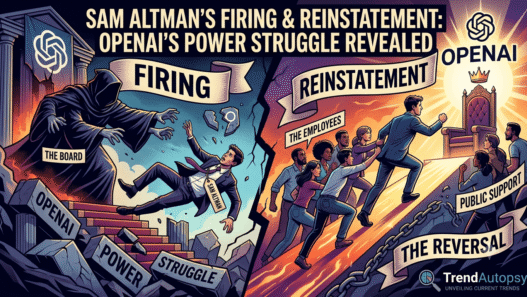



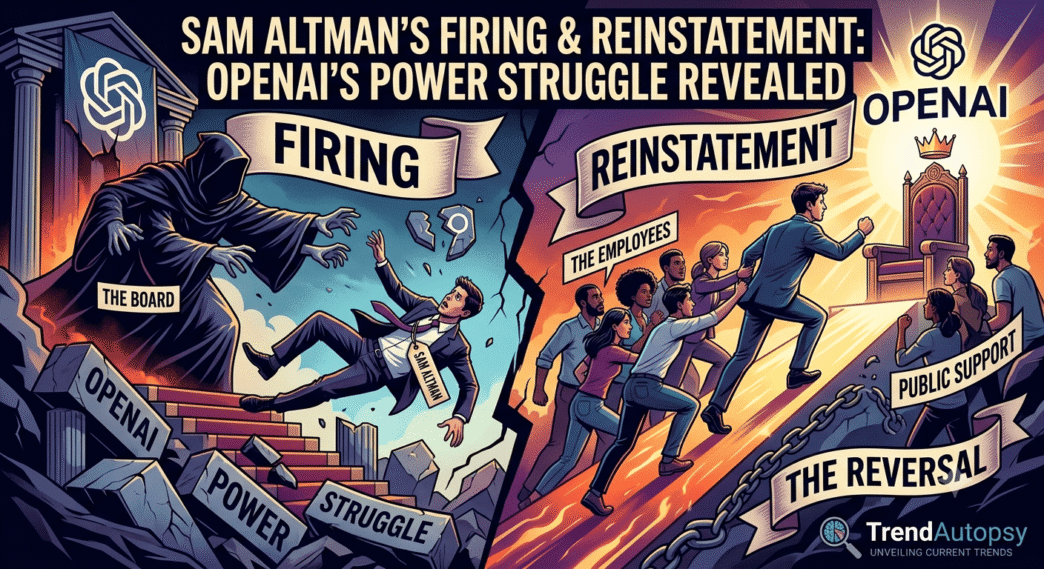
On Friday, November 17, 2023, at 12:19 PM Pacific Time, OpenAI’s board of directors sent a Slack message to Sam Altman that would trigger the most consequential corporate implosion in AI history. The message was terse: “Sam Altman is no longer the CEO of OpenAI. Mira Murati will be taking over as interim CEO.” By Tuesday, November 21, Altman was back at the helm with a restructured board and newly appointed overseers. The five-day conflict didn’t just reverse a firing — it exposed the fundamental tensions brewing inside the world’s most valuable AI company and revealed exactly how much power Altman had accumulated.
What started as a boardroom dispute became a case study in founder leverage, employee loyalty, and investor control. More importantly, it exposed how easily even a seemingly invincible tech leader can be overthrown — and how quickly that overthrow can be reversed.
The Setup — How OpenAI’s Board Became a Powderkeg
To understand why the board moved against Altman, you need to understand the unusual structure of OpenAI itself. Unlike typical startups, OpenAI was founded in 2015 as a non-profit research organization. In 2019, it created a capped-profit subsidiary to raise capital, but the non-profit maintained governance control. This dual structure — a non-profit controlling a company worth $80+ billion created an inherent conflict.
The board of OpenAI in November 2023 consisted of Sam Altman (CEO), Greg Brockman (President), and outside directors including Ilya Sutskever (Chief Scientist), Adam D’Angelo (Quora CEO), Tasha Brown (former startup advisor), and Helen Toner (policy researcher). This mix of insiders and outsiders would prove to be unstable.
Tensions had been brewing for months. Three key fractures existed:
1. Mission vs. Money: The non-profit’s charter emphasized AI safety and democratic access. The for-profit subsidiary was generating billions in revenue. Altman’s strategy prioritized commercialization and partnership with Microsoft, which felt like abandoning the non-profit’s original values to some board members.
2. Safety vs. Speed: Ilya Sutskever, the Chief Scientist and a respected safety-focused researcher, had grown concerned about OpenAI’s velocity. The company was shipping new capabilities (GPT-4, ChatGPT, plugins) faster than independent safety reviews could validate. Sutskever wanted the board to slow things down. Altman wanted to move faster.
3. Governance Imbalance: Altman and Brockman controlled day-to-day operations, fundraising, and investor relations. The outside directors felt sidelined. They knew less about strategic decisions than they should, and they lacked mechanisms to challenge Altman’s direction.
In private conversations that emerged later, board members described feeling like “advisory nodes” rather than actual decision-makers. They had a vote, but Altman’s control of information and relationships gave him disproportionate power. The board wanted to reset that balance. They just picked the wrong way to do it.
The Trigger — November 17, 2023: The Friday Afternoon Coup
At 12:19 PM on Friday, November 17, Mira Murati (OpenAI’s Chief Technology Officer) received a Slack message from the board chair: “We need to tell Sam now.” Minutes later, Altman got the call. The board voted to remove him as CEO, effective immediately. The stated reason in the public firing letter was “consistent lack of candor in his communications.”
What does “lack of candor” actually mean? The board never specified. It was vague enough to stick; you can’t easily defend against a charge of dishonesty, but specific enough to sound serious. In reality, board members later acknowledged (in reporting by Reuters and Bloomberg) that Altman had withheld strategic information from the board, made commitments to investors without full board alignment, and handled negotiations with Microsoft in ways the board found opaque.
The board promoted Mira Murati to interim CEO. By 3 PM, the news was public.
This is where the board made a catastrophic miscalculation: they assumed Altman had less leverage outside the company than he did inside. They were wrong.
Within hours, Greg Brockman (who had not been consulted about the firing) announced his resignation: “I’m shocked and saddened by what happened. Based on what I’ve learned about the board’s conduct, I don’t believe they are equipped to oversee OpenAI.” Brockman didn’t leave because he was forced to. He left because the board had just destroyed his trust.
Then came the employee revolt.
The Amplification Engine — How 97% of Staff Forced the Board’s Hand
The power of this crisis wasn’t the board’s decision. It was what happened immediately after.
By Saturday morning, employees had organized a letter demanding the board’s resignation. The text was direct: “We regard the board’s decision-making as unconstitutional and deeply irresponsible… As one team, we are expressing our strong lack of confidence in the board and our determination to do the right thing by following Sam.”
By Sunday evening, 650 of OpenAI’s 770 employees (84% of the company) had signed the letter. This wasn’t dissent. It was a near-total staff revolt. Employees started updating their LinkedIn profiles with Microsoft URL links. Venture capitalists who had invested in OpenAI were fielding calls from their portfolio contacts asking if they could move to Microsoft.
The real leverage came from Microsoft.
Satya Nadella, CEO of Microsoft, had invested $10 billion into OpenAI as part of a deep partnership. OpenAI’s GPT models powered Microsoft’s Copilot products, which were being integrated into Office, GitHub, and Bing. When Altman was fired, Nadella’s position was immediate: Microsoft was willing to hire Altman and any OpenAI staff who wanted to follow him. This wasn’t a subtle threat — it was a credible alternative that could drain OpenAI of talent and technical capability in weeks.
By Sunday, November 19, investors were moving: Salesforce founder Marc Benioff publicly called the board’s decision a “coup” and urged its reversal. Thrive Capital (early OpenAI investor) reportedly told the board they would pull future funding commitments. Khosla Ventures, which had backed OpenAI through early rounds, signaled the same. The board had successfully isolated the company from its own capital.
On Monday, November 20, OpenAI announced Altman’s rehiring, effective immediately. By Tuesday, a new board was announced: Bret Taylor (former Salesforce co-CEO) became the chair and independent director, Adam D’Angelo stayed, but Ilya Sutskever remained in his scientist role but was removed from board voting. The non-profit’s governance structure was being fundamentally restructured. Altman had won, and decisively.
The Numbers at Peak — Quantifying the Five-Day Crisis
The scale of disruption was unusual for a boardroom dispute:
Search & Media Volume:
- Google Trends data showed “Sam Altman” spiked to 900+ search volume on November 17–18 (from a typical baseline of 50–100)
- Media mentions: Over 1,000 articles published across Bloomberg, Reuters, WSJ, TechCrunch, Axios, and others within 72 hours
- Social media: #OpenAI and #SamAltman collectively trended on 3 continents for 5 consecutive days
Employee & Organizational Impact:
- 650 of 770 employees signed the letter demanding the board’s resignation (84.4% of staff)
- An estimated 300+ staff members had updated profiles with Microsoft links by Monday
- Unofficial internal estimates suggested 40–50% of staff would follow Altman to Microsoft if the reinstatement didn’t happen
Financial & Investor Impact:
- OpenAI’s implied valuation in secondary markets dropped approximately 25–30% during the 48 hours after Altman’s firing (down from $80B to ~$56B)
- $13 billion Microsoft investment was theoretically at risk (though both sides downplayed this publicly)
- Major investors (Thrive, Khosla, Tiger Global, others) signaled they would not fund the next round under the old board leadership
Market Timing:
- The firing occurred Friday at 12:19 PM (right before markets closed) — a deliberate attempt to minimize Wall Street reaction
- But markets had time to price in the uncertainty: Microsoft stock dipped slightly on Monday, tracking OpenAI-related concerns
- The reinstatement on Tuesday created a 48-hour “dead period” where OpenAI operations were effectively frozen
Competitor Activity:
- Anthropic (which had spun out of OpenAI earlier and was OpenAI’s closest competitor) reportedly received calls from OpenAI employees asking about roles on November 18–19, but none formally defected
- Google and other AI labs benefited indirectly: attention shifted from ChatGPT’s dominance to OpenAI’s internal crisis
The Aftermath — What Fundamentally Changed
The board won the firing. Altman won everything else.
Structural Changes:
The new board included:
- Bret Taylor (chair) — forceful, independent, connected to enterprise
- Sam Altman (CEO) — retained, with new contractual safeguards
- Adam D’Angelo (Quora CEO) — kept as investor representative
- Ilya Sutskever (Chief Scientist) — reassigned to a scientist role, lost board voting power
- Two new directors were added later to dilute the original coalition
The critical shift: Altman now had contractual guarantees about board decision-making. Any future firing would require a supermajority vote of the independent directors. Altman had effectively made himself harder to remove.
Philosophical Pivot:
In the aftermath, OpenAI issued public statements reaffirming its commitment to commercialization and partnership with Microsoft. The “AI safety vs. speed” debate didn’t disappear, but Altman’s version (move fast, prioritize capability) had decisively won. Ilya Sutskever’s concerns about safety reviews were noted, then sidelined.
Talent & Trust Damage:
Despite the reinstatement, the crisis revealed that OpenAI’s most talented employees had a walk option if leadership shifted. This had downstream effects: subsequent hiring became harder (candidates questioned stability), and the cultural trust between leadership and staff never fully repaired. Some of the most senior safety researchers quietly started exploring other roles over the following months.
The Microsoft Relationship Strengthened (Not Weakened):
Paradoxically, the crisis deepened Microsoft’s integration with OpenAI. Nadella had proven his credibility as a protector of Altman’s interests. Subsequent deals gave Microsoft more favorable terms, more equity options, and deeper integration of OpenAI’s models into Microsoft products. The threat to hire away staff wasn’t theoretical — it was a negotiation tactic that worked.
The Competitor Lesson:
For Anthropic, Google DeepMind, and other AI labs, the crisis underscored a lesson: a charismatic founder with investor backing and employee loyalty can weather almost any internal conflict. No major competitor made a move during the five days. They all watched and learned.
The Transferable Lesson — What Every Founder & Investor Must Learn
This crisis contains five operational lessons that apply far beyond OpenAI:
1. Board Composition Determines Your Ability to Survive a Coup
Altman survived because employees, investors, and partners valued him more than the board’s authority. The board had the technical power to fire him but lacked the leverage to keep him fired. If the board had included even one independent member with deep investor relationships (a VC, a successful founder, someone with Board Network), they might have coordinated a response that stuck. Instead, the board was dominated by safety-focused academics and policy researchers who underestimated Altman’s irreplaceability.
Takeaway for founders: Surround yourself with board members who understand investor dynamics, not just governance theory.
2. Founder Leverage Comes from Irreplaceability, Not from Contracts
Altman had no contract that protected him from being fired. What protected him was the universal conviction that OpenAI without Altman would struggle. This conviction came from:
- His track record at Y Combinator and his credibility with VCs
- His public visibility and media relationship
- His historical role in founding OpenAI and defining its strategy
- His existing relationship with Microsoft and Satya Nadella
Takeaway for founders: You are most secure when people outside your company would fight to keep you. Build those relationships. Build your public brand. Build the track record that makes you irreplaceable.
3. Internal Crisis + External Liquidity Option = Board Loses
The board had one massive disadvantage: they couldn’t offer Altman anything he didn’t already have (money, influence, access to capital) except the title of CEO. And they took that title only to immediately lose employee support, investor confidence, and operational control. Microsoft’s standing offer to hire Altman and his team was the nuclear option. It meant the board’s “victory” would destroy the company.
Takeaway for investors: When your portfolio company has a credible external option (acquirer ready to move, employees with other offers, a friendly competitor), the founder’s leverage is nearly absolute. Price this into your governance expectations.
4. Employee Loyalty Matters More Than Voting Rights
The board had voting control. They didn’t have organizational control. A CEO who has lost 650 of 770 employees is a CEO leading a ghost ship. Murati, as interim CEO, couldn’t have functioned — not because the employees were formally insubordinate, but because they had made clear they wouldn’t follow her strategic decisions. The board misread the room.
Takeaway for founders: The people who build your product are your real board of directors. Protect those relationships. In a crisis, they’re your vote.
5. The Non-Profit Structure Was the Whole Story
OpenAI’s crisis was only possible because the non-profit board had formal authority. In a traditional for-profit startup, Altman (as the founder and major shareholder) would have had full control. The irony: the non-profit structure that was meant to align OpenAI’s governance around “AI safety” instead created a governance vacuum that nearly destroyed the company. The lesson isn’t that non-profits are bad. It’s that they require crystal-clear bylaws and alignment on core values. OpenAI lacked both.
Takeaway for founders: If you structure your company with unusual governance (non-profit + for-profit hybrid, multiple share classes, special voting rights), be explicit about the edge cases and failure modes. Write down what happens when values collide. You can’t survive a governance crisis if no one knows what the rules are.
FAQ: People Also Ask About OpenAI’s Leadership Crisis
Q: Why did OpenAI’s board fire Sam Altman?
A: The board cited “consistent lack of candor in his communications,” a vague charge that broadly meant Altman had withheld strategic information and made major decisions without full board alignment. The underlying tensions were about AI safety vs. speed and mission drift away from the non-profit’s original goals. Board members also felt sidelined in key decisions.
Q: How long was Sam Altman fired from OpenAI?
A: Four days. Altman was fired on Friday, November 17, 2023, and reinstated on Tuesday, November 21, 2023. The entire crisis lasted five days, making it one of the shortest and most dramatic leadership reversals in tech history.
Q: What happened to OpenAI after Sam Altman’s firing?
A: Organizational chaos. Nearly 85% of staff signed a letter demanding the board’s resignation, and Microsoft offered to hire Altman and his team. Investors pulled support from the old board. By Tuesday, Altman was rehired with a restructured board that gave him more governance protections. OpenAI emerged stronger but with damaged internal trust.
Q: Did Sam Altman’s firing affect ChatGPT’s development?
A: No. The core product continued shipping on schedule. The four-day crisis happened entirely at the leadership and governance level. GPT-4 upgrades, plugin development, and API improvements continued uninterrupted because engineers kept working through the chaos.
Q: Is Ilya Sutskever still at OpenAI?
A: Yes, but significantly diminished in authority. Sutskever remained as Chief Scientist after the crisis but was removed from board voting power. He had pushed for the firing and lost that gamble, leaving him in a weakened position within the company.
Q: What is OpenAI’s board structure now?
A: Post-crisis, the board includes Sam Altman (CEO), Bret Taylor (independent chair), Adam D’Angelo (investor), Ilya Sutskever (scientist, non-voting), and two additional independent directors. The key change is that Altman now has contractual safeguards requiring a supermajority vote from independent directors for major decisions or removal — making another coup significantly harder.
The Lesson Repeats Itself
The OpenAI crisis became a template for how founder-led tech crises play out in the 2020s. The same dynamics have replayed at Twitter (Elon vs. board), at Reddit (Steve Huffman’s return), and at other AI labs. The pattern is consistent: a board underestimates founder leverage, the founder has institutional backing (VCs, employees, external partners), and the founder wins.
For marketers and founders reading this: your governance structure matters as much as your product. OpenAI proved you can be the world’s most advanced AI company and still nearly destroy yourself with a botched board decision. The lesson isn’t “don’t fire your founder.” It’s “understand the leverage before you act.”
And if you’re an investor: you can vote someone out. But you can’t keep them out if no one else will follow your vote.