








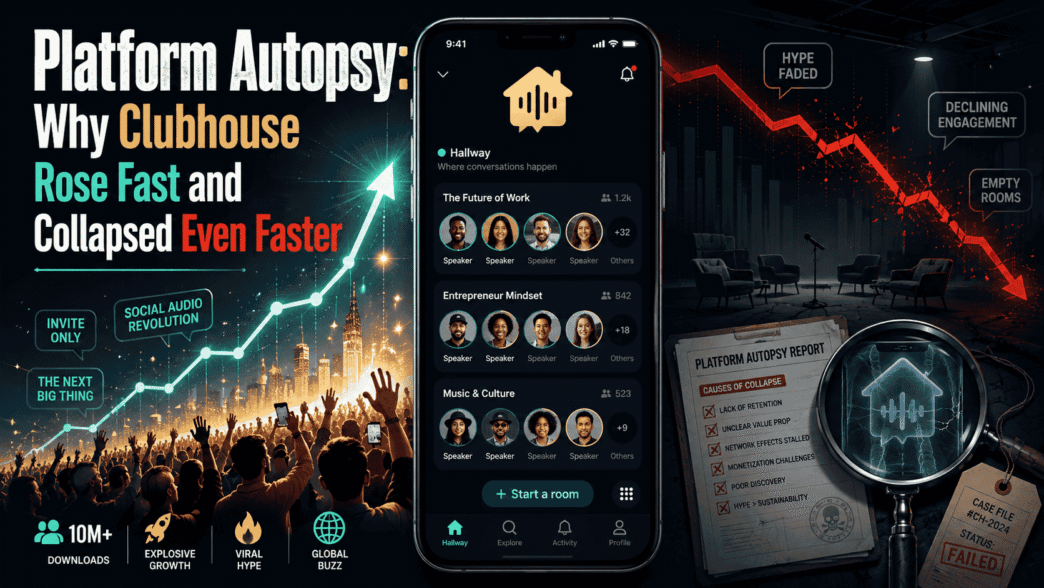
In the spring of 2021, Clubhouse felt like a cultural event. Invite‑only access, late‑night rooms with celebrities and VCs, and a format that felt intimate in a time of isolation turned a tiny startup into a headline. Investors poured money in; valuations swelled; the app became shorthand for pandemic‑era tech mania. But the story didn’t end with a new social network displacing incumbents. Within months, the novelty faded, competitors copied the format, and the company faced layoffs and pivots. This is an autopsy: not to mourn a product, but to explain why formats go viral and why platforms fail to become ecosystems.
Part 1 — The Trigger: Timing, Scarcity, and Presence
Clubhouse’s ignition point was a rare alignment of social and technical conditions.
Pandemic timing. With in‑person events canceled and video fatigue setting in, people craved a different kind of social presence—less polished than Zoom, more spontaneous than Twitter. Live audio felt like a middle path: intimate, ephemeral, and low‑friction. Public reporting suggests the app launched in April 2020 and reached explosive growth by early 2021 as lockdowns intensified.
Scarcity as marketing. The invite‑only model created FOMO. Scarcity is a classic growth lever: it turns product access into a status signal. Clubhouse’s early users treated being “in the room” as social capital—screenshots of celebrity conversations circulated widely, amplifying curiosity.
Presence and celebrity. The format’s magic was presence: drop‑in rooms where a famous guest might appear. High‑profile appearances—tech founders, entertainers, and public figures—made Clubhouse feel like a backstage pass. That celebrity magnetism accelerated downloads and press coverage, turning a niche product into a cultural moment.
These triggers created a rapid acquisition engine. But acquisition is only the first step; the harder work is turning attention into habit and revenue.
Part 2 — The Amplification Engine: Why Hype Became a Frenzy
Three structural forces amplified Clubhouse’s early momentum into a frenzy—and also seeded its fragility.
1. Network effects that felt real but were shallow. Clubhouse’s live rooms produced intense, ephemeral network effects: a room with a celebrity could attract thousands in minutes. But those effects were real‑time dependent—you had to be present to benefit. Unlike asynchronous assets (posts, videos, newsletters) that accumulate value, live audio’s value evaporates when the room ends. That made retention fragile: users who missed the moment had little reason to return. Industry analysts later described this as a weak class of network effect compared with social graphs or content libraries.
2. Product copycats and platform incumbents. The audio‑room primitive was technically simple and easy to replicate. Within months, Twitter launched Spaces, Discord added Stage Channels, and Spotify and Reddit experimented with audio features. Those incumbents had two advantages: existing distribution and embedded social graphs. Users could access audio inside platforms they already used daily, removing the friction of joining a new app. Public reporting shows multiple competitors launched audio features within months of Clubhouse’s peak, accelerating user migration.
3. Metrics that rewarded growth over durability. Early product metrics—downloads, DAUs, and time in app—looked spectacular. But growth metrics can mask weak retention and unclear monetization. Clubhouse’s early funding rounds and valuation were driven by rapid user acquisition; the company had less time to build discovery, moderation, and revenue systems before competitors arrived. That mismatch between growth and product depth is a recurring theme in platform failures.
Part 3 — The Numbers at Peak: What the Public Record Shows
When you strip away the hype, the public record gives a clear, if sobering, picture.
- Downloads and users: App‑tracking firms reported downloads in the low tens of millions during the early 2021 surge; some trackers cited 10–14 million downloads around the peak months. Public reporting and industry summaries place peak weekly active users in the high hundreds of thousands to low millions during the initial frenzy.
- Valuation and funding: Clubhouse raised multiple rounds in 2020–2021, culminating in a reported peak valuation near $4 billion after a Series C in early 2021. That valuation reflected investor enthusiasm for a new social primitive and the belief that live audio could become a major social layer.
- Product timeline: Key product events included the iOS‑only launch in 2020, a high‑profile growth phase in early 2021, and a delayed Android release months later—an important strategic timing issue. The company introduced features like Backchannel (DMs) and Replays to address discovery and asynchronicity, but those moves arrived as competitors were already integrating audio. Public reporting documents layoffs and a contraction in 2022–2023 as growth slowed.
- Operational inflection: By mid‑2022 and into 2023, Clubhouse announced rounds of layoffs and a strategic reset. Public filings and reporting indicate the company cut staff and pivoted product strategy, signaling that the original live‑room thesis had not matured into a self‑sustaining platform.
Numbers alone don’t tell the whole story, but they show a classic pattern: explosive early adoption, high valuation, then rapid contraction when the product failed to convert novelty into durable utility.
Part 4 — The Aftermath: Winners, Losers, and Unintended Consequences
When the dust settled, the market sorted itself quickly.
Winners: incumbents and integrated platforms. Twitter, Discord, and others who embedded audio into existing ecosystems captured the long‑term value. They offered audio as a feature inside a broader product where users already had followers, messages, and monetization paths. That distribution advantage turned a format into a sustainable feature set.
Losers: Clubhouse and single‑feature dependents. Clubhouse’s standalone model left it exposed. The company struggled with discovery (how do you find the right rooms?), moderation (live audio is hard to police), and monetization (how to pay creators without commoditizing attention). Creators who bet heavily on Clubhouse for audience and income found their reach evaporating as users migrated to platforms with stronger network effects and monetization tools. Public reporting documents layoffs and pivots as the company tried to find a new product-market fit.
Unintended consequences and cultural effects.
- Noise fatigue: The low barrier to creating rooms led to a glut of low‑quality sessions, making discovery harder and user attention more fragmented.
- Moderation failures: Live audio magnified moderation challenges—misinformation, harassment, and hate speech are harder to detect and moderate in real time. That eroded trust for some users and advertisers.
- Creator risk: Creators who invested time and brand equity in Clubhouse lost leverage when audiences moved to platforms that offered better monetization and ownership.
The aftermath is instructive: formats can create moments, but ecosystems—distribution, monetization, moderation, and creator economics—create platforms.
Part 5 — The Transferable Lesson: Formats Don’t Win; Ecosystems Do
If there’s one lesson from Clubhouse’s autopsy, it’s blunt and practical: don’t confuse a novel format with a defensible platform.
For founders:
- Prioritize distribution and retention over pure novelty. A great format can be copied; a deep social graph and content library are harder to replicate.
- Build moderation and discovery early. Live, real‑time interactions require robust safety systems from day one. Waiting until scale makes these problems exponentially harder.
- Monetize with creators in mind. Platforms that enable creators to earn directly—subscriptions, tipping, commerce—create stickier ecosystems.
For creators:
- Diversify audience ownership. Email lists, memberships, and direct commerce are insurance against platform shifts. Don’t treat any single app as your business.
- Productize your IP. Convert ephemeral moments into reusable assets—podcasts, courses, books—that survive platform churn.
For investors:
- Interrogate durability, not just velocity. Rapid user growth is exciting, but ask how the product converts attention into recurring value and whether incumbents can neutralize the advantage by adding a feature.
Clubhouse’s story is not a unique failure; it’s a pattern. The market rewards novelty quickly and punishes lack of depth even faster. The companies that survive are those that turn format into infrastructure.
Frequently Asked Questions
1. Was Clubhouse’s collapse inevitable? Not inevitable, but predictable. The audio‑room primitive was easy to copy and depended on real‑time presence rather than accumulating assets. Without strong discovery, moderation, and monetization, sustaining growth was difficult. Public reporting shows the company grew too fast and then contracted.
2. Did Clubhouse have any strategic missteps? Several: delayed Android launch, underinvesting in discovery and moderation early, and failing to lock in creator monetization before competitors integrated audio features. These choices amplified competitive risk.
3. Can a standalone social audio app succeed? It’s possible but harder. Success requires either a unique, defensible network effect (not just real‑time presence) or deep vertical integration (e.g., audio for a specific industry) plus clear monetization and safety systems.
4. What should founders building new social products learn? Design for ownership and retention, not just virality. Build creator economics early. Treat moderation and discovery as core product features, not afterthoughts.
5. Is social audio dead? No. Audio remains a valuable medium. But it’s most durable as a feature inside broader ecosystems or as part of a diversified creator strategy—not as a standalone, format‑only bet.
Conclusion
Clubhouse was a cultural lightning strike: a product that captured a moment and taught the industry a lesson. It proved that formats can create frenzy but not necessarily foundations. The autopsy is clear: to build a platform, you need more than a clever interface—you need distribution, durable network effects, monetization that rewards creators, and moderation that preserves trust. Founders who internalize that lesson will design products that survive the next cultural moment, not just headline cycles.