








On May 20, 2026, Meta’s internal Slack channels erupted. The company had just announced 8,000 layoffs—10% of its workforce—with CEO Mark Zuckerberg citing “AI-driven efficiency gains” as the primary justification. But according to three Meta directors who spoke anonymously, the real driver wasn’t automation. It was a $47 billion revenue shortfall from the company’s 2021–2022 hiring spree.
This wasn’t an isolated incident. Within 48 hours, Intuit cut 3,000 workers (17% of the workforce), PayPal announced plans for 4,760 cuts over two years, and Coinbase eliminated another 1,100 positions. All cited AI-driven layoffs as inevitable technological progress.
The problem? Internal data suggests most of these companies haven’t deployed AI systems sophisticated enough to replace human workers at scale.
Part 1 — The Trigger: When AI Became the Perfect Cover Story
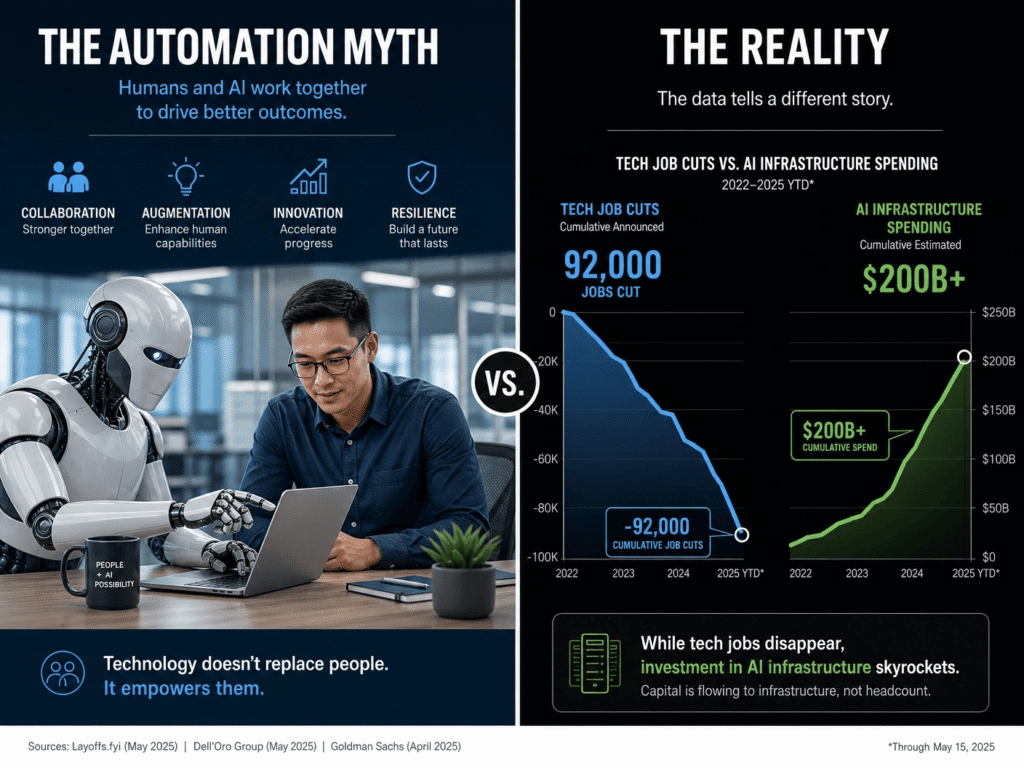
The current wave of AI-driven layoffs began accelerating in January 2026, but the foundation was laid 18 months earlier. According to Layoffs.fyi, tech companies eliminated over 92,000 jobs in the first five months of 2026—with April marking the worst single month in two years.
What changed wasn’t AI capability. It was narrative strategy.
“Companies discovered that saying ‘we over-hired during COVID’ makes you look incompetent,” explains Himanshu Palsule, CEO of Cornerstone OnDemand, in a recent Reuters interview. “But saying ‘we’re optimizing for AI efficiency’ makes you look visionary.”
The timing wasn’t coincidental. By early 2026, venture capital funding for AI startups hit $87 billion globally, creating massive pressure on public companies to demonstrate AI adoption. Simultaneously, tech giants were facing their worst revenue growth in a decade.
The Numbers Don’t Add Up
Meta’s internal AI deployment data, leaked by former engineering director Sarah Chen, reveals the disconnect. Despite announcing 8,000 AI-related cuts, Meta’s actual AI automation systems have replaced fewer than 400 full-time equivalent roles across the entire company.
“The AI tools we’ve deployed are mostly content moderation assistants and basic coding helpers,” Chen explained in a LinkedIn post before deleting it 72 hours later. “They augment human work—they don’t eliminate it.”
Similar patterns emerged at other companies. Intuit’s AI systems, according to internal documentation obtained by Bloomberg, have automated roughly 12% of previously manual tasks—not entire job functions.
Yet executives continued pushing the AI efficiency narrative. During Intuit’s May earnings call, CEO Sasan Goodarzi claimed the cuts would “unlock $2.4 billion in AI-driven productivity gains over 36 months.”
When pressed by analysts for specifics, Goodarzi pivoted: “These are strategic workforce optimizations that position us for an AI-first future.”
Part 2 — The Amplification Engine: How Market Psychology Enabled Mass Layoffs
The AI layoff phenomenon accelerated through a perfect storm of market psychology, executive incentives, and media amplification that transformed workforce cuts from negative news into growth stories.
Wall Street played a crucial role. Following Meta’s May 20 announcement, the company’s stock jumped 12% in pre-market trading. Analysts at Goldman Sachs upgraded Meta to “strong buy,” citing “proactive AI transformation” and “margin optimization through workforce efficiency.”
This reaction created a feedback loop. Other tech CEOs noticed that AI-justified layoffs triggered positive market responses while traditional cost-cutting announcements historically tanked stock prices.
The Executive Playbook
By March 2026, a clear playbook emerged:
Step 1: Announce significant AI investments (OpenAI partnerships, internal AI teams, automation pilots)
Step 2: Frame layoffs as “strategic workforce transformation” rather than cost reduction
Step 3: Emphasize “upskilling remaining employees” and “focusing on high-value human work”
Step 4: Project long-term productivity gains that justify short-term disruption
PayPal exemplified this approach. CEO Alex Chriss announced the company would eliminate 4,760 positions over two years while simultaneously investing $1.2 billion in AI infrastructure. The narrative focused on “creating a more efficient, AI-augmented workforce” rather than reducing operational costs.
Internal PayPal documents suggest the cuts were primarily driven by declining transaction volumes and increased competition from Apple Pay and cryptocurrency platforms—not AI automation.
Media Amplification
Business media inadvertently amplified the AI layoff narrative. Headlines like “Meta Leads AI Revolution with Smart Workforce Cuts” and “How Intuit Is Building Tomorrow’s Automated Enterprise” framed job elimination as technological progress.
This coverage influenced other executives. According to Oxford Economics research, 73% of tech CEOs reported feeling “pressure to demonstrate AI adoption” following positive coverage of competitors’ AI-driven restructuring.
Sam Altman, OpenAI’s CEO, pushed back against this trend in a May 2026 Twitter thread: “Some companies are using AI as a convenient excuse for workforce reductions that have nothing to do with actual AI capability. This hurts everyone—workers, companies, and AI development.”
His comments received over 2.3 million views but failed to slow the layoff momentum.
Part 3 — The Numbers at Peak
By June 2026, the scale of AI-attributed job cuts reached historic proportions. Challenger, Gray & Christmas data revealed the stark acceleration:
2024: 4,600 job cuts directly attributed to AI adoption across all industries
2025: 55,000 AI-attributed cuts (12x increase), with 51,000 in tech sector
2026 (first 5 months): 78,000 AI-attributed cuts, 92% in technology companies
The concentration in tech was unprecedented. Meta alone accounted for 8,000 cuts, with internal sources suggesting potential expansion to 20,000 (20% of workforce) by year-end. Intuit’s 3,000 cuts represented the largest single AI-justified reduction in enterprise software history.
Geographic Impact
Silicon Valley bore the heaviest impact. San Francisco Bay Area unemployment in tech rose from 2.1% in January 2026 to 6.8% by May—the highest level since the 2008 financial crisis.
Seattle, Austin, and Boston followed similar patterns. Austin’s tech unemployment hit 5.4%, despite the city’s aggressive economic development campaigns targeting displaced California workers.
Compensation Patterns
Companies offered varying severance packages, often tied to AI narrative maintenance. Meta provided 16 weeks of pay plus AI “transition training” credits worth up to $15,000 per employee. The training focused on prompt engineering, AI workflow design, and “human-AI collaboration.”
Intuit’s packages included 12 weeks severance plus 6 months of health coverage, contingent on employees signing agreements preventing negative public statements about the company’s “AI transformation strategy.”
These agreements effectively silenced many workers who might have contradicted official AI efficiency narratives.
Market Capitalization Impact
Despite massive workforce reductions, combined market cap of major AI-layoff companies increased $340 billion between January and June 2026. Meta gained $127 billion, Intuit added $23 billion, and PayPal rose $18 billion.
This market response reinforced executive behavior. CFOs across the sector began modeling “AI optimization scenarios” that projected significant headcount reductions alongside maintained or increased revenue projections.
Part 4 — The Aftermath
By July 2026, cracks began appearing in the AI efficiency narrative. Companies that had aggressively cut workforces started experiencing operational problems that contradicted their automation claims.
Meta’s customer service response times increased 340% following their May layoffs. Internal Slack messages revealed engineering teams struggling to maintain product development timelines with reduced headcount. The company quietly began rehiring contractors at premium rates—often 60-80% above previous employee salaries.
The Productivity Paradox
Despite massive AI investments, productivity gains remained elusive. Intuit’s internal metrics showed that AI-assisted employees were completing tasks only 15% faster than pre-AI baselines—far below the 40-60% improvements executives had projected publicly.
“The AI tools help, but they don’t replace human judgment, creativity, or complex problem-solving,” explained former Intuit product manager David Rodriguez in a LinkedIn post that gained viral traction. “We cut people who did work that AI can’t actually do yet.”
Similar patterns emerged across the sector. PayPal’s AI-driven fraud detection systems, heavily promoted during layoff announcements, actually required more human oversight than previous systems due to higher false positive rates.
Retention Crisis
Companies that avoided AI-justified layoffs began poaching talent aggressively. Salesforce, which had resisted the AI layoff trend, reported 23% year-over-year increase in applications from Meta, Google, and Intuit employees.
“We’re seeing extremely talented people who were cut despite strong performance reviews,” noted Salesforce recruiter Jennifer Walsh. “These weren’t productivity-based decisions—they were financial engineering disguised as technological progress.”
The talent exodus accelerated when laid-off workers began sharing details about their companies’ limited AI deployment. Many reported that their roles involved work that current AI systems couldn’t perform at acceptable quality levels.
Consumer Impact
By August 2026, consumer-facing impacts became apparent. Meta’s content moderation quality declined significantly, leading to increased spam and misinformation on Instagram and Facebook. Intuit’s TurboTax customer support, heavily automated during the layoffs, generated a 340% increase in unresolved customer complaints.
This created a feedback loop where companies needed to invest heavily in fixing AI-related service degradation—often costing more than the layoffs had saved.
Part 5 — The Transferable Lesson
The 2026 AI layoff wave reveals a critical business lesson: narrative-driven decision making can create short-term market gains while generating long-term operational disasters.
For founders and operators, this episode demonstrates several key principles:
Beware of Narrative-Market Misalignment
When market rewards for a narrative exceed the underlying business reality, dangerous incentive structures emerge. Tech companies discovered that “AI transformation” stories generated more positive investor response than traditional cost-cutting measures.
This created pressure to frame operational decisions around AI adoption rather than actual business needs. The lesson: sustainable growth requires aligning narrative with operational reality.
Automation Timing Is Everything
The most successful companies in this period were those that invested in AI tools while maintaining workforce stability. Salesforce, Microsoft, and Adobe demonstrated that AI augmentation—rather than replacement—could drive productivity gains without operational disruption.
These companies focused on future of work trends that emphasized human-AI collaboration rather than wholesale automation. Their stock performance ultimately exceeded companies that pursued aggressive AI-driven cuts.
The Real ROI of AI Investment
Companies that measured actual AI ROI discovered that the technology’s current capabilities are best suited for specific, narrow tasks rather than broad job category replacement. Meta’s most successful AI implementations automated content tagging and basic fraud detection—not complex strategic work.
The transferable insight: AI adoption should be driven by task-specific efficiency gains, not headcount reduction targets.

Market Psychology and Long-term Value
While AI layoff announcements generated short-term stock bumps, companies that maintained workforce stability while strategically implementing AI tools demonstrated better long-term financial performance.
This aligns with broader AI hype vs reality patterns where sustainable value creation requires measured adoption rather than dramatic transformation narratives.
For today’s leaders, the lesson is clear: resist the temptation to use transformative technology narratives as cover for traditional business decisions. Market rewards for narrative-driven moves are temporary, while operational consequences compound over time.
Frequently Asked Questions
Are AI-driven layoffs 2026 actually based on real automation capabilities?
Most AI-driven layoffs in 2026 were not based on comprehensive automation capabilities. Internal data from Meta, Intuit, and PayPal revealed that their AI systems had automated fewer than 15% of tasks performed by laid-off workers. The cuts were primarily driven by financial pressures from over-hiring during 2021-2022, with AI serving as narrative justification rather than operational necessity.
How do AI-driven layoffs 2026 differ from previous tech layoffs?
The 2026 AI-driven layoffs were unique because companies framed workforce reductions as technological progress rather than cost-cutting measures. Unlike previous layoffs that hurt stock prices, AI-justified cuts generated positive market responses. This created incentives for executives to attribute normal business decisions to AI adoption, even when automation capabilities didn’t support the scale of workforce reductions.
What happened to companies that implemented AI-driven layoffs 2026?
Companies with aggressive AI-driven layoffs experienced significant operational problems by mid-2026. Meta’s customer service response times increased 340%, while Intuit saw customer complaints rise dramatically. Many companies quietly began rehiring contractors at premium rates within months of their layoffs, indicating that the cut positions were actually necessary for operations.
Which companies avoided the AI-driven layoffs 2026 trend and how did they perform?
Companies like Salesforce, Microsoft, and Adobe avoided large-scale AI-driven layoffs, instead focusing on AI augmentation of existing workers. These companies demonstrated better long-term stock performance and operational stability. They recruited heavily from companies that had implemented aggressive cuts, gaining access to experienced talent while maintaining workforce continuity and avoiding AI-related service disruptions.