

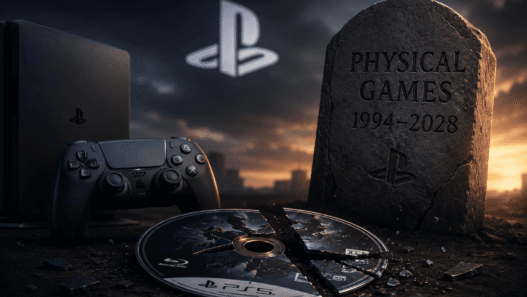





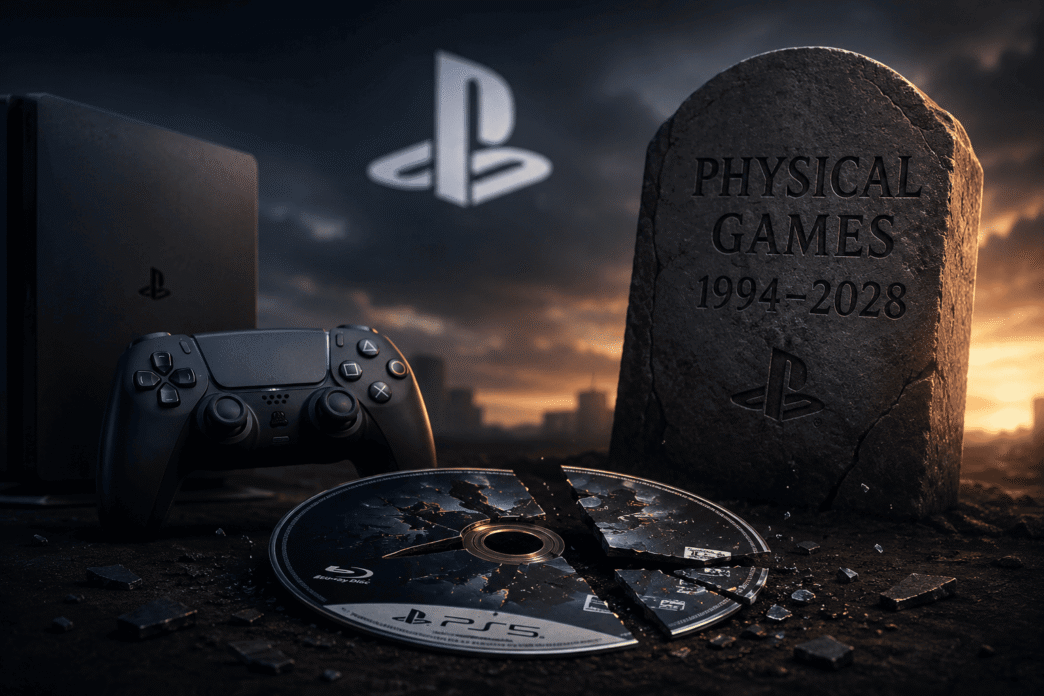
On July 1, 2026, Sony quietly confirmed what many players had feared for years: disc production for PlayStation Physical games would end in January 2028. There was no press conference. No executive video. No community letter. Just a policy update, dropped into the news cycle like a stone into still water and then silence. Within 8 days, more than 213,000 people had signed a Change.org petition demanding Sony reverse the decision. The PlayStation physical games backlash didn’t just trend. It metastasized into a sustained, cross-platform crisis that exposed something far more dangerous than bad timing: a fundamental breakdown in the trust between a legacy brand and the customers who built it.
Part 1 — The Trigger: A Policy Update That Felt Like a Betrayal
Sony’s announcement wasn’t framed as a loss. It was framed as evolution—the kind of corporate language designed to make retreat look like progress. “Consumer preferences” were cited as the driving force behind the move toward an all-digital future. That framing was the first mistake, and arguably the most damaging one.
The data told a completely different story. According to research firm Circana, cited in Deseret News on July 2, 2026, 82% of PS5 consoles sold include disc drives. If the overwhelming majority of PlayStation 5 owners actively chose hardware capable of playing physical media, the argument that consumer preferences drove disc discontinuation collapses immediately. Players noticed. Gaming forums lit up within hours, not because the news was unexpected, but because the justification felt dishonest.
What Sony Was Actually Optimizing For
To understand the backlash structurally, you have to understand the economics Sony was chasing. Digital game sales carry zero manufacturing cost, zero shipping cost, zero retail margin sharing, and virtually no return exposure. In Sony’s fiscal year 2025, digital purchases comprised approximately 80% of full-game sales, according to Reuters data cited by Black America Web on July 6, 2026. On paper, the disc’s death was a rational business decision.
But Sony wasn’t eliminating a product. It was eliminating a relationship. Physical media represents something the gaming industry has struggled to articulate cleanly: proof of ownership. A disc on a shelf cannot be remotely deactivated, server-shuttered, or license-revoked. Digital libraries can be—and have been, across platforms including Sony’s own PlayStation Store, which removed purchased content in specific regional markets without warning in years prior. The moment Sony killed the disc, it also killed the most tangible argument that players owned their games rather than merely licensed them.
Part 2 — The Amplification Engine: Five Days of Silence on Every Platform
Crisis communications has a foundational rule that most PR professionals treat as non-negotiable: acknowledge within 24 hours, respond substantively within 72. Sony’s own internal protocol reportedly operated on a similar framework. Instead, according to tracking by Push Square across updates published July 2 through July 6, 2026, Sony remained completely silent on X (formerly Twitter), Facebook, Bluesky, and Instagram for more than five consecutive days following the announcement.
In an era where brand sentiment moves at platform speed, five days is an eternity. It’s enough time for a narrative to calcify. And that’s exactly what happened.
How Reddit, Change.org, and YouTube Turned the Silence Into the Story
When a major brand goes quiet after a controversial announcement, the internet doesn’t wait. It writes the story itself—and the version it writes is rarely charitable. On Reddit’s r/PlayStation and r/gaming subreddits, the top-voted threads shifted rapidly from “is this confirmed?” to “this is why we can’t trust Sony” to “here’s every time digital ownership failed players.” Each phase of community discourse arrived with screenshots, historical receipts, and emotional testimony from collectors, game preservationists, and parents who bought disc-based games specifically because they could be resold, lent, or kept permanently.
The Change.org petition—which reached the #1 trending position on the platform within days, per Push Square’s July 8 coverage—wasn’t just a number. It was a coordination mechanism. Every new signature was a social sharing event. Every milestone was a news hook. The petition functioned as a distributed PR campaign that Sony’s silence allowed to run completely uncontested.
YouTube commentary channels, many with audiences in the hundreds of thousands, published reaction videos within 48 hours. These videos weren’t fringe content—they were watched by exactly the demographic Sony most needs to retain heading into a console generation transition: engaged, high-spending, long-tenure PlayStation players. Sony gave those creators an empty stage and a hot microphone.
The Preservationist Angle That Sony Didn’t Anticipate
One of the most potent and underreported dimensions of the backlash was the game preservation community. Organizations and advocates dedicated to archiving gaming history—physical media being central to that mission—amplified the announcement as an existential threat to cultural memory. When a game is disc-only and its publisher discontinues it, physical copies become the sole surviving artifacts. When discs disappear entirely, the ability to preserve games outside of corporate server infrastructure disappears with them. This argument resonated far beyond hardcore collectors and drew mainstream media coverage that reframed Sony’s margin play as an attack on cultural heritage.
Part 3 — The Numbers at Peak
By day eight post-announcement, the data points told a coherent story of a brand in genuine reputational freefall:
- 213,022 petition signatures on Change.org, with the petition holding the #1 trending position on the platform (Push Square, July 8, 2026)
- 82% of PS5 hardware sales included disc drives at point of purchase, directly contradicting Sony’s “consumer preference” messaging (Circana, via Deseret News, July 2, 2026)
- 5+ days of social media silence from Sony across all major platforms, breaching standard crisis response timelines (Push Square, July 2–6, 2026)
- 80% digital share of full-game sales in fiscal 2025, revealing the financial incentive Sony had to accelerate disc deprecation regardless of consumer sentiment (Reuters, via Black America Web, July 6, 2026)
What made these numbers collectively damaging was the contrast they created. Sony had a strong financial argument for going digital. It had essentially no public argument that the move benefited players. The 80% digital sales figure, intended to support the “consumers are already choosing digital” narrative, instead highlighted that Sony was forcing a transition on the 20% who hadn’t—and on the 82% who had explicitly bought hardware with a disc slot.
Part 4 — The Aftermath
As of the sustained backlash window covered in this analysis, Sony had not issued a meaningful public response, reversed the decision, or offered any concession to the physical media community. That absence is itself an outcome worth examining.
What Silence Communicates Strategically
There are two reasons a company stays quiet during a crisis: it is genuinely unprepared to respond, or it has calculated that the backlash will exhaust itself before the policy cost outweighs the margin benefit. Sony’s silence most likely reflects the second scenario. The disc discontinuation is an economically irreversible direction for the industry—Microsoft, Nintendo, and third-party publishers are all navigating the same gravitational pull toward digital-only distribution. Sony may have concluded that engaging the backlash legitimizes it, while waiting it out allows the narrative to fade.
The problem with that calculation is longevity. This backlash has an unusually high shelf life because it connects to durable anxieties—digital license revocation, corporate overreach, the erosion of consumer rights—that don’t fade with a news cycle. Every future Sony announcement about digital services, subscription pricing, or game delisting will be filtered through the memory of July 2026. The company didn’t just create a bad news week. It handed critics a permanent reference point.
The Broader Industry Signal
Sony’s handling of this moment will be studied by brand strategists and crisis communicators for years, but it also sends a signal to the gaming industry at large. Players are increasingly aware that digital ownership is a legal fiction—a license, not a purchase. The disc wasn’t just a format. It was a hedge against corporate decisions. As that hedge disappears across the industry, the trust deficit between players and publishers will widen, and the brands that navigate it most honestly will earn durable loyalty while those that optimize silently for margin will accumulate compounding reputational debt.
For a deeper look at how platform decisions erode user trust over time, see our analysis of platform autopsies on TrendsSpy and our breakdown of brand collapse patterns across legacy companies.
Part 5 — The Transferable Lesson
The PlayStation physical games backlash is not really a story about discs. It’s a story about what happens when a company optimizes for its own economics while messaging as if it’s optimizing for its customers—and gets caught in the gap between those two things.
Lesson 1: Never Let Your Data Contradict Your Narrative Publicly
Sony said consumers preferred digital. Circana data showed 82% of PS5 buyers chose disc hardware. In the information environment of 2026, that contradiction surfaces within hours and becomes the headline. If your business rationale is honest—”we’re moving to digital because it’s better for our margins and the industry is heading there anyway”—say so, or say nothing specific. Don’t manufacture a consumer-preference justification that your own sales data disproves.
Lesson 2: Silence Is a Position, and It’s Usually the Wrong One
Five days of silence didn’t protect Sony from the backlash. It handed the backlash a megaphone. When brands go quiet on social media during a crisis, they cede narrative control to the most emotionally activated voices—who are, by definition, not the brand’s advocates. A holding statement acknowledging the community’s concerns, even without reversing policy, would have materially changed the tenor of coverage in the first 72 hours.
Lesson 3: Emotional Contracts Are Real Business Assets
PlayStation’s brand equity was built on decades of emotional relationship-building with players—launch lines at midnight, traded discs between friends, physical collections as personal identity markers. That equity is a balance sheet item even if it doesn’t appear on one. When you make a decision that violates the terms of that emotional contract without acknowledgment or compensation, you don’t just lose a news cycle. You spend brand equity that took thirty years to accumulate. The depreciation rate on that spending is slow but certain.
Founders and marketers operating subscription, SaaS, or platform businesses should read this case carefully. The moment your pricing, feature removal, or access change is perceived as serving your interests at the expense of your users’ interests—without honest explanation—you trigger the same psychological sequence: betrayal, organizing, amplification, calcified narrative. The platform is different. The human response is identical.
Frequently Asked Questions
What is the PlayStation physical games backlash about?
Sony announced on July 1, 2026, that disc production for PlayStation games would end in January 2028. The PlayStation physical games backlash refers to the widespread consumer, collector, and preservationist response—including a 213,000+ signature petition—driven by concerns over digital ownership rights, game preservation, and Sony’s contradictory messaging about consumer preferences.
Why did Sony say it was ending physical game discs?
Sony cited shifting consumer preferences toward digital purchases. However, this framing was widely challenged because Circana data showed 82% of PS5 consoles sold include disc drives, suggesting the majority of players actively chose physical-capable hardware.
How many people signed the petition against Sony’s disc discontinuation?
According to Push Square reporting on July 8, 2026, more than 213,022 people signed the Change.org petition within 8 days of Sony’s announcement, making it the #1 trending petition on the platform at the time.
Why did Sony stay silent for 5 days after the announcement?
Sony did not publicly explain its silence. Crisis communications analysts note that extended brand silence during a controversy can reflect either operational unpreparedness or a calculated bet that the backlash will subside before reversing the policy becomes necessary. In either case, Push Square’s tracking confirmed Sony exceeded its own standard crisis response timeline across all major social platforms.
Does this mean PlayStation games will be digital-only after 2028?
Based on the July 2026 announcement, Sony intends to end disc production by January 2028, which would make new PlayStation game releases digital-only going forward. Physical copies of games already produced would still be playable on disc-compatible hardware, but no new physical media would be manufactured after that date.
What does the PlayStation backlash mean for game preservation?
Game preservation advocates argue that physical media is the most durable archival format because it does not depend on corporate servers or active licensing agreements. Ending disc production means future games will exist exclusively as digital licenses that can, in theory, be revoked, delisted, or made inaccessible if Sony’s servers go offline or the company changes its distribution terms. This concern is widely shared by archivists and historians who study video games as cultural artifacts.