









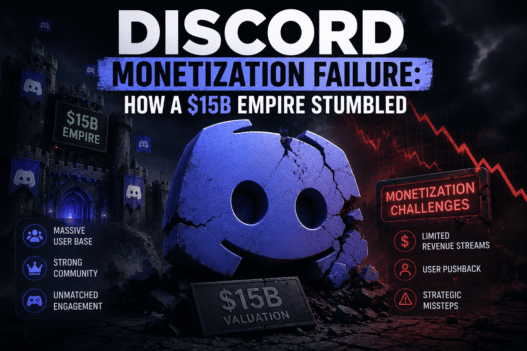
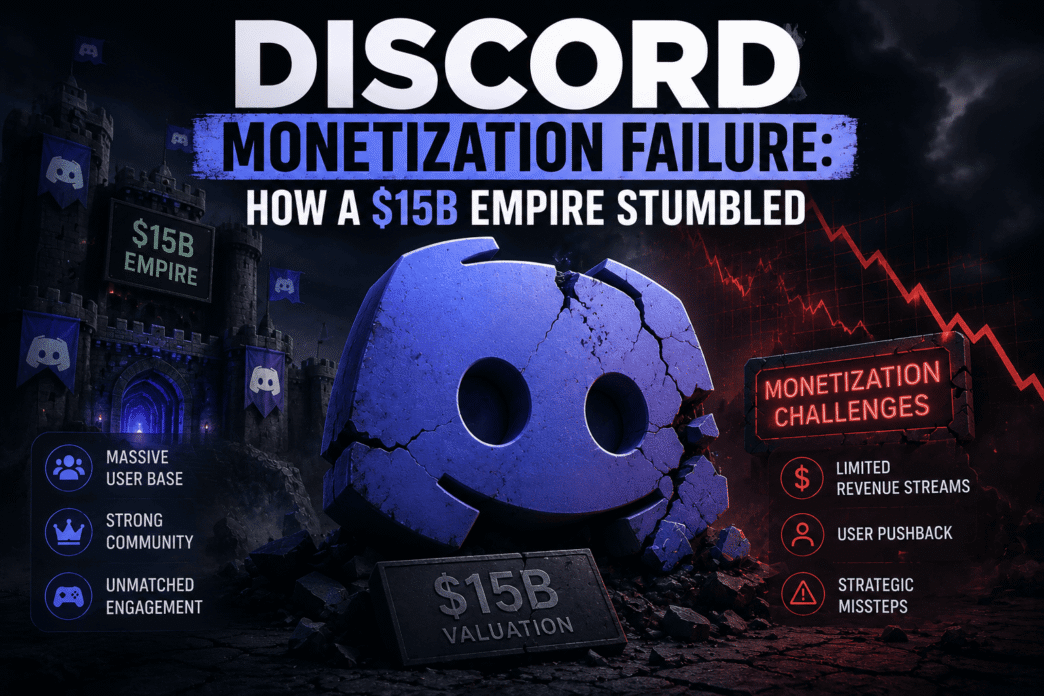
In 2023, Discord announced a new monetization feature for creators: Charged Subscriptions, allowing streamers to charge subscribers directly through Discord. The feature was positioned as a competitor to YouTube’s channel memberships and Twitch subscriptions—a way to let creators earn while staying on Discord.
By mid-2024, it was clear the strategy had failed. Creators were not adopting Discord’s monetization. YouTube was consolidating streaming dominance. And Discord, valued at $15 billion, was facing a critical problem: it had built a billion-user platform without a clear path to revenue.
This is the complete Discord monetization autopsy—how a platform that owned creator loyalty squandered it by trying to monetize too late, too half-heartedly, and too far behind competitors already winning the revenue war.
Part 1 — The Trigger: Discord’s Monetization Announcement
Discord launched in 2015 as a free communication platform for gamers. For eight years, it stayed free. No ads. No premium tiers. Just pure utility—the best place for communities to gather, chat, and stream together.
That free model built an empire. By 2020, Discord had crossed 150 million monthly active users. By 2022, it had 560 million registered users. The platform became the de facto standard for gaming communities, esports teams, creative collectives, and eventually, broader internet communities.
But there was a fundamental problem: Discord made no money from any of them.
In January 2023, Discord announced its monetization push. The strategy had three parts. First, Charged Subscriptions—creators could charge subscribers $0.99 to $99.99 monthly for exclusive perks (special roles, access to private channels, priority chat). Discord would take 30% (matching Apple and Google’s standard). Second, Premium Tier upgrades, a paid version for individual users, add cosmetics and features ($99.99/year). Third, indirect monetization through Amazon integration—creators could sell merchandise and games through Discord, with Discord taking a cut.
On paper, the strategy mimicked YouTube, Twitch, and every other successful creator platform.
In reality, it was years too late.
Part 2 — The Amplification Engine: Why Creators Chose YouTube Instead
The moment Discord announced monetization, creators faced a stark choice: adopt Discord’s untested system, or stick with YouTube and Twitch—platforms where monetization was already proven, audiences were already massive, and the revenue split was already understood.
The decision matrix was brutal to Discord:
YouTube: 2.7 billion logged-in users monthly. Monetization has proven across 15 years. Revenue split: 55/45 (creator keeps 55% of ad revenue). Audience discovery is built into the algorithm. Massive reach.
Twitch: 140 million monthly active users. Monetization has proven across 10 years. Revenue split: 50/50 on subscriptions (creator keeps 50%). Affiliate program for ad hoc revenue. Live streaming optimized at every layer.
Discord: 560 million registered users, but most are lurkers in communities. No algorithmic discovery (you find Discord servers by invitation or word of mouth). Monetization untested. Revenue split: 70/30 (creator keeps 70%, Discord takes 30%)—better than YouTube and Twitch, but creators still didn’t adopt.
The disconnect was structural. Discord’s strength—being a closed, community-owned space—was its weakness for individual creator monetization. A Twitch streamer can go live and reach 100,000 strangers in a single stream because Twitch’s algorithm pushes her to the Browse page. A Discord streamer can only reach the people already in her server.
Charged Subscriptions made sense for tier-1 creators with massive Discord communities (like esports teams or big streamers). But for mid-tier creators (10K–100K followers), monetization on Twitch or YouTube was simply more valuable.
According to data published by Streamlabs, the platform, the choice among creators followed viewer size: creators with <10K viewers defaulted to Discord. Creators with 10K–100K viewers split between Discord and Twitch. Creators with >100K viewers prioritized YouTube or Twitch almost exclusively. Discord’s monetization never changed this distribution because the platform fundamentally couldn’t provide the reach that revenue requires.
Part 3 — The Numbers at Peak
The numbers reveal why Discord’s monetization strategy stalled:
Discord’s Position:
- Monthly active users: 560 million (2024)
- Daily active users: 150 million
- Estimated creator accounts: 50 million
- Creators with >1K subscribers: <2 million (estimated)
- Creators actually using Charged Subscriptions: <100,000 (industry estimates)
YouTube’s Position (for comparison):
- Monthly active users: 2.7 billion
- Daily active users: 2 billion
- Creators earning from monetization: >500,000
- Average revenue per monetized creator: $18,000/year
- Total creator payouts (2023): $70 billion
Twitch’s Position (for comparison):
- Monthly active users: 140 million
- Peak concurrent viewers (simultaneous): 2–4 million
- Monetized streamers: >200,000
- Average revenue per streamer: $4,000–8,000/year
- Total creator payouts (2023): $2 billion
The chasm was massive. Even though Discord had 4× the users of Twitch, Twitch was generating 20× the creator payouts because Twitch’s monetization was integrated at every level—subscriptions, ads, donations, affiliate programs—while Discord’s was bolt-on.
More damaging: Discord’s monetization failed to move the needle on the company’s own revenue. In 2024, Discord’s estimated annual revenue was approximately $200–300 million, flat compared to 2023. Monetization had failed to unlock meaningful new streams. Investors who backed Discord at a $15 billion valuation were watching a company with 560 million users generate less annual revenue than a mid-sized SaaS company.
Part 4 — The Aftermath: Discord’s Pivot Away From Creator Monetization
By late 2024, Discord had quietly deprioritized its creator monetization push. The company pivoted instead toward:
Enterprise Communities: Discord for business communication. Slack had a $27 billion valuation. Discord, with better free features, positioned itself as a Slack alternative for communities and smaller enterprises.
Education: Discord for classrooms and study groups. Integrations with educational platforms and learning management systems.
Indirect Monetization: Rather than forcing creators to monetize on Discord, Discord focused on taking revenue cuts from third-party services—merchandise sales, game sales, and premium game access.
The strategy admission was implicit: Discord couldn’t compete with YouTube and Twitch on creator monetization. The platform was too decentralized, too community-focused, and lacked the discovery mechanisms that made other platforms viable for individual creator revenue.
According to reporting from The Verge, Discord’s 2024 internal roadmap showed zero expansion of Charged Subscriptions features. The feature was left to stagnate—not killed, but clearly not a priority.
Part 5 — The Transferable Lesson: Why Ownership Doesn’t Guarantee Monetization
The Discord monetization failure teaches a critical lesson that applies to every platform facing monetization decisions: owning a community does not mean you can monetize it.
Discord owned creator loyalty in ways YouTube and Twitch never would. Creators built their core communities on Discord. They created custom bots, developed inside jokes, and formed genuine friendships in Discord servers. The network effects were real and deep.
But deep community loyalty does not translate to revenue. Revenue requires reach. A creator monetizes not by extracting value from her existing fans but by acquiring new fans through platform-provided discovery mechanisms. YouTube’s algorithm. Twitch’s Browse page. TikTok’s For You page.
Discord has none of these. By design. Discord was built to be private, owned, and controlled. That’s what made it valuable for existing communities. But it meant new creators had no pathway to find new audiences. And without audience discovery, monetization had nowhere to grow.
The transfer lesson for any platform: if you’re starting from a position of trust but lack discovery, trying to monetize will feel extractive to your users. Discord learned this too late.
Frequently Asked Questions: Discord Monetization Failure
Why did Discord’s monetization fail?
Discord’s monetization failed because the platform lacked built-in audience discovery mechanisms. Creators can only reach people already in their Discord server. YouTube and Twitch offer algorithmic discovery, sending creators to millions of new viewers daily. Without that, monetization opportunities are structurally limited.
Is Discord still trying to monetize creators?
Discord’s Charged Subscriptions feature still exists but has been deprioritized. The company shifted focus to enterprise communities, education, and indirect monetization through third-party services rather than direct creator revenue splits.
How many creators actually use Discord Charged Subscriptions?
Industry estimates suggest fewer than 100,000 creators actively use Charged Subscriptions out of Discord’s 50+ million creator accounts. This represents massive underutilization compared to YouTube (500,000+ monetized creators) and Twitch (200,000+ monetized streamers).
Did Discord’s failed monetization hurt the platform’s growth?
Discord’s user growth remained strong (560 million registered users by 2024), but the failed monetization directly impacted revenue growth and investor returns. Creators who could monetize on YouTube or Twitch shifted their focus there, reducing Discord’s strategic importance.
Could Discord have succeeded if it had launched monetization earlier?
Possibly. If Discord had integrated creator monetization in 2019–2020 before YouTube and Twitch solidified dominance, adoption might have been higher. By 2023, when Discord finally moved, the competitive disadvantage was insurmountable.







I love how your posts are always so well-structured and easy to follow. Keep it up!
Your content is a go-to source for me when I need information. Great work, as always!
Thank you, for your kind words. I\’m committed to maintaining the quality of my posts.