






Three years ago, Nike was untouchable. The world’s most valuable sports brand, a $50 billion revenue machine, the company that defined what athletic footwear meant to global culture. Its slogan was not just a tagline — it was a philosophy that transcended sport.
In 2026, Nike is in genuine trouble. And the story of how it got here is one of the most important brand cautionary tales of the decade.
Nike Brand Crisis 2026: How the World’s Biggest Sports Brand Lost the Plot
Nike’s problems did not arrive suddenly. They built slowly, visibly, and — in retrospect — almost entirely preventably.
The first warning sign came in 2023 when Nike reported its first meaningful market share decline in the premium running shoe category in over a decade. The culprits were not traditional rivals, Adidas or Puma. They were brands most Nike executives had barely heard of five years earlier — On Running, a Swiss startup backed by Roger Federer, and Hoka, a maximalist cushioning brand acquired by Deckers Outdoor in 2013.
Both On Running and Hoka did something Nike had stopped doing: they obsessed over performance technology and built genuine running communities around their products rather than celebrity endorsements and lifestyle marketing.
The numbers tell the story precisely.
According to data reported by The Wall Street Journal’s retail team, On Running’s global revenue grew 58% in 2024, reaching $2.1 billion. Hoka crossed $2 billion in annual revenue for the first time in 2024. Both brands are growing at triple-digit rates in the US premium running market — the exact segment Nike has historically owned.
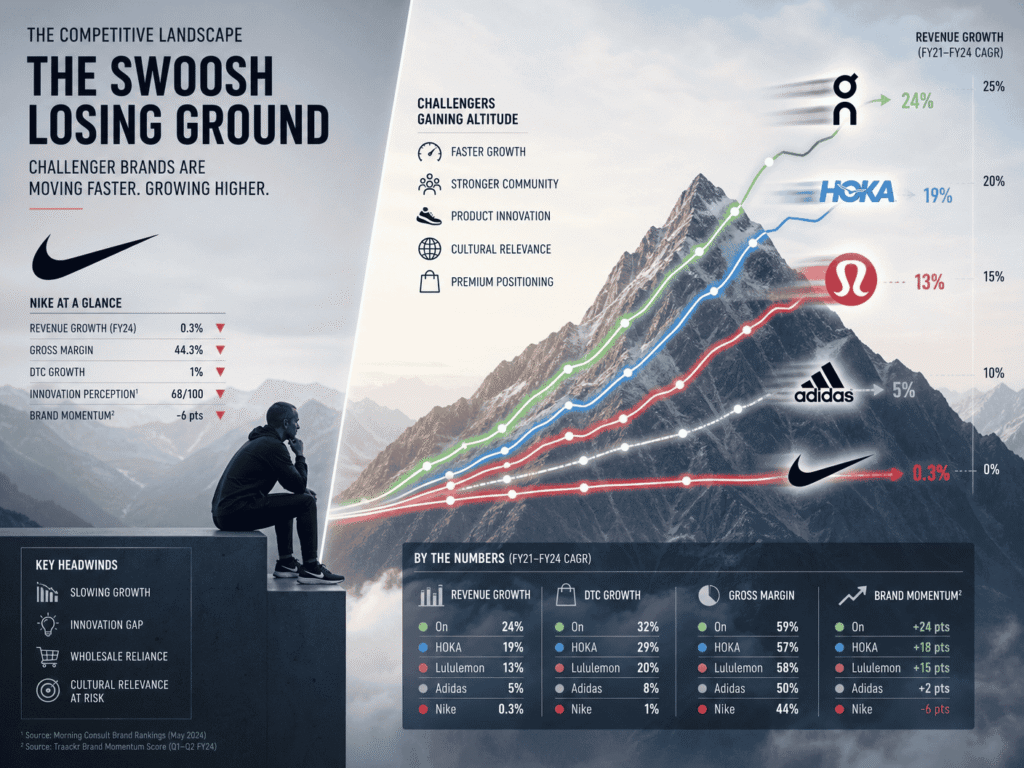
Nike’s revenue for fiscal year 2025 came in at $46.3 billion — down from $51.4 billion in fiscal year 2023. That $5 billion revenue decline over two years is the largest two-year revenue contraction in Nike’s public company history.
What Actually Went Wrong at Nike
Nike’s crisis has three distinct causes — each one a decision that made sense at the time and proved catastrophic in combination.
Cause 1 — The DTC pivot that backfired.
In 2020, then-CEO John Donahoe announced Nike was going “direct to consumer” — cutting wholesale relationships with major retailers, including Foot Locker, DSW, and dozens of regional chains to sell directly through Nike.com and Nike stores.
The logic was sound: higher margins, better data, stronger brand control. The execution was a disaster. Nike lost the retail floor space and the casual customer discovery that wholesale partnerships provided. Competitors filled the shelf space Nike vacated. Foot Locker’s stock crashed when Nike announced the wholesale cuts — then recovered when Foot Locker signed expanded deals with On Running, Hoka, New Balance, and Adidas to fill Nike’s gap.
Nike reversed the DTC pivot in 2023 and began rebuilding wholesale relationships — but the shelf space it lost had been filled. And its competitors had used the window to build retail relationships that Nike had voluntarily abandoned.
Cause 2 — Innovation stagnation.
Nike’s last genuinely revolutionary product innovation was the Vaporfly running shoe in 2016 — the carbon fiber plate shoe that broke marathon world records and transformed competitive running. Everything since has been iteration, not innovation.
Meanwhile, On Running developed its CloudTec cushioning system, Hoka developed maximalist stack height technology, and New Balance returned to performance credibility with its Fresh Foam and FuelCell lines. Nike’s product pipeline became dependent on retro re-releases — Jordan 1s, Air Max 90s, Dunk Lows — that drove short-term revenue but signaled a brand living on nostalgia rather than building toward a future.
Cause 3 — Cultural disconnection.
Nike built its brand on cultural relevance — the 1984 Michael Jordan deal, the 1999 Tiger Woods partnership, the 2018 Colin Kaepernick campaign. For decades, Nike had an almost supernatural ability to identify the cultural moment and plant its flag at the center of it.
That instinct disappeared somewhere around 2021. Nike’s marketing became expensive but generic. Its celebrity partnerships felt transactional. The brand that once led culture began following it — and following it slowly.
According to Morning Consult’s brand tracking data Nike’s brand favorability among consumers aged 18–34 declined 14 percentage points between 2021 and 2025, the demographic that determines what is culturally relevant in sportswear.
Nike’s Response: The 2026 Turnaround Attempt
In late 2024, Nike replaced Donahoe with Elliott Hill, a Nike veteran who had spent 32 years at the company before retiring in 2020. The message was explicit: Nike was returning to its roots.
Hill’s turnaround plan has three pillars.
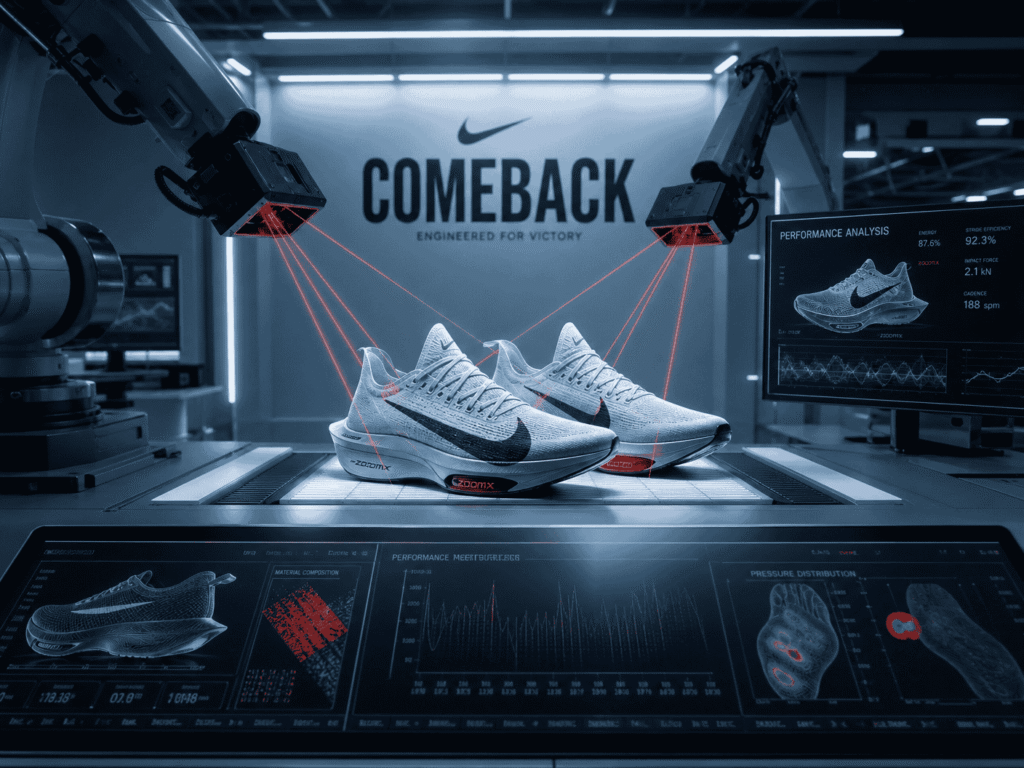
First, reinvestment in sport performance. Nike is reportedly doubling its performance footwear R&D budget in 2025–2026 with a focus on running, basketball, and training — the categories where it has lost most ground.
Second, rebuilding sports marketing authenticity. Nike signed several high-profile deals with emerging athletes rather than established megastars — betting on cultural discovery rather than cultural confirmation.
Third, inventory discipline. Nike flooded the market with discounted products in 2022–2023 to clear pandemic-era inventory surpluses. That discounts trained consumers to wait for sales and damaged the premium brand perception. Hill has committed to cutting promotional discounting significantly.
Whether the turnaround works is the most interesting brand story of 2026. Nike has the resources, the history, and the global infrastructure to recover. But the window is narrowing — On Running, and Hoka are not standing still.
TrendsSpy Take
Nike’s crisis is a textbook example of what happens when a brand mistakes financial engineering for brand strategy. The DTC pivot was a margin optimization play dressed up as a customer experience initiative. The retro re-release strategy was inventory monetization dressed up as heritage marketing.
Both decisions looked smart on a quarterly earnings call and proved ruinous over a three-year horizon.
The brands beating Nike right now — On Running, Hoka, New Balance — are winning not because they outspent Nike but because they outbelieved Nike. They believed in their product technology. They believed in their running communities. They showed up at marathons and running clubs rather than celebrity parties.
Nike forgot that sports brands are built at the finish line, not on the red carpet.
This one is going in our Comeback Story archive — or our Brand Collapse archive. Which category it ends up in depends entirely on what Nike does in the next 18 months.
Why is Nike losing market share in 2026?
Nike has lost market share primarily due to three factors: a failed direct-to-consumer pivot that cost it retail shelf space, a lack of genuine product innovation compared to competitors like On Running and Hoka, and a decline in cultural relevance among younger consumers aged 18–34.
Who is beating Nike in the sneaker market?
On Running and Hoka are the two brands most directly taking share from Nike in the premium running category. New Balance has also significantly recovered market position. In lifestyle sneakers, Adidas has benefited from Nike’s inventory and discounting missteps.
What is Nike’s revenue in 2026?
Nike’s fiscal year 2025 revenue came in at approximately $46.3 billion — down from a peak of $51.4 billion in fiscal year 2023. This represents the largest two-year revenue contraction in Nike’s history as a public company.
Who is the new Nike CEO in 2026?
Elliott Hill became Nike’s CEO in late 2024, replacing John Donahoe. Hill is a Nike veteran who spent 32 years at the company before retiring in 2020. His return signals Nike’s intention to reconnect with its performance sports roots.
Is Nike stock a good investment in 2026?
TrendsSpy does not provide financial advice. For investment analysis on Nike’s turnaround potential, consult a qualified financial advisor or review analyst reports from major investment banks covering the consumer discretionary sector.





Your insights in this post are spot on. I can\’t wait to see what you write next!
Your post is a true masterpiece. I\’ll be referencing it in my own work.
This post is a game-changer. I\’ve learned so much from it – thank you!
Thank you! I\’m thrilled that you found the post valuable. Your support means a lot.
Your post is a true masterpiece. I\’ll be referencing it in my own work.