









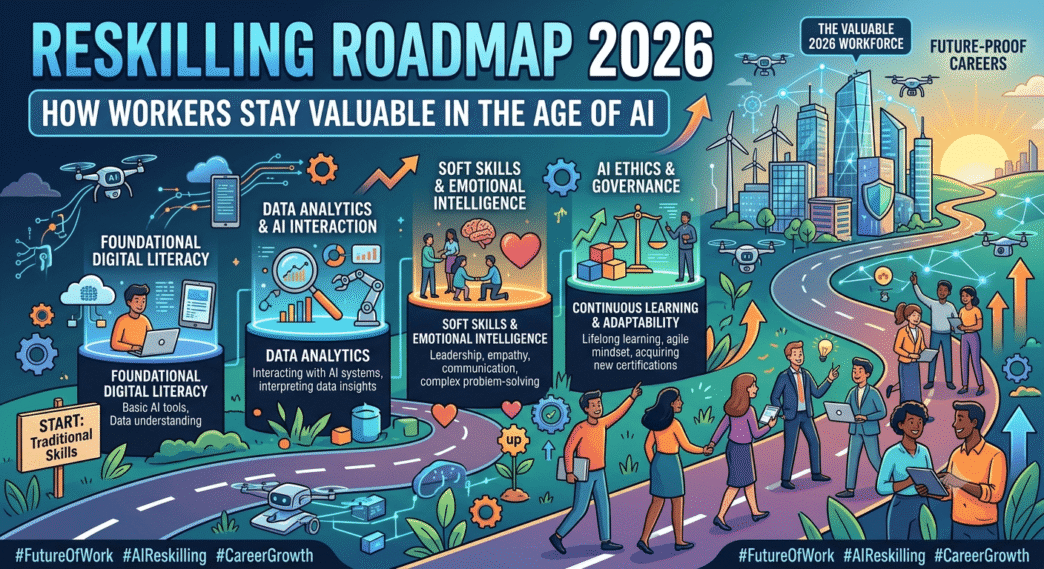
The World Economic Forum’s reskilling push stopped being a policy slogan and started to look like a mass movement. Headlines shifted from “AI will take jobs” to “How do we keep people working?” Governments, big tech and employers scrambled to turn training into a pipeline—not a PR stunt. The result was messy, urgent, and revealing: reskilling in 2026 became less about certificates and more about redesigning how work gets done.
Part 1 — The Trigger
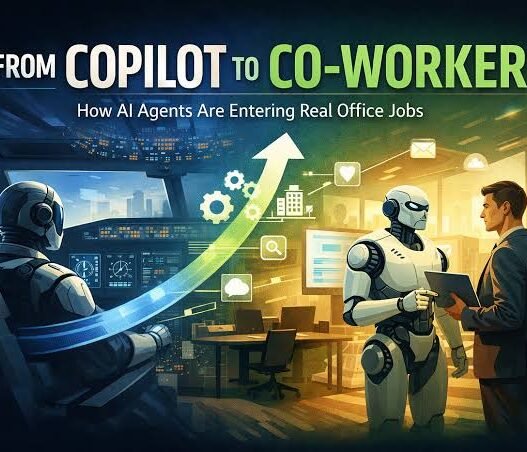
What changed was not a single event but a tight sequence: AI copilots and agentic systems moved from demos into the apps people use every day. When drafting, summarizing, and first‑pass analysis could be done inside Word, Slack, or an IDE, the cost of automation dropped overnight. That shift forced a choice: hire expensive specialists or retrain the people already on payroll.
Public reporting suggests major platforms and enterprise vendors publicly endorsed embedded copilots and agents in 2024–2025, which normalized their use. That endorsement mattered more than any single product: it turned AI from an optional tool into infrastructure. HR teams that had once treated learning as a checkbox suddenly faced a pipeline problem—roles were changing faster than hiring cycles could keep up.
At the same time, macro pressures—tight labor markets in some sectors, recessionary hiring freezes in others—made reskilling economically attractive. For governments, the political stakes were obvious: mass displacement without a plan is a social and electoral risk. So national accelerators, public–private partnerships, and corporate pledges multiplied. Reskilling stopped being a boutique program and became a strategic imperative.
Part 2 — The Amplification Engine
Why did reskilling scale so quickly? Three forces amplified it.
1. Fear turned into agency. Workers who feared obsolescence discovered a lever: learning. Reskilling offered a way to reclaim agency. That psychological shift—fear morphing into proactive behavior—was powerful. People who once ignored training portals began to complete micro‑courses and display new badges on LinkedIn as social proof.
2. Economics favors internal talent. Hiring for new AI‑adjacent roles is expensive and slow. Companies found it cheaper to reskill existing employees who already understood domain context, customers, and internal processes. That calculus pushed budgets toward learning and away from headcount increases.
3. Technology made learning scalable. Ironically, AI itself became a reskilling accelerator. Adaptive learning platforms, personalized micro‑courses, and on‑device practice environments let organizations deliver targeted training at scale. Gamified modules and short, measurable learning sprints increased completion rates compared with old LMS models.
Together, these forces created a feedback loop: as more people reskilled, success stories multiplied, which increased demand for more programs. Reskilling became a cultural signal—proof you could adapt—rather than just a checkbox.
Part 3 — The Numbers at Peak
Public reporting and industry summaries in 2026 show the scale and variety of responses without a single universal metric. Major global initiatives and corporate pledges proliferated; national accelerators launched in several large economies; and private training vendors reported surges in enterprise contracts.
What mattered more than headline totals was distribution. Some sectors—software, digital marketing, cloud operations—saw rapid uptake of AI‑adjacent skills. Others—manufacturing, frontline retail—required different approaches: shorter, hands‑on modules tied to equipment and safety. The unevenness revealed a core truth: reskilling is not one program but a portfolio of interventions tailored to industry, role, and local labor markets.
Where numbers were reported, they tended to show two patterns: (1) high engagement in short, role‑specific modules; and (2) lower conversion from certificates to sustained career change unless programs were tied to internal mobility or hiring guarantees. In other words, training alone rarely moved the needle—what moved careers was training plus a pathway.
Part 4 — The Aftermath
The immediate aftermath was a reordering of skill hierarchies. Three tiers emerged in practice.
Tier 1 AI‑Resistant Skills: Strategic judgment, ethical reasoning, complex stakeholder management, and emotional intelligence. These are the skills that remain hardest to automate and most valuable in leadership and client‑facing roles.
Tier 2 AI‑Augmented Skills: Data literacy, prompt engineering, domain‑specific modeling, and synthesis. These skills amplify human work when paired with AI tools.
Tier 3 AI‑Vulnerable Tasks: Routine data entry, basic formatting, and template reporting—tasks that are easiest to automate and therefore most likely to be offloaded.
Companies that paired reskilling with internal mobility programs retained talent and reduced hiring costs. Teams that treated training as a standalone metric—completion rates and certificates—saw less impact. The difference was simple: pathways beat badges.
There were also unintended consequences. Credential inflation made it harder to signal real expertise. Workers who completed many short courses sometimes found themselves with a stack of certificates but no clear promotion path. And a new inequality emerged: employees with time, managerial support, and access to mentors benefited far more than those in precarious roles or with heavy frontline schedules.
Part 5 — The Transferable Lesson
If there is one lesson from the Reskilling Roadmap 2026, it is this: reskilling must be strategic, not performative. That means three concrete shifts for leaders and workers.
For founders and executives, treat reskilling as infrastructure. Map future roles, identify the skills that will create a competitive advantage, and fund learning as capital expenditure. Tie training to internal mobility and hiring pipelines so learning becomes a route to promotion, not just a checkbox.
For managers, design learning sprints that map to real work. Give people time to practice on the job, pair them with mentors, and require that new skills be used in live projects within weeks. Track outcomes that matter—reduced time to competency, internal hires, and measurable business impact.
For professionals, prioritize skills that increase your leverage. Learn to frame problems, verify AI outputs, and synthesize insights for stakeholders. Combine domain depth with cross‑functional fluency. Treat learning as a portfolio: a few deep bets plus a stream of micro‑upgrades.
For policymakers, focus on access and pathways. Public funding should subsidize programs that guarantee interviews, apprenticeships, or internal placements. Support regional accelerators that connect employers, training providers, and local labor markets.
The broader point is cultural: reskilling works when it becomes part of how organizations operate, not an annual HR ritual. The future favors people who can combine human judgment with AI speed.
Frequently Asked Questions
1. What’s the difference between reskilling and upskilling? Reskilling prepares someone for a different role; upskilling deepens capabilities within the same role. Both matter, but reskilling is essential when whole job families shift.
2. Which skills are most future‑proof? Strategic judgment, ethical reasoning, empathy, and complex stakeholder management. These are the hardest to automate and the most valuable in leadership and client work.
3. How should companies measure reskilling success? Measure outcomes: internal mobility, time to competency, business impact, and retention. Completion rates are necessary but not sufficient.
4. Will reskilling solve inequality? Not by itself. Without access, time, and pathways to jobs, reskilling can widen gaps. Policy and employer design must prioritize equitable access.
5. How quickly should an individual reskill? Think in 90‑day sprints: learn, apply, and demonstrate. Repeat. Short cycles beat long, unfocused programs.
Conclusion
Reskilling Roadmap 2026 was not a single program but a systemic response to a structural shift. The movement exposed a simple truth: technology changes tasks faster than it changes human incentives. The organizations that won were the ones that rewired incentives—tying learning to real career paths, redesigning workflows, and treating training as strategic infrastructure.
If you’re a founder, manager, or worker reading this, the practical takeaway is immediate: stop treating learning as a checkbox. Map the future roles you need, fund the pathways that lead to them, and measure the outcomes that matter. In a world where AI drafts, analyzes, and coordinates, human value will be defined by judgment, synthesis, and the ability to turn new skills into real work. That is the Reskilling Roadmap—and it’s the playbook for staying valuable in 2026 and beyond.







Great content! Keep up the good work!