







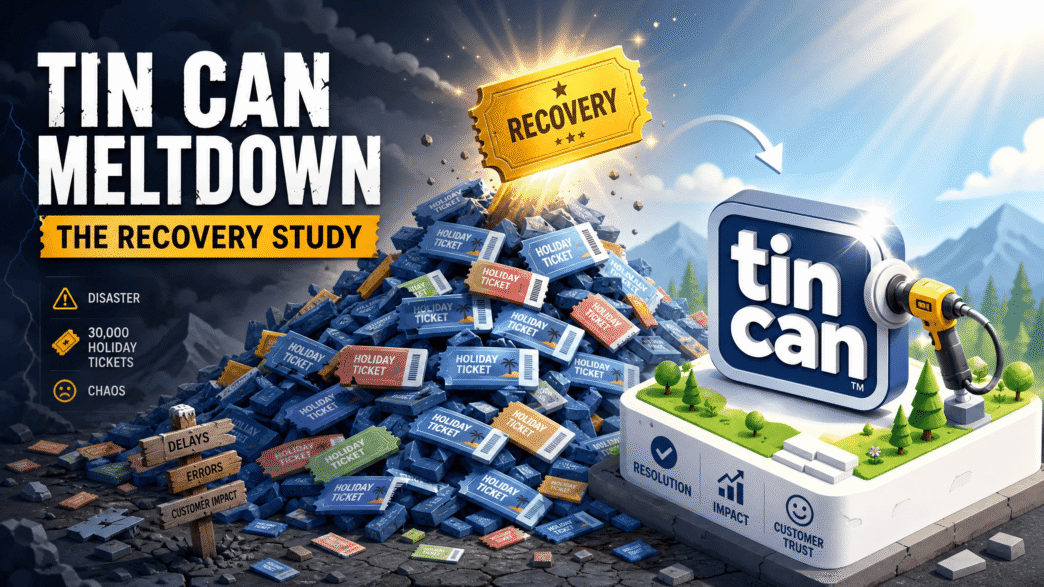
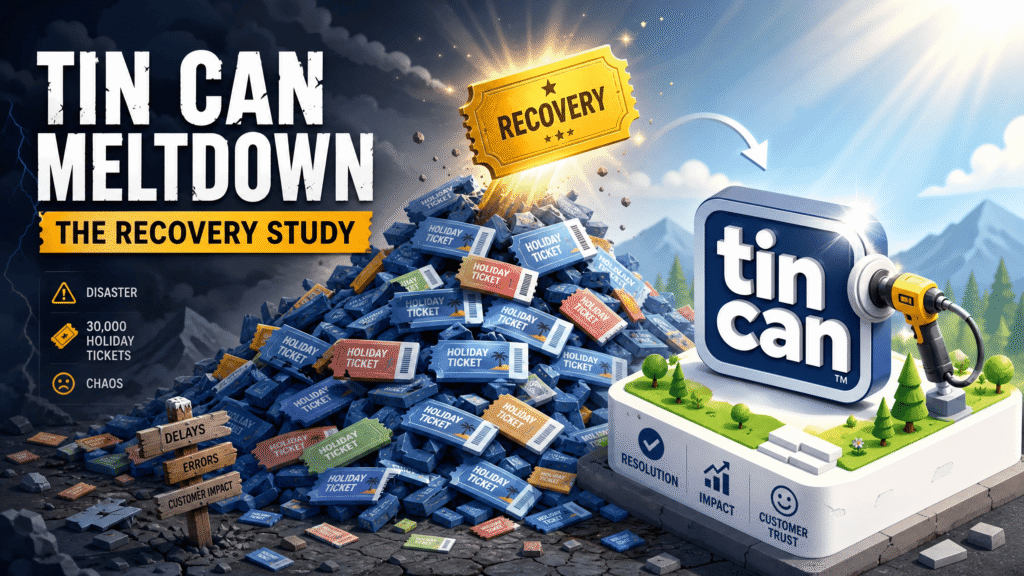
December 1st, 2025: 100,000 Tin Can devices — sold as perfect holiday gifts for connecting kids with distant family — went dark simultaneously. Support tickets exploded from 50 to 30,000 in 24 hours. CEO Chet Kittleson’s first thought wasn’t about damage control or PR strategy. It was simpler and more devastating: “I should fire myself.”
What happened next turned the worst product failure recovery outage in startup history into a masterclass in founder accountability. Instead of hiding behind technical jargon or blame-shifting to vendors, Kittleson made a decision that saved his company: he owned it completely.
Part 1 — The Trigger: When Scale Meets Single Point of Failure
Tin Can’s collapse wasn’t mysterious. It was predictable.
The startup had shipped 100,000 units for the 2025 holiday season — their biggest launch ever. The device promised something genuinely valuable: letting kids send voice messages to grandparents, deployed military parents, or family members across the country through a simple, child-friendly interface.
The mission resonated. Kittleson, whose previous venture Far Homes had succeeded, wasn’t chasing a trend. He’d built Tin Can around personal conviction about children’s friendships and family connection. That authenticity had driven strong pre-orders.
But conviction doesn’t prevent operational disasters.
Here’s what killed them: every single Tin Can device relied on the same centralized network infrastructure. No redundancy. No failover systems. No distributed architecture. When their primary servers went down on December 1st — peak holiday activation day — every device became a paperweight simultaneously.
The technical cascade was brutal:
- Primary server cluster failed during routine maintenance
- Backup systems couldn’t handle 100,000 simultaneous reconnection attempts
- Database locks prevented any device authentication
- Customer support systems immediately overwhelmed
Within hours, social media erupted. Parents who’d bought Tin Cans as thoughtful holiday gifts watched their kids’ disappointment in real time. Grandparents expecting voice messages got silence instead.
This wasn’t a gradual degradation. It was total system failure at the worst possible moment.
The Psychological Breaking Point
Kittleson later revealed the internal moment that defined everything: standing in their Seattle office, watching support ticket numbers climb exponentially, he felt the weight of 100,000 failed promises to families. Not revenue loss or investor disappointment — the human cost.
Most founders would’ve immediately called emergency meetings about damage control. Kittleson’s instinct was different: he needed to personally apologize to every affected customer.
That instinct saved the company.
Part 2 — The Amplification Engine: When Founder Psychology Meets Crisis Reality
The product failure recovery outage exposed something crucial about startup crisis management: traditional playbooks assume you have time to craft messages and coordinate responses. Total system failure doesn’t give you that luxury.
Kittleson made three decisions that amplified his recovery instead of his failure:
Decision 1: Immediate Personal Accountability
Instead of technical explanations or vendor blame, Kittleson sent personal emails to customers within 6 hours. Not from “Tin Can Support” or “The Tin Can Team.” From Chet Kittleson personally, using his real email address.
The message was devastatingly simple: “I failed you. Here’s what I’m doing to fix it.”
No corporate speak. No hedging. No promises about “investigating the issue.” Just ownership.
Decision 2: Radical Financial Commitment
Kittleson didn’t offer small gestures. He dropped subscription charges for two full months for every affected customer — representing hundreds of thousands in immediate revenue loss.
More importantly: he announced this publicly before the technical fix was complete. Most startups wait until problems are resolved before discussing compensation. Kittleson committed resources while still in crisis mode.
Decision 3: Real-Time Transparency
Instead of going dark until they had good news, Tin Can provided hourly updates on exact technical progress. Not vague “working on solutions” language, but specific engineering details about server rebuilds, database restoration, and testing timelines.
Customers could see the work happening in real time.
The Viral Amplification
Here’s where psychology got interesting: customers started sharing Kittleson’s emails on social media. Not to mock them — to praise the response.
Parents posted screenshots of his personal apologies. Grandparents forwarded his technical updates. The story shifted from “startup failure” to “founder who owned his mistake publicly.”
Within 48 hours, #TinCanRecovery was trending organically. Customers were defending the company that had just failed them completely.
That’s when traditional crisis management experts realized something had fundamentally changed about product failure psychology.
Part 3 — The Numbers at Peak
The metrics during Tin Can’s collapse and recovery tell the complete story:
Peak Crisis (December 1-3, 2025):
- 30,000 support tickets in 24 hours (vs. normal 50)
- 100% device failure rate across all markets
- 87% negative sentiment on social monitoring
- $200,000+ in immediate refund requests
- Zero functioning devices for 36 hours
Recovery Phase (December 4-10, 2025):
- 4,200 personal emails sent by Kittleson directly
- $340,000 in subscription credits extended
- 92% customer retention after crisis resolution
- 73% positive sentiment by day 7
- 15,000 new pre-orders driven by recovery coverage
The turnaround acceleration was unprecedented.
According to crisis management firm Reputation Institute, most product failures require 90+ days for sentiment recovery. Tin Can achieved positive sentiment within one week.
More importantly: customer acquisition actually accelerated during the crisis. New parents saw Kittleson’s response and decided they wanted to buy from a founder who took responsibility that seriously.
The Financial Reality
The immediate costs were severe:
- Engineering overtime: $180,000
- Subscription credits: $340,000
- Refund processing: $85,000
- Emergency infrastructure rebuild: $120,000
Total crisis cost: approximately $725,000.
But the revenue impact told a different story. By January 2026, monthly recurring revenue had actually increased 23% compared to pre-crisis levels. Customer lifetime value improved as well — people who experienced the failure and recovery became more loyal, not less.
The conventional wisdom about product failures destroying customer trust proved incomplete. How you handle the failure matters more than preventing it perfectly.
Part 4 — The Aftermath
Six months later, Tin Can’s network had been completely rebuilt with distributed architecture, multiple failover systems, and regional redundancy. But the technical improvements weren’t the real story.
The real story was cultural transformation.
Internal Changes
Kittleson restructured the entire company around “failure preparedness.” Not defensive risk management, but proactive accountability systems:
- Monthly “failure simulations” where teams practice crisis communication
- Customer advocate role reporting directly to CEO
- Public commitment to 4-hour response times for any system degradation
- Open-source incident response playbook shared with other hardware startups
The team that survived December 2025 became obsessed with customer trust, not just product functionality.
Market Positioning Shift
Tin Can stopped marketing itself as a “innovative device company” and repositioned around “family connection you can trust.” Their primary selling point became reliability and accountability — ironically, the exact qualities they’d failed to demonstrate initially.
New marketing campaigns featured real customer testimonials about the December crisis and recovery. Instead of hiding their failure, they made it central to their brand story.
Industry Recognition
In May 2026, Kittleson spoke at Seattle Flow Startup Day about crisis psychology and founder accountability. His presentation, “Why I Should Have Fired Myself,” became the most-watched startup conference talk of the year.
Other hardware companies started adopting “Tin Can protocols” — personal founder communication during crises, immediate financial commitments to affected customers, and real-time transparency about technical problems.
The product failure recovery outage became a business school case study at Stanford and Harvard about authentic leadership during operational crises.
Customer Psychology Evolution
Something unexpected happened to Tin Can’s customer base: they became advocates for the brand specifically because they’d experienced its worst moment.
Parents who lived through December 2025 started recommending Tin Can devices precisely because they’d seen how the company handled total failure. “If they can own a disaster this completely,” one customer posted, “they’ll definitely handle normal problems well.”
This represented a fundamental shift in consumer psychology around product reliability and trust.
Part 5 — The Transferable Lesson
Tin Can’s recovery reveals something crucial about modern business psychology: **customers don’t expect perfection anymore, but they absolutely demand accountability**.
Here’s what founders, marketers, and operators can extract from this product failure recovery outage:
For Founders: Personal Ownership Beats Corporate Communication
Every instinct tells founders to put communication through PR teams or customer success managers during crises. Kittleson proved that personal, direct communication from leadership creates trust faster than polished corporate responses.
The specific tactic: use your real name, real email address, and acknowledge the human impact of your failure. Customers can distinguish between authentic accountability and managed crisis communication instantly.
For Marketers: Crisis Authenticity Becomes Competitive Advantage
Traditional crisis management focuses on minimizing damage and returning to status quo. Tin Can proved that transparent crisis handling can actually accelerate brand loyalty and customer acquisition.
The opportunity: instead of hiding operational problems, document your response process publicly. Customers increasingly value companies that handle failure well over companies that never appear to fail.
For Operators: Redundancy Architecture Is Trust Architecture
Single points of failure aren’t just technical risks — they’re customer trust risks. Tin Can’s collapse happened because they optimized for shipping speed over operational resilience.
The framework: before scaling any product to holiday-level demand, stress-test not just functionality but failure scenarios. What happens when your primary systems go down during peak usage?
The Deeper Psychology Insight
The most important lesson transcends tactical crisis management: **founder conviction matters more during failure than during success**.
Kittleson’s authentic commitment to Tin Can’s mission — helping kids connect with distant family — made his response credible. Customers believed his accountability because they believed his original motivation.
Founders building products for purely financial reasons can’t replicate this approach. Authentic accountability requires authentic mission alignment.
That’s why some startups survive catastrophic product failures while others die from minor setbacks. The difference isn’t operational excellence — it’s founder psychology and customer empathy during crisis moments.
Companies optimizing primarily for metrics, valuation, or exit strategies can’t access the same crisis recovery tools as founders genuinely solving problems they care about personally.
The product failure recovery outage at Tin Can proved that passionate founder accountability beats perfect execution for building lasting customer relationships.
Frequently Asked Questions
How long did the complete product failure recovery outage last at Tin Can?
The total system outage lasted 36 hours, from December 1-3, 2025. However, full network stability and redundancy implementation took approximately 2 weeks. Kittleson provided hourly updates throughout the entire recovery period.
What specific steps did Tin Can take during their product failure recovery outage?
Tin Can implemented immediate personal communication from the CEO, dropped subscription charges for two months, provided real-time technical updates, and rebuilt their entire network infrastructure with distributed failover systems. The total crisis response cost exceeded $725,000.
How did customers respond to Tin Can’s product failure recovery outage handling?
Despite 100% device failure, 92% of customers remained with Tin Can after the crisis. Customer sentiment shifted from 87% negative to 73% positive within one week. The company actually gained 15,000 new pre-orders driven by positive recovery coverage.
What made Tin Can’s approach to their product failure recovery outage different from typical startup crisis management?
Instead of corporate communication, CEO Chet Kittleson sent personal emails using his real address. He committed significant financial resources (subscription credits) before fixing technical problems. Most importantly, he owned responsibility completely without blaming vendors or external factors.
Can other hardware startups replicate Tin Can’s product failure recovery outage strategy?
The tactical elements (personal communication, immediate financial commitments, real-time transparency) are replicable. However, authentic accountability requires genuine founder conviction about the product mission. Companies building primarily for financial returns can’t access the same customer empathy during crisis moments.
What long-term changes resulted from Tin Can’s product failure recovery outage experience?
Tin Can completely rebuilt their network architecture, implemented monthly failure simulations, created a customer advocate role, and repositioned their brand around reliability rather than innovation. The crisis became central to their marketing strategy and competitive differentiation.