








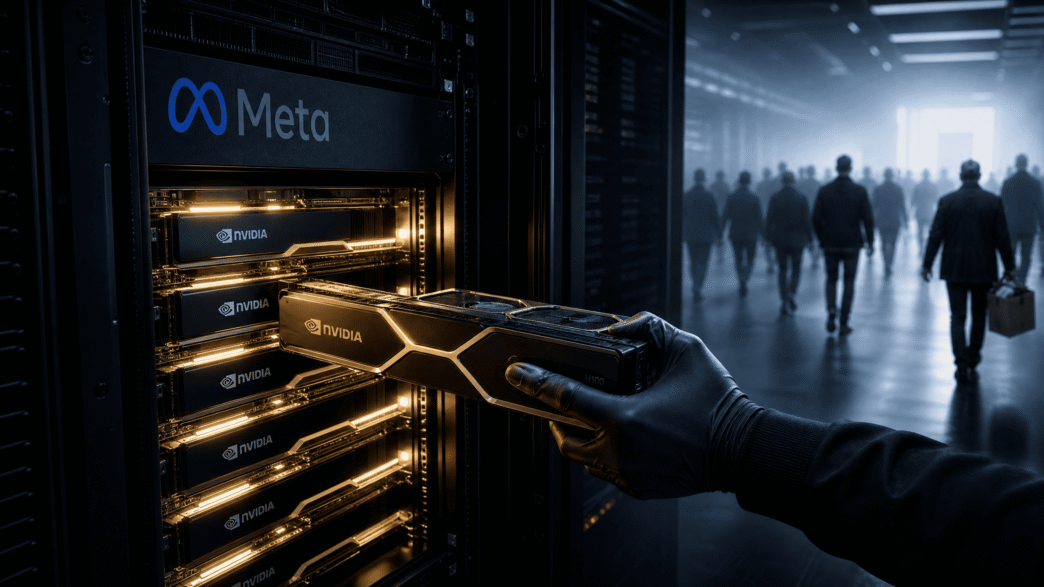
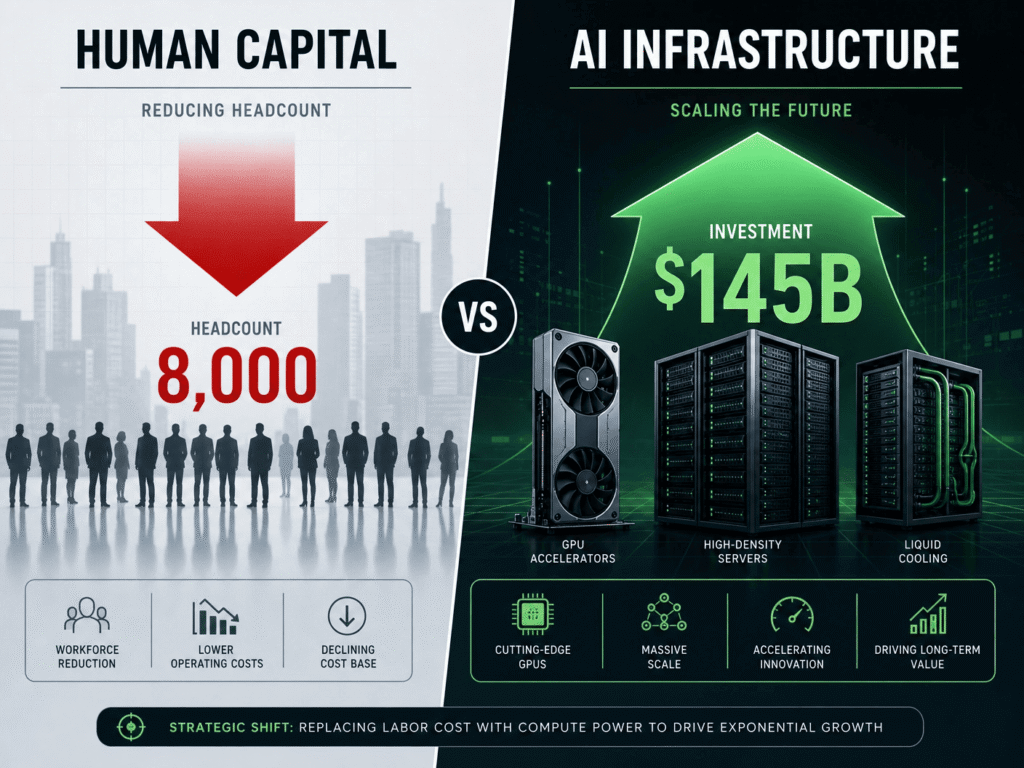
On May 20, 2026, Meta announced it was laying off 8,000 employees. The stock barely moved. Three hours later, the company raised its AI capex guidance to $125-145 billion for the year—roughly five times what it pays its entire workforce. This wasn’t a cost-cutting crisis. It was the first major example of Meta layoffs, AI capex 2026 strategy: firing humans to fund machines.
The math reveals something unprecedented in corporate history. Meta’s total employee compensation hovers around $27 billion annually. Their new AI infrastructure budget dwarfs that by $100+ billion. They’re not cutting people to save money—they’re cutting people to reallocate capital toward computing power.
This represents a fundamental shift in how tech companies view their most expensive assets. For the first time, buying GPUs became more strategic than retaining talent.
Part 1 — The Trigger: When Payroll Became Secondary
The layoff announcement came during Meta’s Q1 2026 earnings call. CEO Mark Zuckerberg didn’t frame it as belt-tightening. Instead, he described it as “resource optimization for our AI-first future.”
The numbers tell the real story. According to Reuters, Meta’s 8,000 cuts represented 12% of its workforce but freed up roughly $3.2 billion in annual compensation costs. That same day, the company announced plans to spend $40-50 billion on Nvidia H200 chips alone.
The timing wasn’t coincidental. Meta’s AI training runs were hitting compute bottlenecks. Their Llama 4 model required 10x as much processing power as Llama 3, and their VR/AR ambitions demanded real-time AI rendering capabilities that their current infrastructure couldn’t support.
The Internal Memo That Changed Everything
Three days before the public announcement, an internal memo leaked to The Information revealed Meta’s strategic thinking. The document, titled “Compute vs. Headcount: The New Resource Trade-off,” outlined how AI infrastructure now delivers higher ROI than human capital in specific divisions.
The memo identified three categories of employees: “AI-essential,” “AI-adjacent,” and “AI-replaceable.” The 8,000 cuts came exclusively from the latter two groups. Engineering roles focused on traditional web development are being automated, content moderation positions are being automated, and middle management layers are deemed inefficient in an AI-assisted workflow.
What made this different from previous tech layoffs was the explicit acknowledgment that these weren’t temporary cuts. Meta wasn’t planning to rehire when economic conditions improved. These roles were being permanently eliminated and their functions absorbed by AI systems.
The Nvidia Connection
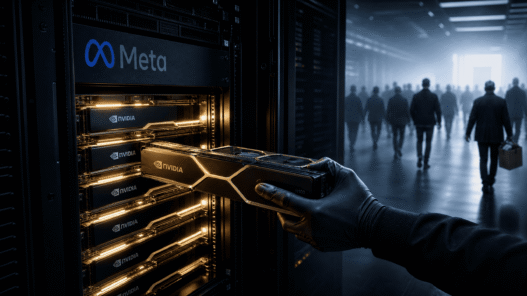
Meta’s relationship with Nvidia provides crucial context. In March 2026, Meta signed a $15 billion multi-year GPU procurement deal—one of the largest corporate technology purchases in history. The contract included priority access to Nvidia’s next-generation B200 chips, scheduled for 2027 delivery.
But there was a catch. NVIDIA required significant upfront payments and demanded proof of Meta’s “serious commitment” to AI infrastructure. Cutting payroll expenses became the fastest way to demonstrate that commitment and free up cash flow for chip purchases.
Internally, executives calculated that every $1 spent on advanced GPUs generated more productive output than $1 spent on additional headcount. This wasn’t theoretical—Meta had been testing this hypothesis across multiple teams since late 2025.
Part 2 — The Amplification Engine: The Capital Reallocation Playbook
Meta’s approach created a template that other tech companies immediately began studying. The playbook was surprisingly straightforward: identify AI-replaceable functions, calculate the compute equivalent, then make the swap.
According to 24/7 Wall St, Meta’s AI capex guidance of $125-145 billion represented the single largest corporate technology investment in history. But the real innovation was how they funded it.
Traditional capex increases require debt financing or equity dilution. Meta’s model used internal reallocation—cutting operational expenses to fund infrastructure expenses. This kept their balance sheet clean while dramatically expanding their AI capabilities.
The Three-Phase Implementation
Meta rolled out the transition in phases, each designed to minimize public backlash while maximizing capital efficiency.
Phase 1: Administrative Automation (January-March 2026) targeted roles like HR coordination, basic financial analysis, and routine content review. These positions required minimal specialized knowledge and could be easily automated using existing AI tools.
Phase 2: Creative Assistance (April-June 2026) focused on graphic design, copywriting, and video editing roles. Meta’s internal AI tools had reached human-level performance in these areas, making the positions redundant.
Phase 3: Engineering Optimization (planned for late 2026) will target software development roles where AI coding assistants can handle 70%+ of routine programming tasks.
The May 20 announcement covered primarily Phase 2 cuts, with some overlap into Phase 3 preparation.
Industry-Wide Implications
Meta’s success emboldened other companies. Skillsyncer’s tracking data shows that 212 companies announced layoffs in 2026, totaling 134,603 workers—an average of 935 job losses per business day.
But the pattern differed from previous recession-driven cuts. Companies weren’t struggling—they were strategically reallocating. Oracle’s 30,000-person reduction, Amazon’s 15,000 cuts, and Google’s 12,000 layoffs all coincided with massive AI infrastructure investments.
The cumulative effect created a new economic phenomenon: simultaneous job destruction and capital deployment. Traditional economic indicators couldn’t capture this shift because GDP growth remained positive even as unemployment in specific sectors spiked.
Part 3 — The Numbers at Peak
By June 2026, the scale of Meta’s transformation became clear. The company had eliminated 8,000 positions while adding 50,000 new GPU units to its data centers. The math was stark: each laid-off employee’s annual salary could purchase roughly 6-8 high-end AI chips.
Meta’s AI infrastructure spending broke down as follows:
- $40-50 billion: Nvidia GPU purchases (H200 and B200 chips)
- $25-35 billion: Data center construction and expansion
- $20-25 billion: Power infrastructure and cooling systems
- $15-20 billion: Networking and storage upgrades
- $25-30 billion: Software licensing and AI model training costs
The total exceeded most countries’ annual GDP and represented roughly 15% of all global semiconductor production capacity for 2026.
Productivity Metrics
Meta tracked productivity gains obsessively. Internal documents showed that AI-assisted teams completed projects 40-60% faster than traditional teams. More importantly, AI systems could work continuously—no vacation days, no sick leave, no performance reviews.
The company’s “productivity per dollar” metric became the new North Star. Traditional employees generated an average of $180,000 in annual value per $90,000 in compensation. AI infrastructure generated $300,000+ in annual value per $50,000 in operational costs.
These numbers justified the layoffs financially, but they also revealed something profound about the changing nature of value creation in tech companies.
Stock Market Response
Investors initially reacted with confusion. Meta’s stock price fluctuated between $485 and $520 during the week following the announcement—neither a crisis drop nor an enthusiasm spike.
The muted response reflected uncertainty about whether this represented innovation or desperation. Traditional metrics suggested Meta was performing well: revenue growth remained strong, user engagement was stable, and profit margins were expanding.
But the layoffs created narrative confusion. Was this a company investing in the future or cutting costs to survive? The market couldn’t decide, creating unusual volatility patterns that technical analysts struggled to interpret.
Part 4 — The Aftermath
By August 2026, the consequences of Meta’s strategy became apparent across multiple dimensions. The company had successfully implemented its AI-first transformation, but the broader implications were more complex than anticipated.
Employee morale among the remaining staff initially declined. Survivors worried about future cuts and questioned their job security. However, productivity metrics showed that remaining employees, now AI-assisted, reported higher job satisfaction and felt more strategically valuable.
Meta’s recruiting strategy had to evolve rapidly. The company could no longer compete on traditional benefits like job security or work-life balance. Instead, they positioned themselves as the place to work with cutting-edge AI tools and unlimited compute resources.
Competitive Dynamics
Other tech companies faced pressure to match Meta’s capital allocation approach. Google, Microsoft, and Amazon all announced similar workforce “optimizations” paired with AI infrastructure investments.
This created an industry-wide arms race. Companies that didn’t adopt the AI-first capital allocation model risked falling behind technologically. But companies that did adopt it faced public relations challenges and potential talent retention issues.
The result was an accelerated transformation of the entire tech sector. Job categories that seemed secure in 2025 became obsolete by mid-2026. Meanwhile, new roles emerged around AI system management, prompt engineering, and human-AI collaboration.
Economic Ripple Effects
The aggregate impact extended beyond tech. When multiple major employers simultaneously reduce headcount while increasing capital spending, it creates unusual economic conditions.
Local economies around Meta’s offices experienced immediate effects. Restaurants, retail stores, and service providers lost customers as 8,000 high-income consumers left the area. Simultaneously, construction and electrical contractors benefited from massive data center expansion projects.
The net effect was economic redistribution rather than contraction. Money shifted from consumer spending to infrastructure investment, creating winners and losers in unexpected places.
Part 5 — The Transferable Lesson
Meta’s Meta layoffs, AI capex 2026 strategy reveals a fundamental shift in how modern companies should think about resource allocation. The traditional trade-off between labor and capital has been disrupted by AI’s unique characteristics.
For marketers and founders, the key insight is that AI infrastructure investments now compete directly with payroll for budget allocation. This creates new strategic questions: Which human functions can be automated? What’s the ROI comparison between hiring and buying compute? How do you manage the transition without destroying morale?
The New Resource Allocation Framework
Smart companies are adopting Meta’s three-part evaluation process for every role and function:
1. AI Replaceability Assessment: Can this function be performed by current or near-future AI systems at 80%+ human quality?
2. Compute Cost Analysis: What’s the total cost of ownership for AI systems versus human employees over 3-5 years?
3. Strategic Value Calculation: Does this role provide unique human insight that creates a competitive advantage?
Functions that score high on replaceability and cost-effectiveness but low on strategic value become prime candidates for automation and workforce reduction.
Implementation Strategies
The companies succeeding with this transition share several characteristics. They communicate transparently about their AI strategy rather than disguising layoffs as cost-cutting. They invest heavily in training remaining employees to work with AI tools. And they time workforce reductions to coincide with AI capability deployments.
More importantly, they view this as a permanent shift rather than a temporary efficiency gain. The companies treating AI adoption as a short-term cost optimization are missing the deeper transformation.

The lesson for business leaders is stark: in the AI era, capital allocation decisions will increasingly favor compute over payroll. Companies that adapt to this reality first will gain sustainable competitive advantages. Those that don’t risk becoming irrelevant as their AI-enhanced competitors achieve superior productivity and cost structures.
Frequently Asked Questions
Why did Meta choose layoffs over other cost-cutting measures for their AI capex expansion?
Meta’s layoffs weren’t about reducing costs—they were about reallocating capital from human labor to AI infrastructure. The company determined that every dollar spent on advanced GPUs generated a higher ROI than the same dollar spent on additional employees. Traditional cost-cutting measures like reducing office space or travel wouldn’t free up the $100+ billion needed for their AI transformation.
How does Meta layoffs AI capex 2026 strategy differ from previous tech layoffs?
Previous tech layoffs were defensive moves during economic downturns, aimed at preserving cash and maintaining profitability. Meta’s 2026 cuts were offensive strategic moves during a period of strong financial performance, designed to fund massive infrastructure investments. The laid-off employees weren’t replaced by new hires—their functions were absorbed by AI systems.
What specific AI capabilities justified replacing 8,000 Meta employees?
Meta’s internal AI systems had reached human-level performance in content moderation, graphic design, basic coding, data analysis, and customer service functions. Their Llama 4 model could handle complex reasoning tasks, while specialized AI tools automated video editing, copywriting, and routine administrative work. The company calculated that AI systems could perform these functions 24/7 at lower total cost than human employees.
How will Meta’s AI-first capital allocation approach affect other tech companies?
Meta’s success created industry pressure for similar transformations. Companies that don’t adopt AI-first capital allocation risk falling behind technologically as competitors achieve superior productivity and cost structures. However, the approach requires massive upfront capital investment and sophisticated AI capabilities, making it more accessible to larger tech companies than smaller competitors.
What are the long-term implications of prioritizing Meta layoffs, AI capex 2026, over the human workforce?
This represents a fundamental shift toward AI-augmented business models where compute resources become more strategically valuable than human labor for many functions. Long-term implications include accelerated AI development, increased productivity for remaining employees, but also potential societal challenges around employment displacement and wealth concentration in AI-capable companies.
Can other industries replicate Meta’s layoffs-to-fund-AI strategy outside of tech?
The strategy is most applicable to knowledge work industries where AI can effectively replace human cognitive tasks. Financial services, media, consulting, and customer service industries have already begun similar transformations. However, industries requiring physical presence, complex interpersonal skills, or specialized manual expertise face greater challenges implementing this approach.