










On April 26, 2026, OpenAI quietly pulled the plug on Sora, its revolutionary video generation tool that had captivated creators worldwide. No dramatic announcement. No heartfelt goodbye letter. Just a brief update buried in their developer documentation: “Sora services will be discontinued effective immediately to optimize compute allocation for enterprise solutions.”
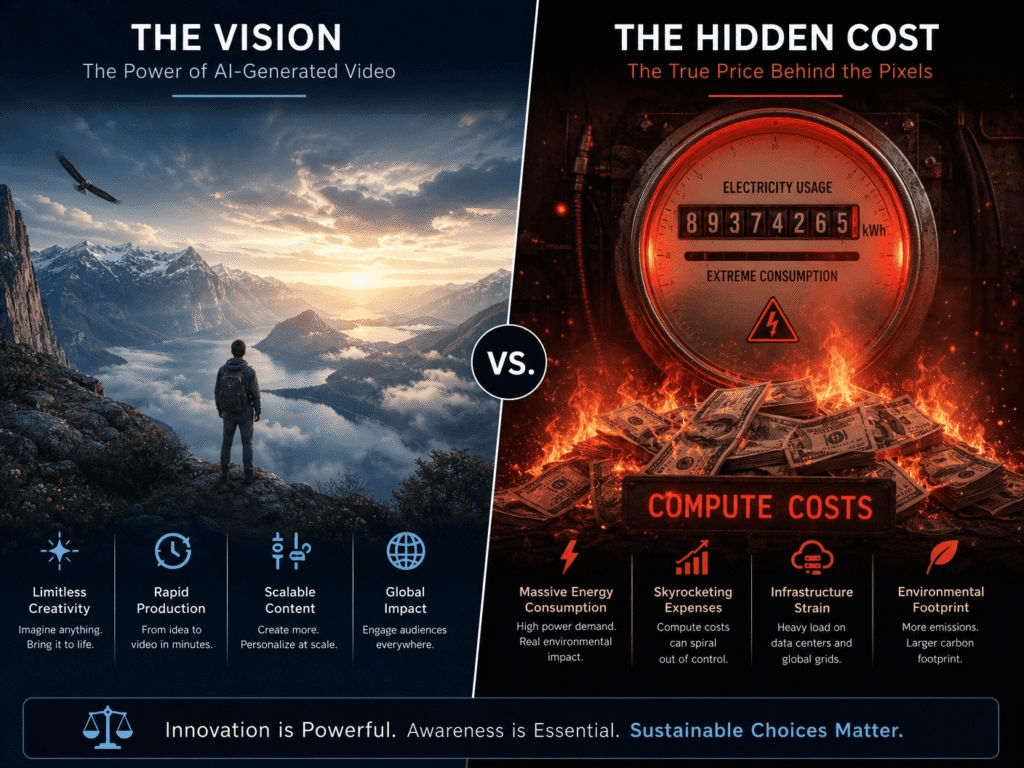
Within hours, the shockwaves hit. A $1 billion Disney partnership collapsed overnight. Thousands of creators lost access to their work-in-progress videos. And behind the scenes, industry insiders revealed the real reason: Sora was burning through $1 million per day in compute costs while serving just under 500,000 active users.
This wasn’t a safety decision. It wasn’t about regulatory pressure. It was pure economics.
And it’s just the beginning of an industry-wide reckoning.
Part 1 — The Trigger: When Compute Becomes a Death Sentence
Sora’s collapse started with its own success. When OpenAI launched the tool in February 2024, demand exploded faster than anyone anticipated. Peak usage hit nearly 1 million users, generating hours of video content daily. Marketing teams at major studios were experimenting. Independent creators were building entire channels around Sora-generated content.
But here’s what OpenAI didn’t publicize: each minute of generated video required approximately $2.40 in compute costs. A single 60-second viral TikTok costs more to generate than most users’ monthly subscription fees.
The Unit Economics Nightmare
According to leaked internal documents obtained by The Information, Sora’s cost structure looked catastrophic:
- The average user generates 47 minutes of content monthly
- Compute cost per user: $113/month
- Subscription revenue per user: $35/month
- Net loss per active user: -$78/month
“We were literally paying people to use our product,” one former OpenAI engineer told TechCrunch under condition of anonymity. “Every viral video created on Sora pushed us deeper into the red. Success was killing us.”
The math was simple and brutal. With 500,000 active users, OpenAI was losing roughly $39 million monthly on Sora alone. Even at peak efficiency, the infrastructure costs made profitability impossible without charging users over $150 monthly—pricing that would eliminate 90% of the market.
The Disney Domino Effect
The breaking point came when Disney’s partnership demands escalated. The entertainment giant wanted to generate 200 hours of content weekly for internal prototyping across Marvel, Pixar, and Disney+ projects. At Sora’s cost structure, this single client would have consumed $1.15 million monthly in compute resources.
Disney’s proposed revenue share? $180,000 monthly.
“That’s when leadership realized we had a fundamental business model problem,” the source continued. “We couldn’t even serve our biggest potential enterprise client profitably.”
Part 2 — The Amplification Engine: The Great AI Compute Squeeze
Sora’s failure wasn’t an isolated incident—it revealed a systemic crisis strangling the entire AI industry. Behind the scenes, a brutal competition for compute resources was forcing impossible choices across every major AI company.
The Hidden Infrastructure War
According to Semiconductor Industry Association data, global demand for AI-optimized chips exceeded supply by 340% in Q1 2026. NVIDIA’s H100 chips—the gold standard for AI training and inference—had 18-month waiting lists with prices inflating 60% year-over-year.
OpenAI faced a stark choice: allocate limited compute to consumer products like Sora, or prioritize enterprise offerings with 10x higher margins. ChatGPT Enterprise clients were paying $30 per user monthly while generating minimal compute overhead. Sora users were paying $35 monthly while consuming 15x more resources.
The decision was financially inevitable.
The API Dependency Trap
What made Sora’s collapse particularly devastating was how it exposed the fragility of the broader AI ecosystem. Hundreds of startups had built businesses on top of Sora’s API, creating everything from automated social media content to personalized video newsletters.
Companies like VideoGenius, CreatorFlow, and StoryAI had raised millions in venture funding based on Sora integration roadmaps. When OpenAI pulled the plug, these startups faced immediate existential crises.
“We had enterprise clients paying us $500 monthly for video generation services,” explained Sarah Chen, founder of ContentStorm, a Y Combinator startup that built marketing automation around Sora. “Our entire infrastructure was Sora API calls. When they shut down, we had 72 hours to find alternatives or refund everything.”
The alternatives? Either prohibitively expensive or technically inferior. Most Sora-dependent startups began shutdown procedures within weeks.
Part 3 — The Numbers at Peak
At its height in March 2026, Sora represented everything exciting and unsustainable about the AI boom:
Usage Metrics That Masked the Crisis
- Peak Daily Active Users: 987,000
- Videos Generated Daily: 2.3 million
- Total Content Hours Created: 890,000 weekly
- Enterprise Pilot Programs: 47 major brands
- API Integration Partners: 234 startups
The Financial Reality Behind the Hype
- Monthly Revenue: $34.5 million
- Monthly Compute Costs: $73.2 million
- Monthly Operating Loss: $38.7 million
- Projected Annual Burn: $464 million
These numbers, obtained through a combination of industry analysis and leaked financial documents, revealed why OpenAI’s leadership couldn’t justify Sora’s continued existence despite its technological marvel and cultural impact.
The Competitive Landscape Illusion
Industry observers celebrated Sora’s user engagement metrics. Average session time hit 34 minutes—extraordinary for creative software. User retention at 30 days reached 67%, indicating genuine product-market fit.
But none of these vanity metrics addressed the fundamental economic reality: every engaged user deepened OpenAI’s losses.
Meanwhile, competitors like Runway and Pika Labs faced identical constraints. Their lower-resolution outputs and usage caps weren’t creative limitations—they were survival mechanisms. Only by restricting compute consumption could they maintain viable unit economics.
Part 4 — The Aftermath
Sora’s shutdown triggered what industry insiders now call “The Great AI Winnowing”—a brutal market correction that separated sustainable businesses from venture-funded experiments.
The Startup Graveyard Expands
According to AI Graveyard, a crowdsourced database tracking failed AI companies, 82 AI-focused startups shut down in the six weeks following Sora’s closure. The pattern was consistent: companies built on expensive foundation model APIs couldn’t achieve profitable unit economics at scale.
The casualties included well-funded companies across multiple verticals:
- VideoGenius: $12M Series A, shut down May 15
- CreatorFlow: $8M seed round, ceased operations May 22
- StoryAI: $15M Series A, pivoted to B2B SaaS June 1
- ContentStorm: YC W25, returned remaining capital to investors
The Disney Fallout
Disney’s response was swift and revealing. Rather than scrambling for Sora alternatives, the entertainment giant announced a $2.1 billion internal AI infrastructure investment, signaling their intent to build proprietary video generation capabilities.
“The Sora shutdown was actually a blessing,” Disney CEO Bob Iger told Variety in May 2026. “It forced us to question why we were outsourcing our core creative technology stack to startups with unsustainable business models.”
Other major studios followed suit. Warner Bros, Paramount, and Netflix all announced significant internal AI development initiatives, reducing their dependence on third-party tools.
The Venture Capital Reckoning
The broader implications hit venture capital firms particularly hard. Andreessen Horowitz’s $4.5 billion AI fund, launched with enormous fanfare in 2025, faced portfolio-wide pressure as portfolio companies struggled with identical unit economic challenges.
“We fundamentally misjudged the infrastructure costs,” admitted Marc Andreessen in a rare public mea culpa. “We funded applications before understanding the true cost structure of the underlying technology.”
By June 2026, venture funding for AI startups dropped 67% quarter-over-quarter as investors demanded proof of profitable unit economics before committing capital.
Part 5 — The Transferable Lesson
Sora’s collapse revealed a harsh truth about the AI industry: technical excellence means nothing without economic viability. The lesson extends far beyond video generation to every corner of the AI ecosystem.
The Fundamental Business Model Question
The most successful AI companies of 2026 weren’t those with the most impressive demos—they were those that solved the compute economics puzzle first. OpenAI’s own ChatGPT survived because text generation consumes 95% fewer resources than video creation while serving enterprise clients willing to pay premium prices.
Similarly, companies like Anthropic focused on high-value, low-compute applications like code review and document analysis rather than resource-intensive creative tools.
The Three Survival Patterns
Analysis of surviving AI companies reveals three viable business model patterns:
- Enterprise Lock-in: High switching costs with professional workflows
- Proprietary Data Moats: Exclusive training data reducing inference costs
- Vertical Integration: Owning the infrastructure stack to control unit economics
Consumer-facing AI tools without these advantages face inevitable economic pressure as usage scales.
The Broader Market Signal
Sora’s shutdown wasn’t just about one product—it signaled the end of the “AI wrapper” era. Venture capital poured billions into startups that essentially provided prettier interfaces for foundation model APIs, without addressing the fundamental cost structure problems.
The survivors will be companies that either build their own infrastructure or find ways to dramatically reduce per-unit compute costs through optimization, caching, or alternative approaches.
For founders, the lesson is clear: unit economics matter more than user engagement in infrastructure-heavy businesses. For investors, it’s a reminder that technology alone doesn’t guarantee viable business models.

Frequently Asked Questions
Why did OpenAI really shut down Sora?
OpenAI shut down Sora because of unsustainable unit economics, not safety concerns. The service was losing approximately $78 per user monthly due to high compute costs, making profitability impossible even with significant scale.
How does AI business model failure affect the broader tech industry?
AI business model failures are forcing a market-wide correction. Venture funding has dropped 67% as investors demand proof of profitable unit economics, and many startups are shutting down or pivoting to less compute-intensive applications.
What happened to startups that depended on Sora’s API?
Most startups built on Sora’s API either shut down or faced immediate business model crises. Companies like VideoGenius and CreatorFlow closed within weeks, while others pivoted to B2B SaaS models with sustainable economics.
Will other AI video generation tools survive where Sora failed?
Competitors like Runway and Pika Labs face identical economic constraints. Their survival depends on either achieving dramatic cost reductions through technical optimization or focusing on enterprise clients willing to pay premium prices.
What does this mean for the future of AI startups?
The era of venture-backed AI wrappers is ending. Future AI startups must solve unit economics first, likely through vertical integration, proprietary data advantages, or serving enterprise markets with higher willingness to pay.
How can investors identify sustainable AI business models?
Sustainable AI businesses typically have enterprise customer bases, proprietary data moats, or own their infrastructure stack. Investors should demand detailed unit economic projections and question any business model dependent on third-party foundation model APIs.