







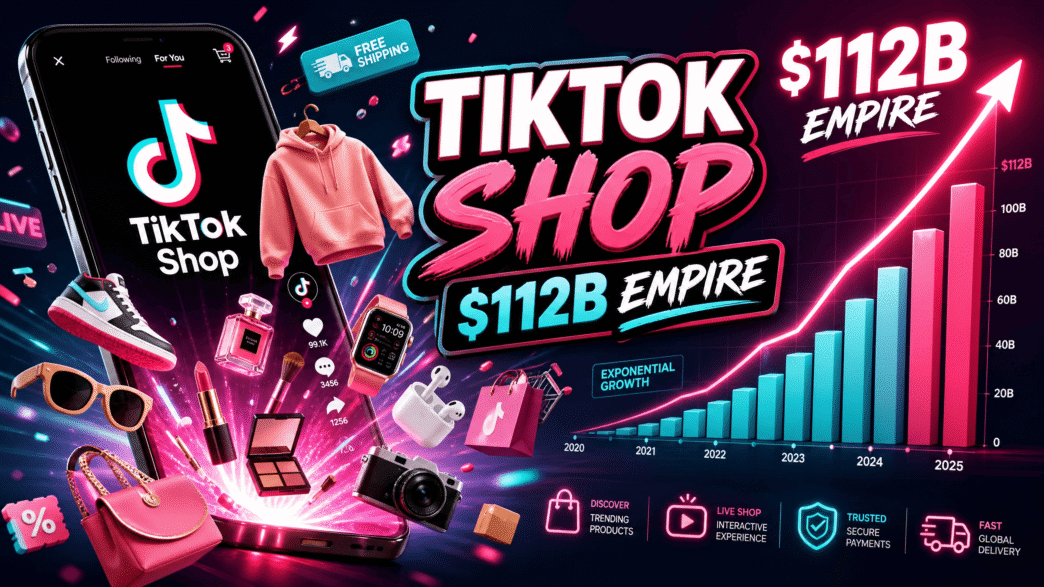
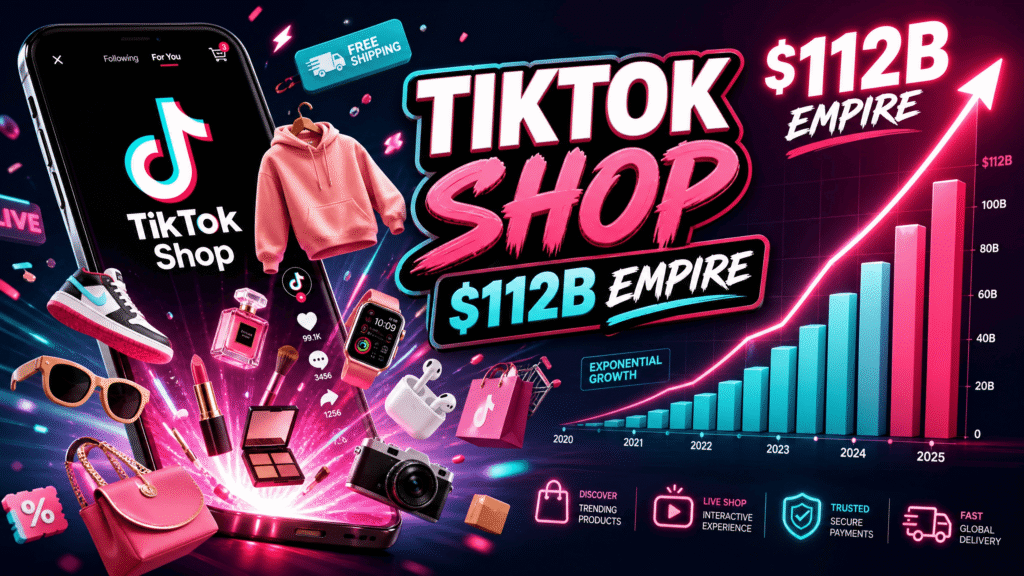
TikTok Shop just projected $112.2 billion in global gross merchandise value for 2026—a staggering 75% jump from $64 billion in 2025. To put that in perspective: Amazon took 13 years to reach $100 billion. TikTok Shop did it in three.
The numbers aren’t just big—they’re reshaping retail. The platform’s US market alone is forecast to hit $23.4 billion in 2026, giving TikTok Shop larger e-commerce sales than Target, Costco, or Best Buy combined. That’s not social commerce as a side hustle. That’s social commerce as the main event.
Here’s exactly how TikTok Shop growth 2026 became the fastest retail revolution in internet history—and why every traditional retailer is scrambling to decode what just happened.
Part 1 — The Trigger: Entertainment Meets Impulse Commerce
TikTok Shop didn’t start as an e-commerce platform. It started as a feature buried inside the world’s most addictive entertainment app. That accident became its superpower.
When TikTok Shop officially launched in the US in September 2023, most analysts dismissed it as “another social commerce experiment.” Facebook had tried it. Instagram had tried it. Pinterest had tried it. None broke through.
But TikTok Shop wasn’t trying to be another shopping tab. It was weaponizing something fundamentally different: algorithmic impulse discovery.
Traditional e-commerce follows a predictable funnel: awareness → consideration → search → purchase. TikTok Shop collapsed that into: entertainment → impulse → transaction. All in under 60 seconds.
The platform’s algorithm doesn’t show you products you’re searching for. It shows you products you didn’t know you wanted—presented by creators you trust, in content that doesn’t feel like advertising.
The Creator-Commerce Bridge
Here’s where TikTok Shop broke the code: they turned every creator into a potential sales affiliate. Not through boring banner ads or product placement, but through native content that felt like entertainment first, commerce second.
Creators could tag products directly in videos, earn commission on sales, and build entire businesses around product discovery. The platform took a cut, creators earned revenue, and users discovered products through genuine enthusiasm rather than corporate messaging.
By mid-2024, TikTok Shop had 15+ million active sellers globally with 475,000 US shops—a 5,000% increase from just 4,450 shops in mid-2023, according to data from Resourcera and Marketing LTB.
That wasn’t growth. That was an ecosystem explosion.
Part 2 — The Amplification Engine: Algorithm-Driven Commerce Discovery
TikTok Shop’s real breakthrough wasn’t the shopping feature—it was the algorithmic commerce engine underneath it.
The platform’s recommendation system doesn’t optimize for engagement alone. It optimizes for commercial intent signals buried inside entertainment behavior. Watch time on product videos, comment sentiment, save rates, and share patterns all feed back into the algorithm to surface products you’re statistically likely to buy.
The result: TikTok Shop achieved a 4.7% conversion rate—2.2x higher than Instagram Shopping (2.1%) and 2.6x higher than Facebook Shops (1.8%), according to ShortFormNation and eMarketer data.
Live Commerce Explosion
But the real amplification happened through live commerce streams. Creators started hosting live shopping events, demonstrating products in real-time while viewers purchased directly through the app.
These weren’t polished QVC-style productions. They were raw, authentic sessions where creators tested makeup, tried on clothes, or demonstrated gadgets while chatting with viewers. The intimacy created trust. The real-time interaction created urgency.
Live commerce creators saw 84% more sales than the previous year, according to eMarketer research. Beauty & Personal Care alone generated $2.49 billion in GMV—22% of total platform sales.
The Network Effect
As more creators started earning significant commissions, they began optimizing content specifically for TikTok Shop discovery. Product review videos, “get ready with me” sessions featuring shoppable items, and unboxing content all drove commerce engagement.
The platform’s algorithm rewarded this content with higher distribution because it generated revenue for TikTok. Creators got more views, earned more commissions, and produced more commerce content. The flywheel accelerated.
According to ShortFormNation data, the US buyer base expanded from 35 million to 65 million users in a single year—an 87.3% revenue growth rate that left traditional retailers studying TikTok Shop’s playbook.
Part 3 — The Numbers at Peak
By 2026, TikTok Shop’s numbers told the story of retail disruption in real-time.
Global domination metrics:
- $112.2 billion projected global GMV for 2026
- 75% year-over-year growth from $64 billion in 2025
- 15+ million active sellers across all markets
- 4.7% average conversion rate—the highest in social commerce
US market capture:
- $23.4 billion forecast for US market alone in 2026
- 18.2% of total US social commerce volume
- Projected 23.7% market share by 2027, according to eMarketer and Retail Dive
- 475,000 active US shops—more than Etsy’s top-tier sellers
Category breakdown revealed where TikTok Shop growth 2026 hit hardest:
- Beauty & Personal Care: $2.49B GMV (22% of platform sales)
- Fashion & Accessories: $1.87B GMV (17% of platform sales)
- Electronics & Gadgets: $1.34B GMV (12% of platform sales)
- Home & Garden: $1.12B GMV (10% of platform sales)
To understand the scale: TikTok Shop’s US revenue projection exceeds Target’s entire e-commerce division, Costco’s digital sales, and Best Buy’s online revenue—combined.
Creator Economics at Scale
The creator economy numbers were equally staggering. Top TikTok Shop affiliates were earning $50,000+ monthly through commission structures that rewarded volume over follower count.
Unlike traditional influencer marketing where mega-creators commanded premium rates, TikTok Shop’s algorithm democratized earnings. Micro-creators with 10,000 followers could out-earn macro-creators with 1 million if their content drove more conversions.
This created an arms race for commerce-optimized content that traditional retail advertising couldn’t match.
Part 4 — The Aftermath
TikTok Shop’s explosion triggered seismic shifts across the retail ecosystem that no one saw coming.
Traditional Retail Panic
Major retailers started reporting “social commerce attribution gaps” in earnings calls—corporate speak for “we don’t know where our customers are discovering products anymore.”
Target, Walmart, and Macy’s all announced “creator partnership initiatives” in late 2025, essentially attempting to reverse-engineer TikTok Shop’s success. Amazon launched “Amazon Inspire,” a short-form video shopping experience that felt like a desperate TikTok clone.
But copying features isn’t the same as copying culture. TikTok Shop worked because it was native to the platform’s entertainment ecosystem. Bolt-on shopping features felt exactly like that—bolt-ons.
Meta’s Aggressive Response
Facebook and Instagram accelerated their shopping features, but faced a fundamental problem: their algorithms optimized for engagement, not commerce. Users came to scroll and socialize, not shop.
TikTok users, by contrast, had already trained the algorithm that product discovery was part of their entertainment experience. The behavioral data was richer, the commercial intent was clearer, and the conversion rates reflected it.
Meta’s response included aggressive creator fund investments and commission structures designed to lure TikTok Shop affiliates. Early results showed limited success—creators couldn’t replicate TikTok Shop’s conversion rates on other platforms.
Supply Chain Disruption
TikTok Shop’s success also disrupted traditional supply chains. Brands started optimizing product development for “viral potential” rather than seasonal demand cycles.
Products that tested well in TikTok Shop’s ecosystem received accelerated production timelines. Traditional market research was partially replaced by TikTok Shop performance data. If something sold well through creator content, brands scaled it immediately.
This created new trend cycles that moved faster than traditional retail could adapt to.
Part 5 — The Transferable Lesson
TikTok Shop growth 2026 reveals a fundamental shift in how commerce actually works in the attention economy. The lesson isn’t about social features or creator partnerships—it’s about entertainment-first commerce architecture.
For Founders: Build Commerce Into Content, Not Content Into Commerce
Traditional e-commerce tries to make shopping entertaining. TikTok Shop made entertainment shoppable. That’s a crucial distinction.
If you’re building a commerce business, don’t ask “how do we make our product pages more engaging?” Ask “how do we make engaging content directly purchasable?”
The winners in creator economy commerce will be platforms that treat content creation and transaction completion as the same user flow, not separate experiences.
For Marketers: Algorithmic Discovery Beats Search Optimization
TikTok Shop proved that algorithmic product discovery can outperform search-based discovery when the algorithm understands commercial intent.
Instead of optimizing for keyword search rankings, successful brands on TikTok Shop optimized for algorithmic signals: engagement rates, comment sentiment, save rates, and share patterns that indicated purchase intent.
This requires a fundamental shift from SEO thinking to “algorithmic commerce optimization”—understanding how platform algorithms interpret commercial signals within entertainment content.
For Creators: Volume-Based Commissions Trump Follower-Based Rates
TikTok Shop’s commission structure rewarded sales performance over audience size. Creators who generated conversions earned more than creators who generated views.
This created a new creator economy model where commercial effectiveness mattered more than vanity metrics. The highest-earning TikTok Shop affiliates focused on conversion optimization, not follower growth.
For creators in any vertical, this signals a shift toward performance-based monetization rather than attention-based monetization.
How TikTok Shop Became a $112 Billion E-Commerce Empire in Just 3 Years
The Broader Implication
TikTok Shop’s success suggests that the future of commerce isn’t “social commerce” as an add-on feature—it’s commerce platforms that happen to be social.
The winning formula: entertainment algorithm + creator economics + frictionless transactions = retail disruption at scale.
Traditional retailers trying to add social features are solving the wrong problem. The real opportunity is building entertainment platforms that monetize through commerce, not commerce platforms that entertain through content.
Frequently Asked Questions
How did TikTok Shop achieve 75% growth in 2026?
TikTok Shop growth 2026 was driven by algorithmic product discovery, creator-affiliate systems, and conversion rates 2.2x higher than Instagram Shopping. The platform expanded from 35M to 65M US buyers in one year while growing seller count by 5,000%.
Why does TikTok Shop convert better than other social commerce platforms?
TikTok Shop achieves 4.7% conversion rates because its algorithm optimizes for commercial intent signals within entertainment content. Users discover products through trusted creators in native content, creating higher purchase intent than traditional social media advertising.
What makes TikTok Shop different from Amazon or traditional e-commerce?
TikTok Shop inverted the commerce funnel from search → discovery → purchase to entertainment → impulse → transaction. Instead of users searching for products, the algorithm serves products users didn’t know they wanted through creator content.
How much can creators earn through TikTok Shop affiliate commissions?
Top TikTok Shop affiliates earn $50,000+ monthly through volume-based commissions rather than follower-based rates. Micro-creators with 10,000 followers can out-earn macro-creators if their content drives more conversions, democratizing creator commerce earnings.
Will TikTok Shop growth continue in 2027 and beyond?
TikTok Shop is projected to capture 23.7% of US social commerce by 2027, with continued growth driven by algorithmic optimization and creator ecosystem expansion. The platform’s ability to compress discovery-to-purchase cycles gives it sustainable competitive advantages over traditional retail.
How are traditional retailers responding to TikTok Shop’s success?
Major retailers like Target, Walmart, and Amazon launched creator partnership programs and short-form video shopping features to compete with TikTok Shop. However, bolt-on social commerce features struggle to replicate TikTok’s native entertainment-to-commerce user behavior.