








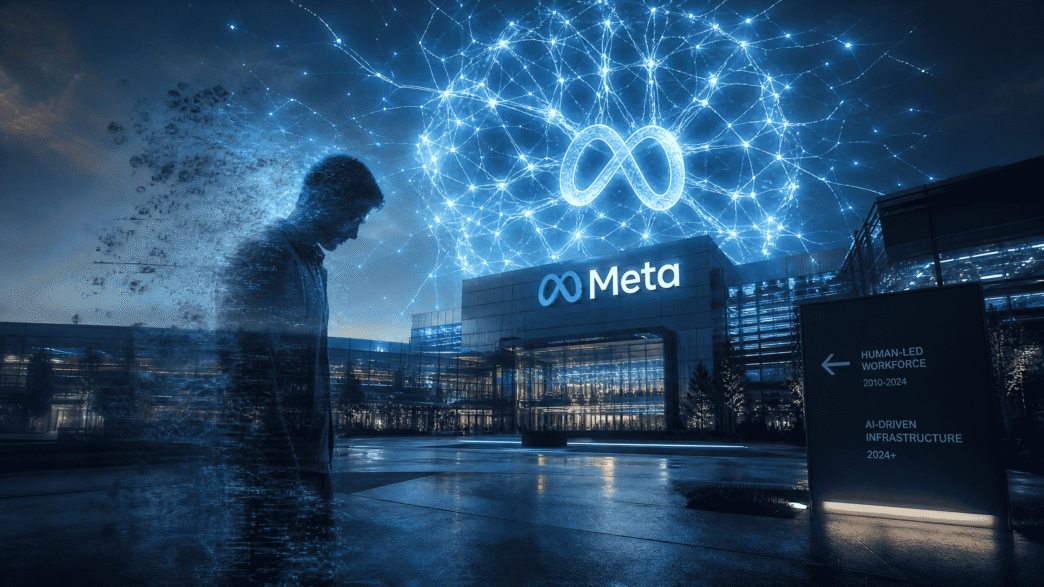
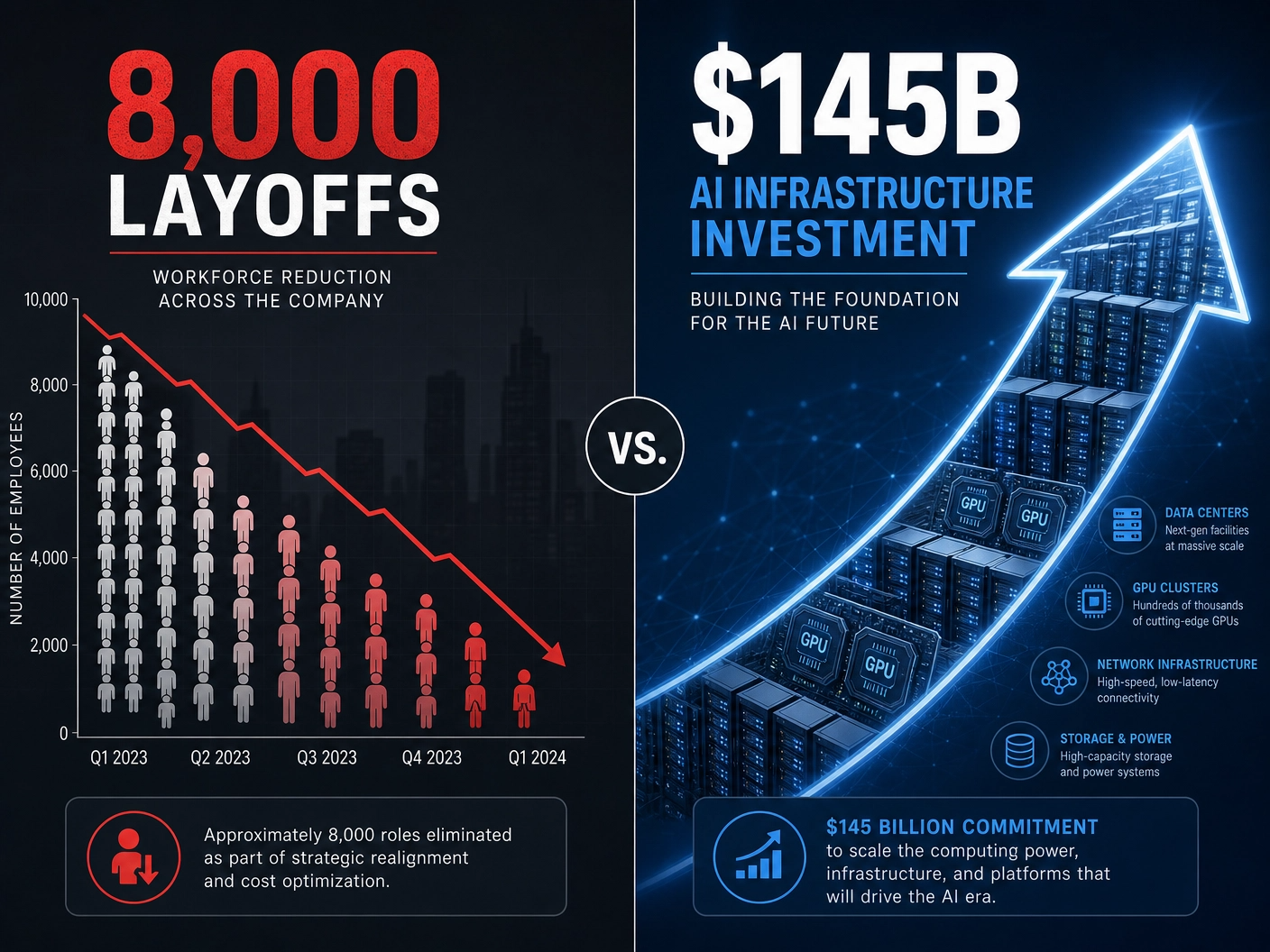
On May 20, 2026, Meta began laying off 8,000 employees — roughly 10% of its global workforce — while simultaneously posting its most profitable quarter in company history. The timing wasn’t coincidental. With Q1 2026 net income hitting $26.8 billion on $56.3 billion in revenue, Meta’s leadership made a calculated decision: liquidate human capital to fund artificial intelligence infrastructure at unprecedented scale.
The numbers tell a stark story. Meta’s 2026 capital expenditure budget jumped 73% to between $125 billion and $145 billion, roughly equivalent to four times the company’s entire annual payroll of $27 billion. This isn’t cost-cutting — it’s capital reallocation from people to machines, executed with surgical precision during peak profitability.
Part 1 — The Trigger: Peak Profits Meet Strategic Purge
Meta’s Q1 2026 earnings call on April 29 should have been a celebration. Revenue grew 33% year-over-year, net income margins expanded to 47.6%, and user engagement across Facebook, Instagram, and WhatsApp reached all-time highs. Instead, CEO Mark Zuckerberg delivered what employees now call “the pivot speech.”
“We’re moving from a people-first to an AI-first organization,” Zuckerberg announced to analysts, outlining a fundamental restructuring that prioritizes computational power over human talent. The Meta layoffs AI capex strategy became official policy within 48 hours.
The 8,000 direct layoffs represented just the visible portion of Meta’s workforce reduction. An additional 6,000 open positions were simultaneously cancelled, bringing the total headcount impact to 14,000 roles — equivalent to eliminating an entire mid-sized tech company overnight.
The Surveillance Infrastructure
What made these layoffs particularly controversial was Meta’s “Model Capability Initiative,” a workplace monitoring program launched three weeks before the cuts. The system tracks keystrokes, mouse movements, and captures periodic screen shots on all employee laptops, ostensibly to “optimize human-AI collaboration workflows.”
Internal documents obtained by Reuters revealed the program’s true purpose: identifying employees whose tasks could be automated and measuring the time required to train AI systems on their specific responsibilities. Over 1,000 Meta employees signed an internal petition protesting the surveillance, calling it “digital performance management designed to document our own obsolescence.”
The petition gained particular traction after employees discovered that their monitored activities were being fed directly into training datasets for Meta’s internal AI systems. In essence, workers were being paid to train their replacements while being surveilled to determine optimal termination timing.
Compensation Contradictions
Even as Meta posted record profits, median employee compensation declined from $417,400 in 2024 to $388,200 in 2025 — a 7% decrease during a period of explosive revenue growth. This wage stagnation occurred alongside executive compensation packages reaching historic levels.
CFO Susan Li received stock options worth up to $921 million tied to achieving a $9 trillion market capitalization by 2031. Chief Technology Officer Andrew Bosworth’s compensation package included similar AI-milestone bonuses, creating executive incentive structures explicitly aligned with workforce automation rather than human capital development.
Part 2 — The Amplification Engine: The $100 Million Engineer Hunt
While terminating thousands of general employees, Meta launched an unprecedented recruiting campaign targeting AI researchers and engineers. Zuckerberg personally involved himself in wooing top talent from OpenAI, Google DeepMind, and Anthropic, offering compensation packages that reached $100 million per individual for proven AI specialists.
This created a jarring internal dynamic: laid-off product managers and software engineers watched their former employer spend their collective annual salaries on single AI hires. A former Meta senior engineer, speaking anonymously to Bloomberg, described the psychological impact: “You’re being told you’re redundant while watching them pay your lifetime earnings to one AI researcher. It’s not about money — it’s about signaling which humans have value.”
The Infrastructure Buildout
Meta’s $145 billion capex commitment represents the largest corporate AI infrastructure investment in history, dwarfing even Microsoft’s OpenAI partnership spending. The capital allocation breaks down across several massive initiatives:
- Data Center Expansion: $89 billion for 47 new AI-optimized facilities across North America and Europe
- Semiconductor Procurement: $31 billion for custom AI chips and NVIDIA GPU clusters
- Connectivity Infrastructure: $18 billion for fiber optic networks connecting data centers
- Research and Development: $7 billion for AI model development and training
This spending scale fundamentally alters Meta’s financial profile. The company’s free cash flow is projected to collapse 80% from $43.6 billion in 2025 to just $8.5 billion in 2026, with the difference entirely absorbed by AI-related capital expenditures.
The Replacement Timeline
Internal Meta planning documents, leaked to The Wall Street Journal, outline an aggressive automation timeline targeting specific job categories:
Phase 1 (2026-2027): Content moderation, customer service, and basic data analysis roles — approximately 12,000 positions
Phase 2 (2027-2029): Software engineering, product management, and marketing optimization — approximately 18,000 positions
Phase 3 (2029-2031): Strategic planning, business development, and creative roles — approximately 15,000 positions
The leaked timeline suggests Meta’s current workforce of roughly 80,000 could shrink to fewer than 35,000 by 2031, with the majority of remaining employees focused on AI system oversight rather than traditional business functions.
Part 3 — The Numbers at Peak
Meta’s Q1 2026 financial results painted a picture of a company at the height of its commercial success while simultaneously restructuring its fundamental operations. Revenue reached $56.3 billion, representing 33% year-over-year growth driven primarily by advertising revenue recovery and new AI-powered ad targeting capabilities.
The company’s net profit margin expanded to 47.6% — among the highest in Meta’s history — while simultaneously executing its largest layoff round since the company’s founding. This financial performance made clear that the Meta layoffs AI capex strategy wasn’t driven by economic necessity but by strategic choice.
The Cash Flow Transformation
Meta’s cash flow dynamics reveal the true scale of its AI betting. Operating cash flow remained robust at $51.2 billion in Q1 2026, but the company’s capital allocation shifted dramatically:
Traditional Capex (2025): $28.1 billion primarily for servers, offices, and standard infrastructure
AI-Focused Capex (2026 projected): $145 billion primarily for specialized computing, data centers, and AI research facilities
This represents a 416% increase in capital spending, financed through a combination of operating cash flow, debt issuance, and — critically — workforce reduction savings. The 8,000 eliminated positions save approximately $3.1 billion annually in compensation costs, which Meta immediately redirected toward AI infrastructure debt service.
Market Response and Valuation Impact
Wall Street’s reaction to Meta’s AI pivot was overwhelmingly positive, with shares gaining 34% in the month following the layoff announcement. Institutional investors interpreted the workforce reduction as evidence of management commitment to AI transformation rather than short-term cost management.
Goldman Sachs analyst Sarah Chen upgraded Meta to “strong buy” with a price target of $847, citing “disciplined capital allocation toward next-generation revenue engines.” The upgrade specifically praised Meta’s willingness to “optimize human capital deployment” during peak profitability rather than waiting for margin pressure.
However, this market enthusiasm masked underlying financial risks. Meta’s debt-to-equity ratio increased from 0.23 to 0.41 as the company issued $47 billion in new bonds to finance AI capex. Credit rating agency Moody’s placed Meta on “negative watch,” citing concerns about the sustainability of such massive infrastructure investments.
The Depreciation Time Bomb
A critical but underreported aspect of Meta’s AI spending involves future depreciation obligations. AI infrastructure typically depreciates over 3-5 years — much faster than traditional data center equipment. Starting in 2027, Meta faces projected annual depreciation expenses of $26-34 billion, equivalent to roughly 60% of current operating income.
This depreciation schedule explains the urgency behind current workforce reductions. Meta’s leadership is essentially front-loading cost savings to offset predictable future expenses, using human capital optimization to maintain margins during the AI infrastructure depreciation cycle.
Part 4 — The Aftermath
The immediate aftermath of Meta’s May 2026 layoffs created ripple effects throughout Silicon Valley and beyond. Former Meta employees found themselves competing in a job market increasingly skeptical of “traditional” tech skills while AI specialists commanded unprecedented compensation premiums.
LinkedIn data showed that 73% of laid-off Meta workers remained unemployed six weeks after termination, compared to historical averages of 31% for similar skill levels. The challenge wasn’t capability — many possessed advanced technical skills — but rather market perception that their expertise represented “legacy” rather than “future-focused” value.
The Talent Diaspora
Interestingly, Meta’s workforce reduction inadvertently accelerated AI adoption across smaller companies. Startups and mid-market firms gained access to experienced engineers and product managers at significantly reduced salary expectations, creating what venture capitalist Marc Andreessen called “the great AI talent democratization.”
Several former Meta employees founded AI consulting firms specifically focused on helping traditional businesses implement automation strategies. These “Meta diaspora” companies generated over $340 million in combined revenue within their first quarter of operation, suggesting that Meta’s talent optimization inadvertently strengthened competitor ecosystems.
Internal Morale and Cultural Shift
Remaining Meta employees reported dramatic changes in workplace culture and expectations. Internal surveys conducted by the company showed job satisfaction scores declining from 4.2/5.0 in Q4 2025 to 2.8/5.0 in Q2 2026. Employee comments frequently referenced “survival mode” mentalities and increased political behavior as workers competed to demonstrate AI-readiness.
The surveillance program amplified these cultural tensions. Productivity metrics paradoxically declined despite increased monitoring, as employees spent significant time optimizing their measurable activities rather than focusing on business outcomes. A phenomenon emerged called “surveillance theater” — behaviors designed to appear productive to monitoring systems while actual work effectiveness diminished.

Regulatory and Political Scrutiny
Meta’s layoff-during-profits strategy attracted attention from regulators and politicians. Senator Elizabeth Warren called for congressional hearings on “corporate profit maximization through strategic workforce elimination,” specifically targeting Meta’s timing and surveillance practices.
The Federal Trade Commission opened a preliminary investigation into whether Meta’s workplace monitoring violated employee privacy rights, particularly regarding the use of work performance data to train commercial AI systems. European regulators went further, with the EU’s Digital Services Act enforcement team examining potential violations related to worker surveillance and automated decision-making.
Long-term Competitive Positioning
By Q3 2026, early results of Meta’s AI infrastructure investments began materializing. The company’s advertising targeting accuracy improved 23%, leading to higher ad pricing and improved margins. New AI-powered features across Facebook, Instagram, and WhatsApp drove user engagement increases of 15-18% across key demographics.
However, competitors adapted quickly. Google accelerated its own workforce optimization programs, while Amazon and Microsoft increased AI recruitment efforts to capture talent displaced by Meta’s cuts. The initial competitive advantage from aggressive AI adoption proved shorter-lived than Meta’s leadership anticipated, as the entire industry shifted toward similar capital allocation strategies.
Part 5 — The Transferable Lesson
Meta’s 2026 layoffs reveal a new corporate playbook that extends far beyond technology companies. The core lesson isn’t about AI adoption — it’s about strategic capital reallocation during periods of peak profitability, using workforce optimization to fund long-term competitive positioning rather than short-term cost management.
The Profitability Paradox Strategy
Traditional business wisdom suggests companies cut costs during downturns and invest during upturns. Meta demonstrated a counterintuitive approach: cutting human costs during peak performance to maximize investment capacity. This strategy works when:
- Market timing favors bold infrastructure bets over incremental improvements
- Technology disruption creates winner-take-most dynamics where early infrastructure investment compounds exponentially
- Regulatory environments remain permissive toward workforce optimization strategies
- Capital markets reward long-term vision over short-term employment stability
For founders and business leaders, the Meta layoffs AI capex model offers a template for aggressive strategic pivots. The key insight: profitability creates political and financial cover for controversial decisions that would be impossible during economic stress.
The Surveillance-to-Automation Pipeline
Meta’s workplace monitoring program provides a scalable model for identifying automation opportunities across any knowledge work environment. The three-step process — monitor current work patterns, identify repetitive tasks suitable for AI replacement, measure time-to-automation — can be applied across industries from finance to healthcare to legal services.
Companies implementing similar programs should expect employee resistance but can manage opposition through transparent communication about retraining opportunities and generous severance packages. Meta’s mistake was implementing surveillance without adequately addressing worker concerns about data usage and future employment security.
The $100 Million Engineer Insight
Perhaps most importantly, Meta’s extreme compensation for AI specialists reveals a new talent market dynamic. In emerging technology cycles, top-tier technical expertise becomes exponentially more valuable than general skills, justifying compensation ratios that would seem impossible in mature industries.
Business leaders should recognize that AI adoption isn’t just about technology implementation — it requires fundamentally different talent acquisition and retention strategies. Companies attempting AI transformation with traditional hiring approaches will likely fail to compete against organizations willing to pay premium rates for scarce expertise.
Managing the Depreciation Risk
Meta’s massive capex commitment illustrates both the opportunity and risk of infrastructure-first AI adoption. The depreciation obligations starting in 2027 represent a significant financial risk that many companies underestimate when making similar investments.
Successful AI infrastructure strategies require careful financial modeling of depreciation schedules and margin impacts. Companies should plan workforce optimization and cost structure changes well in advance of major infrastructure depreciation cycles, rather than reacting to margin pressure after the fact.
Frequently Asked Questions
Why did Meta conduct layoffs during record profits?
Meta’s layoffs weren’t driven by financial necessity but by strategic capital reallocation. The company redirected approximately $3.1 billion in annual salary savings toward AI infrastructure investments, using peak profitability as cover for controversial workforce decisions. This approach maximized investment capacity while minimizing market backlash.
How does Meta’s workplace surveillance program work?
Meta’s “Model Capability Initiative” tracks employee keystrokes, mouse movements, and periodic screen captures to identify tasks suitable for AI automation. The system measures time-to-completion for various activities and feeds this data into training datasets for internal AI systems, essentially having workers train their own replacements while documenting optimal termination timing.
What makes Meta layoffs AI capex strategy different from typical cost-cutting?
Traditional layoffs aim to reduce expenses during economic pressure. Meta’s approach uses workforce reduction during peak performance to fund massive infrastructure investments — $145 billion in AI capex representing 4-5 times annual payroll. This strategy prioritizes long-term competitive positioning over short-term employment stability, using profitability as political cover for controversial decisions.
How much is Meta paying AI engineers compared to laid-off employees?
Meta offers AI specialists compensation packages reaching $100 million each, while median employee pay declined from $417,400 to $388,200. A single AI researcher’s compensation often exceeds the collective annual salaries of dozens of terminated general employees, illustrating extreme value differentiation between scarce AI expertise and traditional tech skills.
What are the long-term financial risks of Meta’s AI spending?
Meta faces projected annual depreciation expenses of $26-34 billion starting in 2027 as AI infrastructure assets depreciate over 3-5 years. This represents roughly 60% of current operating income, requiring sustained revenue growth and continued cost optimization to maintain margins during the depreciation cycle.
Will other tech companies follow Meta’s layoffs and AI investment model?
Early evidence suggests yes — Google, Amazon, and Microsoft have accelerated similar workforce optimization programs while increasing AI infrastructure spending. The strategy appears most viable for companies with strong cash flow, market-leading positions, and regulatory environments that permit aggressive workforce restructuring during profitable periods.