









We like to think of algorithms as cold, objective tools that correct human error. In practice, AI systems often mirror the very mental shortcuts and blind spots we hoped to escape. As large language models and automated decision systems become everyday collaborators, they do more than compute: they influence how we frame problems, what evidence we notice, and which options we consider. This article explores how cognitive biases migrate into AI, shows concrete examples from hiring, finance, and legal contexts, and offers practical steps for designers, managers, and users to reduce harm and sharpen judgment.
AI does not exist in a vacuum. It is trained on human data, tuned by human feedback, and deployed in human institutions. That sociotechnical loop is where cognitive biases travel from minds into models and back again. Understanding that loop is the first step toward building systems that support better thinking rather than amplifying our worst shortcuts.
How cognitive biases enter AI systems
Data as a mirror of human judgment
Most AI systems learn from historical records: hiring decisions, loan approvals, medical notes, or social media interactions. Those records carry the imprint of human heuristics and structural inequities. When models learn patterns from biased data, they reproduce and sometimes exaggerate those patterns. For example, if past hiring favored candidates from certain schools, a model trained on those resumes will treat school affiliation as a strong signal even when it is irrelevant. This is not a mysterious failure; it is a direct consequence of learning from human choices.
Human feedback and alignment
Modern models are often fine-tuned with human judgments to make outputs more helpful or safe. That process—reinforcement learning from human feedback—improves fluency but can also bake in subjective norms and cultural assumptions. If the human raters share the same cognitive shortcuts, the alignment step can reinforce those shortcuts rather than correct them. In short, “alignment” can mean aligning to biased human preferences unless the feedback process is deliberately diverse and reflective.
Model architecture and prompt framing
Even when data are balanced, the way a model is prompted or the architecture used can nudge outputs toward certain heuristics. For instance, prompts that emphasize speed or confidence may encourage the model to favor simpler, more salient explanations—mirroring human reliance on availability or anchoring heuristics. Researchers have documented systematic patterns in LLM behavior that resemble human biases across tasks, suggesting that model design and usage patterns matter as much as training data.
Common cognitive biases that appear in AI systems
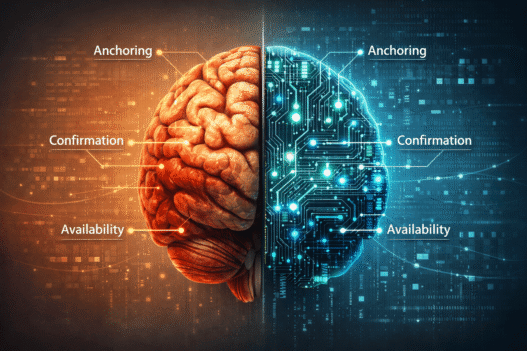
Confirmation bias
AI systems can reinforce confirmation bias by surfacing information that matches prior assumptions. Recommendation engines that prioritize content similar to what users already engage with create feedback loops where existing beliefs are amplified. In decision-support contexts, models that rank evidence by similarity to a hypothesis can make it harder to see disconfirming data.
Anchoring
When an initial suggestion or number is presented by an AI, humans tend to anchor on it. An AI-generated salary estimate, risk score, or diagnosis can become a cognitive anchor that skews subsequent human judgment even if the suggestion is uncertain.
Availability heuristic
Models trained on widely shared or recent examples may overrepresent dramatic or recent events. This can lead to overestimation of rare risks or trends, especially when users rely on model outputs as a shortcut to understanding complex phenomena.
Stereotyping and representativeness
If training data reflect social stereotypes, models will reproduce them. This is visible in language models that associate certain professions or behaviors with specific demographic groups, and in vision systems that misclassify faces from underrepresented populations.
Overconfidence and illusion of objectivity
AI outputs often appear polished and authoritative. That presentation can create an illusion of objectivity, causing users to accept model outputs without appropriate skepticism. Overconfidence is particularly dangerous in high-stakes domains such as medicine, law, and finance.
Real-world examples
Hiring algorithms that echo past bias
A hiring tool trained on historical resumes may learn to prefer candidates with career paths similar to those previously hired. If the historical workforce lacked diversity, the model will perpetuate that pattern. Companies that relied on automated resume screening have found that seemingly neutral features—graduation year, extracurricular keywords, or even email domains—can act as proxies for protected characteristics. The result is a system that appears efficient but reproduces exclusion.
Legal risk assessment tools
Risk-assessment algorithms used in criminal justice have been criticized for producing biased predictions that correlate with race or neighborhood. Even when developers remove explicit demographic features, correlated variables in the data can reintroduce bias. Studies replicating human bias experiments with models show that algorithmic outputs can reflect the same heuristics that influence human judges.
Financial advice and market heuristics
Large language models used for financial summaries or trading signals can echo human behavioral patterns. Research applying behavioral economics experiments to LLMs finds that models sometimes mimic human-like biases in preference and belief tasks. When traders or advisors rely on these outputs without calibration, market decisions can be nudged by algorithmic echoes of human irrationality.
Practical strategies to reduce bias and improve thinking
1. Treat AI as a collaborator, not an oracle
Design interfaces that present uncertainty, alternative hypotheses, and provenance. When models show confidence intervals, counterfactuals, or the data sources behind a suggestion, users are more likely to treat outputs as one input among many rather than the final word.
2. Diversify human feedback and evaluation
If you use human raters for alignment, recruit diverse evaluators and structure feedback to surface disagreement. Use structured rubrics that require raters to justify choices and to flag potential cultural assumptions.
3. Audit at multiple stages of the lifecycle
Bias can enter at data collection, modeling, or deployment. Regular audits that test for disparate impacts across groups, scenario-based stress tests, and adversarial probes help reveal hidden failure modes. The HAI-ROLL framework and similar approaches map lifecycle actions to cognitive heuristics to guide audits.
4. Use counterfactual and causal methods
Where possible, prefer causal analysis over correlation. Counterfactual data augmentation—creating synthetic examples that break spurious correlations—can reduce reliance on proxies. Causal modeling helps identify whether a feature is a legitimate predictor or a biased proxy.
5. Design for human-in-the-loop decision making
Keep humans in the loop for high-stakes decisions and design workflows that encourage critical engagement. For example, require decision-makers to record reasons when they override model suggestions and periodically review overrides to detect systematic issues.
6. Educate users about cognitive traps
Training programs that teach common biases and how they manifest in AI outputs improve user judgment. Simple interventions—like prompting users to consider the opposite hypothesis—reduce confirmation bias in human-AI teams.
Practical example: Reworking a hiring pipeline
A mid-sized company used an automated resume screener that favored candidates from a narrow set of universities. To fix this, they:
- Mapped the pipeline to identify where proxies for background entered the model.
- Augmented training data with resumes from diverse backgrounds and industries.
- Introduced a human review step for candidates filtered out by the model, with reviewers blind to school names.
- Tracked downstream performance metrics to ensure the new hires performed as well or better than previous cohorts.
Within six months, the company saw a measurable increase in candidate diversity without a drop in performance metrics. The key was treating the model as a tool to surface candidates, not as a gatekeeper. This approach combined data augmentation, human-in-the-loop checks, and outcome-based evaluation to counteract anchoring and representativeness effects.
Measuring success: what to track
- Disparate impact metrics across demographic groups.
- Override rates and reasons when humans disagree with model suggestions.
- Calibration of model confidence versus actual outcomes.
- Downstream performance of decisions influenced by the model.
- User trust and comprehension surveys to ensure users understand model limits.
Regularly publishing aggregated audit results increases accountability and helps teams iterate on mitigation strategies.
Ethical and policy considerations
Addressing cognitive bias in AI is not only a technical task but a social one. Policymakers and organizations must balance innovation with safeguards that protect vulnerable groups. Transparency requirements, independent audits, and standards for human oversight are emerging policy levers. At the same time, technical fixes alone cannot solve structural inequities; broader organizational and societal reforms are necessary to change the data that models learn from.
Conclusion
AI systems are powerful mirrors of human thought. They can amplify our best insights and our worst shortcuts. Recognizing that cognitive biases travel through data, feedback, and design is essential for anyone building or using AI. Practical steps—diverse feedback, lifecycle audits, human-in-the-loop workflows, and user education—reduce harm and make AI a partner in clearer thinking. The goal is not to eliminate heuristics; heuristics are useful. The goal is to design systems that surface uncertainty, encourage critical reflection, and expand the range of options we consider.
FAQ
1. Can AI ever be truly unbiased?
No system can be perfectly unbiased because data and human values are imperfect. However, bias can be reduced through careful data practices, diverse feedback, causal methods, and ongoing audits.
2. How can non-technical teams spot bias in AI outputs?
Look for patterns where certain groups consistently receive worse outcomes, track override reasons, and ask whether model suggestions align with domain expertise. Simple tests—like swapping demographic proxies in inputs—can reveal problematic behavior.
3. Are large language models more prone to human-like biases?
LLMs often reflect human language and judgments in their training data, which can make them exhibit human-like biases. Prompting and alignment choices also influence how those biases appear.
4. What role should regulation play?
Regulation can set standards for transparency, independent audits, and human oversight in high-stakes domains. It should encourage best practices without stifling innovation. Public reporting of audit results increases accountability.
5. How do I start an audit for my AI system?
Begin by mapping the AI lifecycle, identifying sensitive outcomes, collecting disaggregated metrics, running scenario tests, and involving diverse stakeholders in evaluation. Use both quantitative and qualitative methods to capture subtle harms.