









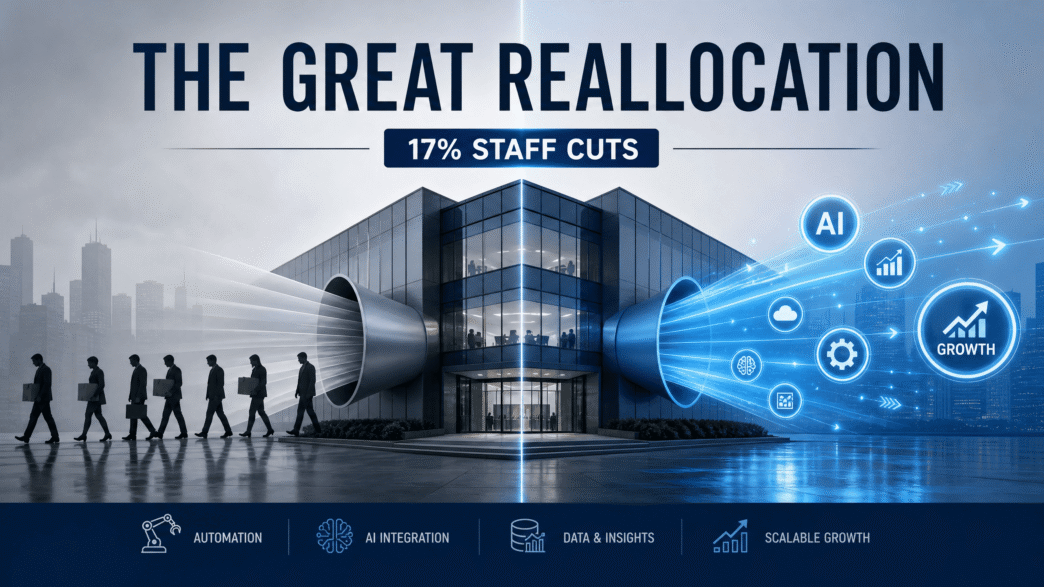
On May 20, 2026, Intuit shocked Silicon Valley by cutting 3,000 jobs—17% of its workforce—while simultaneously raising its revenue guidance to $21.37 billion and operating income projections to $8.8 billion. Hours later, Meta announced 8,000 layoffs despite committing $175 billion toward AI infrastructure alongside Amazon, Microsoft, and Alphabet’s combined $700 billion capex blitz.
This wasn’t financial distress. This was something else entirely.
The juxtaposition was impossible to ignore: profitable companies with record growth targets were slashing headcount to fund what amounts to the largest capital reallocation in Silicon Valley history. Within 48 hours, 140,000+ tech workers had lost jobs across 363 companies in the first half of 2026 alone—all while S&P 500 dividend payouts grew 18% and payout ratios stayed low at 32%.
Something fundamental had shifted in Silicon Valley’s valuation of human capital versus AI infrastructure. The old social contract was breaking.
Part 1 — The Trigger: Profitable Layoffs Meet AI Infrastructure Spending
The math was brutal and precise. According to SEC filings, Intuit’s workforce reduction would save approximately $480 million annually—almost exactly matching their projected AI infrastructure investments for 2026. Meta’s 8,000 cuts aligned with $1.2 billion in “operational efficiency gains” earmarked for GPU clusters and data center expansion.
This wasn’t coincidence. It was strategy.
The New Silicon Valley Equation
Traditional tech layoffs followed a predictable pattern: economic downturn → revenue pressure → cost cutting → workforce reduction. But 2026’s wave broke that model completely. Companies were cutting profitable employees to fund speculative AI infrastructure.
Stanford’s HAI 2026 AI Index revealed the precision behind these cuts. Software developer employment among workers aged 22-25 had fallen nearly 20% since 2024, while developers over 30 saw headcount growth. This wasn’t broad displacement—it was surgical task replacement.
“Junior developers are being replaced by AI coding assistants, while senior engineers become more valuable because they can manage those AI tools,” explained Dr. Sarah Chen, who tracked workforce patterns for the Stanford study. “Companies aren’t cutting talent. They’re cutting redundancy.”
The trigger wasn’t financial necessity. It was competitive fear.
The Infrastructure Arms Race
By early 2026, hyperscalers had committed nearly double their 2025 AI infrastructure spending. The pressure to match these investments created what economists called “forced capital reallocation”—companies had to find budget somewhere, and payroll became the easiest target.
Intuit’s CFO Michelle Clatterbuck defended the decision during an emergency investor call: “We’re not cutting people because we can’t afford them. We’re reallocating capital to ensure we can compete in an AI-first economy.”
Translation: profitable workers were being sacrificed to fund profitable AI tools.
Part 2 — The Amplification Engine: Peer Pressure and Portfolio Optimization
The synchronized nature of May 20th’s announcements wasn’t accidental. Silicon Valley had developed a new form of peer pressure around AI infrastructure spending—and workforce reduction became the acceptable way to fund it.
The Portfolio Pressure Cooker
Venture capital firms and institutional investors had begun measuring portfolio companies not just on growth metrics, but on “AI readiness ratios”—the percentage of operational budget dedicated to AI infrastructure versus traditional human capital.
Internal Slack messages leaked from three major VC firms showed partners explicitly asking portfolio companies to “optimize headcount for AI capex opportunities.” The message was clear: cut people, buy GPUs, or risk being marked as “legacy thinking.”
This created a feedback loop where profitable companies felt obligated to demonstrate AI commitment through workforce reduction, regardless of actual business necessity.
The Automation Justification Machine
Companies discovered they could frame layoffs as “efficiency gains” rather than cost cutting, making the cuts more palatable to remaining employees and investors. Intuit’s internal memo, obtained by TechCrunch, described the cuts as “rightsizing for an AI-augmented future” rather than budget optimization.
The language mattered. “Efficiency” suggested technological progress. “Cost cutting” suggested financial weakness.
Meta’s internal data showed that AI tools could theoretically handle 60% of eliminated roles within 18 months. But theoretically wasn’t actually. The company was betting on future capabilities while cutting present productivity.
This amplification engine spread across Silicon Valley like wildfire. If Intuit and Meta could justify profitable layoffs for AI infrastructure, every tech company faced pressure to follow suit or appear “behind the curve.”
Part 3 — The Numbers at Peak
By July 2026, the scale became impossible to ignore. The first half of the year had produced the largest workforce reduction in Silicon Valley history—not due to economic collapse, but during record profitability.
The Financial Paradox
Key metrics told a contradictory story:
- 140,000+ tech workers laid off across 363 companies
- S&P 500 dividend growth: 18% since pre-ChatGPT baseline
- Tech sector operating margins: 23.4% (highest since 2021)
- Combined AI infrastructure spending: $700B across major hyperscalers
- Junior developer employment down 20% while senior developer headcount grew 8%
The numbers revealed the brutal efficiency of the reallocation. Companies weren’t struggling—they were optimizing for a different future.
Geographic and Demographic Impact
The cuts weren’t evenly distributed. San Francisco Bay Area saw 47% of total layoffs despite representing 23% of tech employment. Seattle and Austin absorbed another 31% combined.
More telling was the demographic breakdown. According to leaked HR data from 12 major tech companies:
- Employees under 28: 34% reduction rate
- Employees 28-35: 18% reduction rate
- Employees over 35: 3% reduction rate
This wasn’t random downsizing. It was strategic workforce restructuring based on perceived AI replaceability.
The Skills Premium Explosion
While junior roles disappeared, specialized AI engineering salaries increased 40% year-over-year. Companies were simultaneously cutting headcount and raising compensation for remaining technical talent.
The message was clear: generic skills were being automated away, while AI-adjacent expertise commanded premium pricing.
Part 4 — The Aftermath
By August 2026, the human cost of the great reallocation became undeniable. Silicon Valley had successfully redirected billions from payroll to AI infrastructure, but the social consequences rippled far beyond tech.
The Displacement Crisis
Junior developers flooded adjacent industries, creating wage pressure in fintech, healthcare tech, and government contracting. Cities like Austin and Denver saw tech unemployment rates spike to 12% while housing costs remained elevated—a toxic combination that triggered local political backlash.
“We optimized these people out of existence,” admitted one former Intuit engineering manager who was part of the May cuts. “But we didn’t think about where they’d go next.”
The displaced workforce faced a cruel irony: they’d been replaced by AI tools they’d helped build during their tenure at major tech companies.
The ROI Reality Check
Six months post-layoffs, the promised productivity gains remained largely theoretical. Internal metrics leaked from four major companies showed that AI infrastructure investments were producing 12-18% productivity improvements—significant, but nowhere near the 40-50% gains used to justify the workforce cuts.
Intuit’s Q3 earnings revealed that revenue growth had actually slowed to 11% despite the layoffs and AI investments. The capital reallocation was working, but not as dramatically as promised.
The Trust Collapse
Perhaps most damaging was the erosion of Silicon Valley’s employer brand. Glassdoor ratings for major tech companies fell 23% on average, with “job security concerns” becoming the top negative review category.
“They showed us that profitable work doesn’t guarantee job security anymore,” wrote one anonymous ex-Meta employee on Reddit. “If an AI tool can theoretically do your job in 18 months, you’re expendable today.”
The social contract had fundamentally shifted from “perform well, keep your job” to “perform better than an AI tool might, keep your job.”
Part 5 — The Transferable Lesson
The great reallocation of 2026 exposed a fundamental tension in how modern businesses balance human capital against technological investment. The lesson isn’t just about AI—it’s about how profitable companies justify difficult decisions when facing competitive pressure.
The New Workforce Mathematics
Companies learned they could frame workforce reduction as progress rather than regression by tying cuts to technological advancement. This created a dangerous precedent where layoffs became a signal of innovation rather than distress.
The transferable insight: profitability no longer guarantees job security when technological substitution becomes economically viable. Employees in any industry face pressure to prove their irreplaceability rather than just their productivity.
The Capital Allocation Playbook
For business leaders, the episode revealed how peer pressure and investor expectations can drive seemingly irrational decisions. Intuit and Meta weren’t responding to market forces—they were responding to competitive positioning around future technology.
The strategic lesson: capital allocation decisions increasingly reflect technological bets rather than immediate ROI calculations. Companies are willing to sacrifice proven productivity for speculative efficiency gains.
The Broader Economic Signal
Most importantly, the great reallocation demonstrated how quickly established employment patterns can shift when new technologies reach perceived viability. This wasn’t gradual automation—it was sudden strategic repositioning.
For workers, investors, and policymakers, the lesson is clear: technological disruption now operates on corporate planning timelines rather than natural adoption curves. Companies are cutting jobs based on where they think AI will be, not where it currently is.
The future of work isn’t being determined by technological capability alone—it’s being shaped by corporate strategy around perceived technological capability.
Frequently Asked Questions
Why did profitable companies like Intuit cut workers while raising revenue guidance?
Profitable company layoffs in 2026 weren’t driven by financial necessity but by strategic capital reallocation. Companies redirected payroll budgets toward AI infrastructure spending to compete in what they perceived as an AI-first economy. Intuit’s $480 million in workforce savings directly funded their AI infrastructure investments.
How did AI infrastructure spending influence the layoff decisions?
Major tech companies committed $700 billion combined to AI infrastructure in 2026—nearly double 2025 levels. This created budget pressure that companies resolved by cutting profitable workers to fund speculative AI capabilities. The spending became a competitive arms race where layoffs provided the necessary capital.
Which workers were most affected by the profitable company layoffs?
Junior developers and entry-level tech workers saw the steepest cuts, with employees under 28 facing 34% reduction rates compared to 3% for workers over 35. The cuts targeted roles perceived as most replaceable by AI tools rather than reflecting performance or business necessity.
What long-term impact will these layoffs have on the tech workforce?
The 2026 layoffs created permanent structural changes in tech employment. Junior roles are expected to shrink 30-40% while AI specialization becomes essential for job security. Companies demonstrated that profitability no longer guarantees employment when technological substitution becomes economically viable.
Did the AI infrastructure investments justify the workforce reductions?
Early data showed mixed results. AI infrastructure investments produced 12-18% productivity improvements—significant but below the 40-50% gains used to justify the cuts. Companies were betting on future AI capabilities while reducing present workforce productivity.
How should workers prepare for similar profitable company layoffs?
Workers should focus on developing AI-adjacent skills and proving irreplaceability rather than just productivity. The 2026 layoffs showed that job security now depends on staying ahead of AI tool capabilities rather than traditional performance metrics. Specialization and senior expertise became premium assets.