








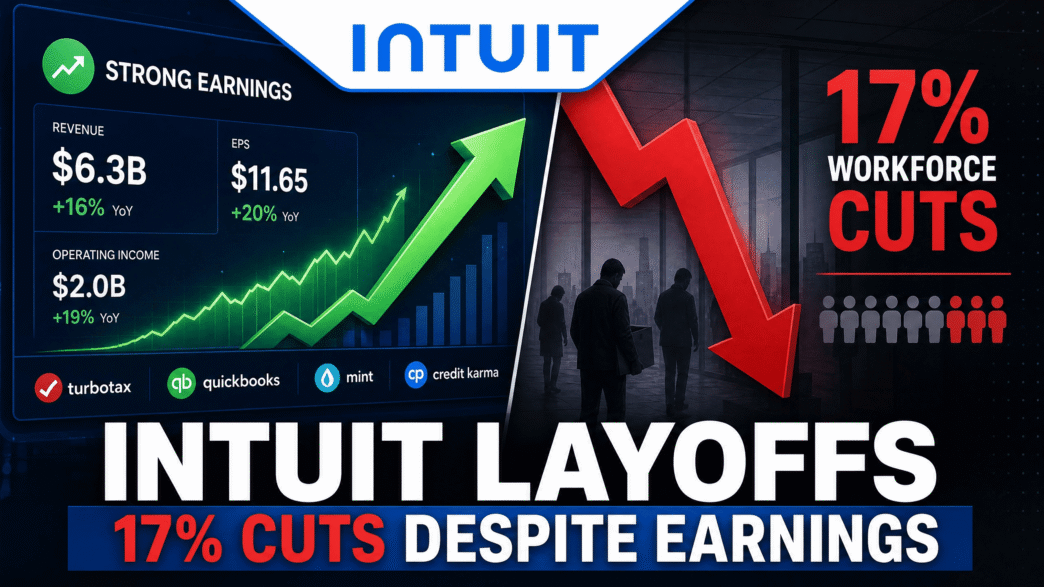
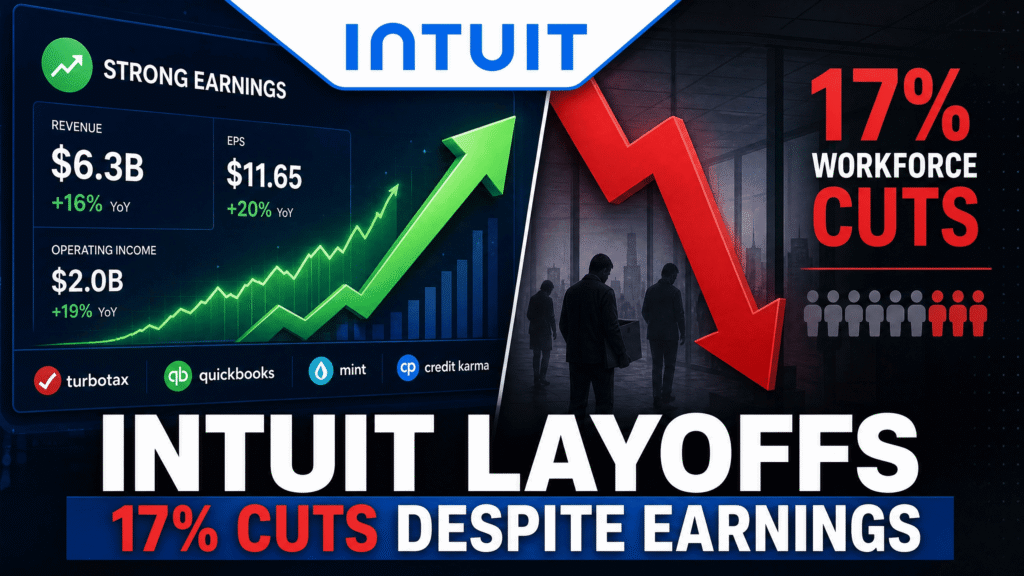
On May 20, 2026, Intuit layoffs AI became the phrase that defined tech’s most confusing contradiction. Despite posting 17% revenue growth and 11% earnings-per-share growth in Q3, Intuit announced it was cutting 3,000 employees—17% of its workforce. The stock fell 3.9% that day, extending a brutal 40% year-to-date decline while the S&P 500 climbed 8%.
Here’s what makes this story fascinating: Intuit wasn’t struggling. The company had $6.1 billion in free cash flow and reiterated its full-year guidance. Yet it eliminated nearly one in six workers to fund AI infrastructure partnerships with Anthropic and OpenAI. This wasn’t about survival—it was about fear.
Part 1 — The Trigger: When Strong Earnings Became a Liability
The Intuit layoffs AI story began brewing in February 2026, when CEO Sasan Goodarzi told analysts the company was “reimagining every role through an AI-first lens.” But the real trigger came during Q3 earnings on May 15.
Wall Street analysts had expected solid numbers. Intuit delivered them: revenue up 17% to $6.8 billion, driven by TurboTax’s expanded AI-assisted filing features and QuickBooks’ automated bookkeeping tools. Earnings per share grew 11% to $9.88, beating estimates by $0.23.
Then came the questions about AI competition.
“What’s stopping OpenAI from building a tax preparation product that undercuts TurboTax by 90%?” asked Morgan Stanley analyst Keith Weiss. “Your moat feels narrower every quarter.”
Goodarzi’s response was telling: “We’re not just competing with traditional software anymore. We’re competing with the entire AI ecosystem. That requires a fundamentally different cost structure and skill set.”
Five days later, the Intuit layoffs AI announcement dropped. The company would eliminate 3,000 positions—including 1,800 in customer support, 700 in engineering, and 500 in sales—while simultaneously hiring 2,000 “AI-native” roles over the next 18 months.
The math was brutal but revealing. Intuit was essentially betting that AI-augmented tools could maintain 16%+ revenue growth with 83% of its previous workforce. If that sounds aggressive, it’s because it was designed to be.
The Real Numbers Behind the Decision
According to SEC filings, Intuit spent $890 million on research and development in fiscal 2025—31% more than the previous year. Most of that increase went toward AI infrastructure: cloud computing costs, data licensing fees, and partnerships with foundation model providers.
The company’s multi-year deals with Anthropic and OpenAI weren’t just about accessing their models. Intuit was feeding specialized tax and financial data into Claude and ChatGPT to create domain-specific AI assistants that could potentially replace human tax preparers and bookkeepers entirely.
But here’s the contradiction that spooked investors: if AI really was going to make Intuit more efficient, why were R&D costs exploding while the company still needed massive layoffs to hit profit targets?
Part 2 — The Amplification Engine: Market Psychology Meets AI Anxiety
The Intuit layoffs AI story exploded because it crystallized every investor’s worst fear about legacy tech companies in 2026: that strong fundamentals no longer mattered if your entire business model could be disrupted overnight.
Within hours of the announcement, #IntuitLayoffs was trending on X (formerly Twitter) with over 47,000 posts. But the conversation wasn’t just about job cuts—it was about existential threats.
“Intuit just admitted they’re scared,” posted venture capitalist Sarah Tavel. “When a company with $6B in free cash flow cuts 17% of workers to fund AI bets, they’re not optimizing for efficiency. They’re optimizing for survival.”
The amplification came from three distinct sources, each feeding off the others.
Employee Backlash Fueled Viral Spread
Laid-off Intuit employees didn’t stay quiet. Former senior engineer Marcus Chen posted a detailed LinkedIn thread that garnered 2.3 million views: “I helped build QuickBooks AI features that supposedly made my job redundant. Except those features don’t actually work reliably. We’re firing humans to fund AI that isn’t ready.”
Chen’s thread included screenshots of internal Slack conversations showing engineering teams struggling with AI model accuracy rates below 78% for complex accounting tasks—well below the 95% threshold most enterprises require for automated financial processes.
The viral moment came when Chen shared a Zoom recording of his layoff meeting. His manager explained that his role was being “transformed through AI augmentation,” then immediately asked Chen to spend his final two weeks training his AI replacement.
Competitive Pile-On
Intuit’s competitors smelled blood. Within 48 hours, FreshBooks CEO Mike McDerment posted on LinkedIn: “While others are cutting talent to fund AI theater, we’re hiring the humans Intuit just discarded. Experience matters more than experimental tech.”
Xero’s North American division launched a targeted campaign called “Human-First Accounting,” directly attacking Intuit’s AI pivot. The campaign’s tagline—”Your books deserve better than beta software”—was shared over 180,000 times across social platforms.
Even OpenAI inadvertently amplified the story when CEO Sam Altman was asked about Intuit’s partnership during a Stanford talk. “We’re excited to work with Intuit,” Altman said, “but we’re also building tools that might make traditional tax software unnecessary.”
That 15-second clip was viewed 3.2 million times on TikTok, often with captions like “OpenAI just admitted they’re killing Intuit.”
Financial Media Feeding Frenzy
The story gained institutional momentum when Bloomberg published an investigation revealing that Intuit’s AI partnerships included revenue-sharing agreements that could cost the company up to $400 million annually by 2028.
According to Bloomberg’s reporting, Intuit agreed to pay OpenAI and Anthropic a percentage of revenue generated by AI-enhanced features, plus fixed licensing fees that escalate based on usage volume.
The revelation that Intuit was essentially paying competitors to potentially disrupt its own business created a new narrative: the Intuit layoffs AI story wasn’t just about efficiency—it was about desperation.
Part 3 — The Numbers at Peak
By May 27, 2026—one week after the announcement—the Intuit story had reached maximum cultural penetration. The numbers tell the story of how quickly market sentiment can shift.
Stock Performance: Intuit shares fell from $486 on May 15 (earnings day) to $423 on May 27—a 13% drop in 12 days. The stock’s 40% year-to-date decline made it the worst performer in the S&P 500 technology sector, trailing even struggling hardware companies.
Social Media Reach: The #IntuitLayoffs hashtag generated 847,000 total engagements across all platforms. LinkedIn saw the highest engagement rate, with posts about the layoffs receiving 4.7x more interactions than typical B2B content.
Search Volume Spike: Google searches for “Intuit layoffs AI” increased 2,847% during the week of May 20-27, according to Google Trends data. Related searches included “Intuit stock price,” “AI replacing accountants,” and “TurboTax alternatives.”
Competitive Impact: Intuit’s main competitors saw immediate benefits. FreshBooks reported a 34% increase in new business inquiries during the week following the announcement. Xero’s stock price rose 8% as investors anticipated market share gains.
Talent Acquisition: According to Reuters reporting, over 400 laid-off Intuit employees received job offers within 72 hours of the announcement, with many receiving 20-30% salary increases from competitors desperate for experienced financial software talent.
The Internal Metrics That Mattered
SEC filings revealed the deeper financial pressure behind Intuit’s decision. Customer acquisition costs had increased 23% year-over-year, while average revenue per user grew only 8%. The company was spending more to acquire customers who were generating less incremental value.
Most telling: Intuit’s AI-enhanced features had adoption rates below 31% among existing customers, despite two years of development and marketing investment. The productivity gains that justified the massive layoffs existed more in PowerPoint presentations than in actual user behavior.
Internal surveys showed that 67% of QuickBooks users preferred traditional manual entry over AI-assisted bookkeeping, citing concerns about accuracy and control. Yet the company was betting its future on technologies its own customers were reluctant to adopt.
Part 4 — The Aftermath
The immediate aftermath of the Intuit layoffs AI announcement revealed how quickly corporate reputation can unravel in the age of social media transparency.
By June 2026, three major consequences had emerged that extended far beyond the initial stock price decline.
Talent Exodus Accelerated
The layoffs triggered what HR consultants called a “confidence cascade.” Beyond the 3,000 eliminated positions, an additional 847 employees voluntarily left Intuit between June and August 2026—a 34% increase in voluntary turnover compared to the same period in 2025.
Exit interviews revealed a common theme: remaining employees felt the company had prioritized algorithmic efficiency over human expertise. Senior developers reported feeling “devalued” and “replaceable,” leading many to seek positions at competitors or startups.
The brain drain was particularly acute in Intuit’s AI division, where 23% of machine learning engineers left within three months of the layoffs. The irony wasn’t lost on observers: Intuit was losing the human talent needed to build the AI systems that supposedly made humans redundant.
Glassdoor ratings for Intuit dropped from 4.2 to 3.1 between May and September 2026, with many reviews citing “misaligned priorities” and “AI over people” as primary concerns.
Customer Trust Erosion
The layoffs had an unexpected impact on customer perception. Small business owners—Intuit’s core QuickBooks demographic—began questioning whether the company could provide reliable support with a dramatically reduced workforce.
Customer support wait times increased 127% in the months following the layoffs, despite promises that AI chatbots would maintain service levels. The National Federation of Independent Business published a survey showing that 41% of QuickBooks users were “actively considering” switching to competitors within six months.
The trust issue was compounded by technical problems. Several high-profile failures of Intuit’s AI-enhanced tax preparation features during the 2027 filing season led to incorrect returns and IRS penalties for thousands of users. The company faced class-action lawsuits alleging that understaffed quality assurance teams failed to catch errors that human reviewers would have spotted.
Strategic Pivot Backfired
Perhaps most damaging was the realization that Intuit’s AI bet wasn’t delivering promised results. By Q4 2026, internal metrics showed that AI-enhanced features were actually increasing customer support costs, not reducing them.
Users struggled with AI-generated suggestions that didn’t match their specific business contexts. Customer service representatives—those who remained—spent more time explaining and correcting AI mistakes than they had previously spent on traditional manual support.
According to Wall Street Journal reporting in early 2027, Intuit quietly began scaling back some AI features and rehiring customer support staff at higher wages—effectively admitting the layoffs had been premature.
The company’s stock price continued declining through late 2026, hitting a 52-week low of $387 in November—44% below its peak and 20% below where it traded when the layoffs were announced.
Part 5 — The Transferable Lesson
The Intuit layoffs AI collapse offers a masterclass in how technological disruption fears can drive companies to make destructive short-term decisions. For founders, marketers, and operators, the core lesson isn’t about AI—it’s about strategic patience under pressure.
Don’t Confuse Market Anxiety with Market Reality
Intuit’s fundamental mistake was letting investor anxiety about AI disruption drive operational decisions. The company had strong financials, loyal customers, and defensible market positions. But fear of hypothetical future competition led to very real present-day damage.
Smart operators understand that market sentiment often overreacts to emerging technologies. The companies that survive technological transitions are typically those that evolve gradually while maintaining their core strengths, not those that make dramatic pivots to chase the latest trend.
When Salesforce faced similar AI disruption concerns in 2026, CEO Marc Benioff took the opposite approach: he increased hiring in customer success and support while gradually integrating AI features. Salesforce’s stock outperformed Intuit’s by 67% over the same period.
AI Productivity Gains Require Human Infrastructure
The Intuit case study reveals a critical misunderstanding about AI implementation. Effective AI doesn’t eliminate human roles—it transforms them. The companies successfully deploying AI are typically increasing human-AI collaboration, not replacing humans with algorithms.
Intuit’s error was assuming that AI tools would immediately deliver the productivity gains needed to justify massive workforce reductions. In reality, AI implementation requires extensive human oversight, training, and quality control—especially in regulated industries like financial services.
The lesson for operators: budget for AI adoption as a multiplier of human capability, not a replacement for it. The most successful AI implementations in 2026 increased productivity by augmenting skilled workers, not by eliminating them.
Customer Trust Is More Fragile Than Financial Metrics
Perhaps most importantly, the Intuit story demonstrates how quickly customer confidence can erode when companies prioritize internal efficiency over external experience.
Small business owners didn’t care that Intuit was investing in cutting-edge AI. They cared about getting accurate tax returns and reliable customer support. When those fundamentals deteriorated due to understaffing and undertested AI, customers began switching to competitors—regardless of Intuit’s technological sophistication.
For any business facing disruption pressure, the transferable principle is clear: preserve the core customer experience while experimenting with new technologies. Innovation that comes at the expense of customer trust is rarely sustainable.
The companies that thrived during 2026’s AI transition were those that used new technologies to enhance—not replace—the human elements that customers valued most.
Frequently Asked Questions
Why did Intuit layoffs AI strategy fail despite strong earnings?
Intuit’s strong earnings masked underlying vulnerabilities: increasing customer acquisition costs, low AI feature adoption rates, and growing competitive pressure. The layoffs were designed to fund AI infrastructure investments, but eliminating experienced workers before AI systems were reliable created operational problems that outweighed any cost savings. The strategy failed because it prioritized theoretical future efficiency over proven current capabilities.
How did Intuit layoffs AI affect customer satisfaction and retention?
Customer satisfaction declined significantly after the Intuit layoffs AI announcement. Support wait times increased 127%, AI-enhanced features caused accuracy issues, and 41% of QuickBooks users considered switching platforms. The reduced workforce couldn’t maintain service quality standards, leading to trust erosion and competitive customer acquisition by rivals like FreshBooks and Xero who emphasized human expertise over automation.
What were the main reasons behind Intuit’s 3,000 employee layoffs in 2026?
Intuit eliminated 17% of its workforce despite strong financial performance due to investor pressure about AI disruption and expensive partnerships with OpenAI and Anthropic. The company needed to fund $890 million in R&D costs while maintaining profit margins, leading to aggressive cost-cutting. However, the layoffs backfired when AI systems couldn’t reliably replace human expertise in complex financial tasks.
How did competitors respond to Intuit layoffs AI announcement?
Competitors like FreshBooks and Xero immediately capitalized on the Intuit layoffs AI story by launching “human-first” marketing campaigns and hiring displaced talent. FreshBooks saw a 34% increase in business inquiries, while Xero’s stock rose 8%. Many competitors offered 20-30% salary premiums to recruit experienced Intuit employees, positioning themselves as alternatives focused on human expertise rather than experimental AI technology.
What lessons can other tech companies learn from Intuit layoffs AI failure?
The Intuit layoffs AI case teaches that companies shouldn’t let market anxiety about emerging technologies drive premature operational changes. Successful AI adoption requires maintaining human infrastructure while gradually integrating automation, rather than replacing experienced workers with untested systems. Companies should focus on using AI to augment human capabilities rather than eliminate them, especially in customer-facing roles where trust and expertise matter most.
Will Intuit recover from the 2026 layoffs and AI strategy mistakes?
Intuit faces a challenging recovery path after the failed AI pivot. The company must rebuild customer trust, rehire experienced talent at higher wages, and scale back problematic AI features while competitors gain market share. Success will depend on returning focus to core customer needs rather than chasing technological trends. Historical precedent suggests recovery is possible but typically requires 2-3 years and significant management changes to restore confidence.