







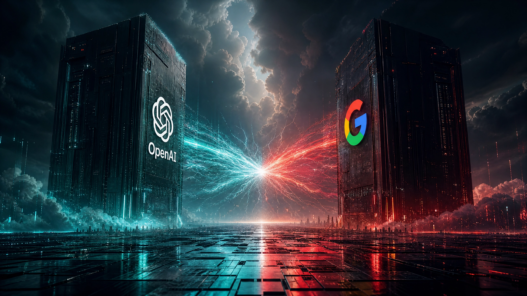
Something is happening to Google that has never happened before. For the first time in 25 years, the world’s most dominant search engine is genuinely scared, and the company doing the scaring is OpenAI.
The OpenAI vs Google 2025 battle is not just a product rivalry. It is a fundamental fight over how humanity accesses information. And right now, nobody is certain who wins.
Why OpenAI vs Google 2025 Is the Biggest Tech Battle in a Decade
Google has owned search since 1998. At its peak, it commanded over 92% of the global search market — a monopoly so complete that “Google” became a verb in every major language on earth.
That dominance is now under pressure for the first time in a generation.
OpenAI launched ChatGPT in November 2022. Within two months, it had 100 million users — the fastest consumer product adoption in internet history, surpassing Instagram and TikTok. By 2025, ChatGPT processes over 10 million queries per day, and OpenAI has launched a direct search product that pulls live web results.
According to data published by Statista, Google’s global search market share remained at 89.7% in Q1 2025 despite the rise of AI alternatives.
Google’s response has been aggressive but uneven. It launched Gemini — formerly Bard — as its AI answer to ChatGPT. It rolled out AI Overviews in Google Search, which summarize answers directly at the top of search results. It acquired and invested in AI companies at a pace unprecedented in its history.
But internally, Google faces a problem it calls the “innovator’s dilemma” in its own board presentations. Every AI answer it gives in search is one that does not show 10 blue links. Ten blue links are what advertisers pay for. AI answers threaten the $175 billion advertising revenue machine that funds everything Google does.
OpenAI has no such conflict. It is not protecting legacy revenue. It is attacking.
Part 1 — The Trigger: The Moment Google Knew It Had a Real Problem
The trigger for the OpenAI vs Google crisis arrived in December 2022 — just weeks after ChatGPT launched.
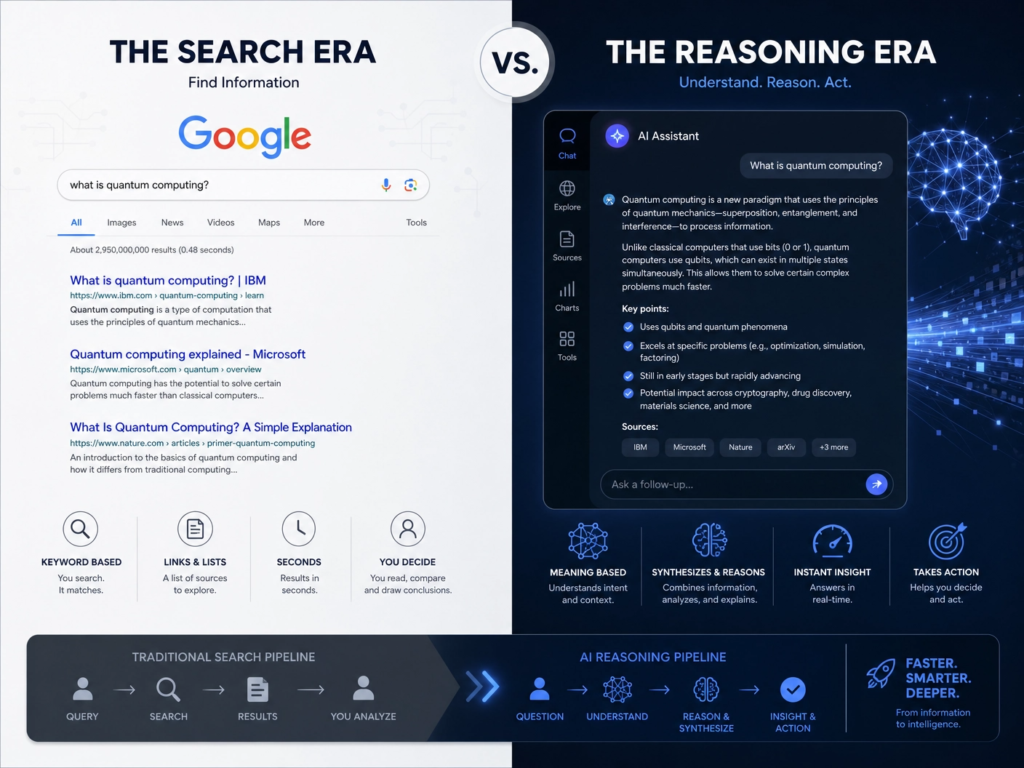
Google’s internal search team ran a study. They gave a sample of users access to ChatGPT alongside Google Search and tracked which tool they used for different query types. For informational queries — “explain how X works,” “what is Y,” “summarize Z” — users preferred ChatGPT at a rate that alarmed leadership.
The findings were serious enough that CEO Sundar Pichai issued a company-wide “code red” — an internal emergency designation Google had never previously used for a competitive threat.
The problem was not that ChatGPT was better at everything. It was that ChatGPT was better at the queries that were growing fastest. The shift from “search and click” to “ask and receive” was exactly the user behavior Google had internally predicted could one day threaten its model. It had arrived four years earlier than expected.
Part 2 — The Amplification Engine: How the AI War Escalated
The OpenAI vs Google battle escalated through three distinct waves in 2023 and 2024.
Wave one was the product launches. Microsoft invested $13 billion in OpenAI and integrated ChatGPT into Bing, Edge, and Office 365. For the first time since the 1990s browser wars, Bing was relevant. Microsoft’s $13 billion investment in OpenAI was confirmed in their official partnership announcement and fundamentally changed the competitive landscape of search. Google rushed Bard to market before it was ready — it gave an embarrassingly wrong answer in its launch demo, wiping $100 billion off Alphabet’s market cap in a single day.
Wave two was the talent war. OpenAI and Google DeepMind began competing for the same small pool of elite AI researchers. Salaries for senior AI engineers reached $1 million per year and beyond. Google DeepMind lost several high-profile researchers to OpenAI and to Anthropic — a company founded by former OpenAI employees, including siblings Dario and Daniela Amodei.
Wave three was the enterprise market. In 2024, both companies pivoted aggressively toward selling AI services to businesses. Google had the advantage of existing enterprise relationships through Google Workspace. OpenAI had the advantage of ChatGPT’s brand recognition and the ChatGPT Enterprise product. Both companies signed billions of dollars in enterprise contracts throughout 2024.
By early 2025, the battle had become a multi-front war — consumer search, enterprise software, hardware infrastructure, and regulatory environment simultaneously.
Part 3 — The Numbers: Who Is Actually Winning OpenAI vs Google in 2025
The data tells a more nuanced story than the headlines suggest.
OpenAI:
- ChatGPT monthly active users: 400 million (February 2025)
- OpenAI annual revenue run rate: $3.4 billion (early 2025)
- OpenAI valuation: $157 billion (October 2024 funding round)
- ChatGPT daily queries: 10+ million
- OpenAI enterprise customers: 1 million+ businesses
Google:
- Google Search global market share: still 89.7% (Q1 2025)
- Google AI Overviews monthly users: 1 billion+
- Alphabet annual revenue: $350 billion (2024)
- Google Cloud AI revenue growth: 28% year-over-year (2024)
- Gemini app monthly active users: 35 million
The numbers reveal something important: Google is not losing search yet. Its market share remains dominant. But the growth trajectory of AI-native tools versus traditional search is where the threat lives. Among users aged 18–34, AI assistant usage for information queries grew 340% in 2024 while traditional search usage in the same demographic grew just 4%.
The battle is not over with today’s users. It is over tomorrow’s habits.
Part 4 — The Aftermath: What Has Already Changed
The OpenAI vs Google war has already permanently changed the internet — regardless of who ultimately wins.
Search engine optimization, the entire industry built on ranking in Google’s results, is in crisis. AI Overviews answer queries directly, reducing click-through rates to traditional websites by an estimated 15–25% for informational content. Publishers are reporting significant traffic declines. The SEO industry is scrambling to adapt to a world where ranking number one may generate zero clicks.
Advertising is under pressure. Google’s AI Overviews currently show limited advertising. The question every advertiser is asking is how Google integrates ads into AI-generated answers without destroying the user experience — and what happens to ad revenue during the transition period.
The browser market is shifting. Microsoft Edge, powered by Copilot and ChatGPT integration, reached 13% global browser market share in early 2025 — its highest ever — primarily by positioning itself as the AI-native browser against Chrome.
And a new category of company — AI search — has emerged. Perplexity AI raised $500 million at a $9 billion valuation in early 2025 and is growing at triple-digit rates, building a search product that is neither Google nor ChatGPT but a hybrid of both.
Perplexity AI’s funding and growth trajectory are documented in detail by TechCrunch, which has tracked the company’s rise as the third major player in the AI search war.

Part 5 — The Lesson: What OpenAI vs Google Tells Us About Tech Disruption
The OpenAI vs Google battle is a real-time case study in what happens when a new technology paradigm collides with an entrenched monopoly.
Google’s advantage — 25 years of search index data, 89% market share, $350 billion in annual revenue — is also its constraint. It cannot move as fast as OpenAI because every move it makes risks the advertising revenue that funds everything.
OpenAI’s advantage — no legacy revenue to protect, a single compelling product, and an ability to move fast — is also its constraint. It needs to find a sustainable business model before its cash runway ends.
The lesson for every business watching this battle: the company that disrupts you will almost always be the one with nothing to lose. Not because they are smarter. Because they are not paralyzed by what they already have.
For a deeper look at how entrenched monopolies fail to respond to disruption, read our full breakdown in the Industry Disruption category.
Frequently Asked Questions: OpenAI vs Google 2025
Is OpenAI beating Google in 2025?
OpenAI is gaining significant ground in AI-native information queries but Google still dominates traditional search with nearly 90% global market share. The battle is closer in the under-35 demographic, where AI tool usage is growing much faster than traditional search.
What is Google doing to fight back against OpenAI?
Google has launched AI Overviews in Search, upgraded its Gemini AI assistant, integrated AI into Google Workspace, and invested heavily in Google DeepMind research. It has also signed major enterprise AI contracts and released its own large language models, including Gemini 1.5 and 2.0.
How much is OpenAI worth in 2025?
OpenAI was valued at $157 billion in its October 2024 funding round, making it the most valuable private company in the world. It has a reported annual revenue run rate of approximately $3.4 billion as of early 2025.
Will AI replace Google Search?
AI will not replace Google Search entirely in the near term. However, it is already changing how people use search — particularly for informational queries where AI assistants provide direct answers rather than links. The shift is gradual but measurable, especially among younger users.
Which is better — ChatGPT or Google Gemini?
Both tools perform differently depending on the task. ChatGPT leads in creative tasks, coding assistance, and conversational interaction. Google Gemini integrates better with Google Workspace and has advantages in real-time information retrieval through Google’s search index. Most power users use both.





Your post is a true masterpiece. I\’ll be referencing it in my own work.
I\’m honored to hear that. I\’m always striving to provide the best information possible.
This post is a game-changer. I\’ve learned so much from it – thank you!
Your post is a true masterpiece. I\’ll be referencing it in my own work.
I\’m so glad I found your site. Your posts are consistently excellent.