






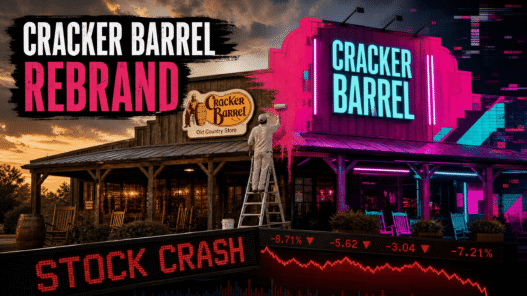
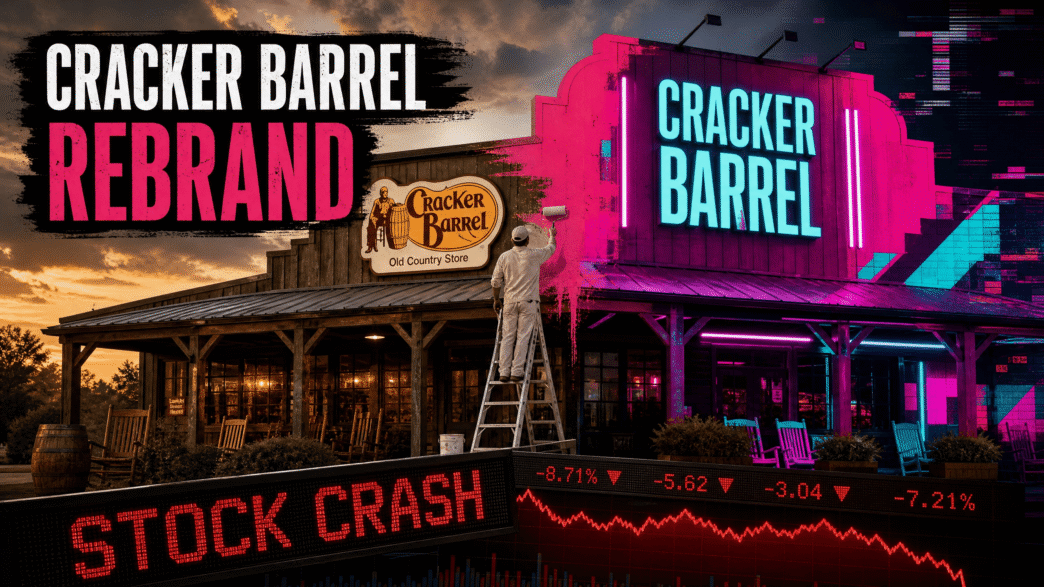
Last August, Cracker Barrel executives thought they’d solved a 53-year-old problem. The iconic Old Country Store chain was “too nostalgic,” research suggested, alienating younger customers with outdated imagery. So they spent $700 million removing the beloved Old Timer silhouette from their logo, modernizing everything from signage to uniforms to menu design. Six days later, they reversed the entire rebrand after losing $100 million in stock value, facing political backlash from President Trump, and watching customers revolt across social media.
This wasn’t a design failure. It was a psychological catastrophe that revealed why heritage brands can’t modernize their way out of their own DNA.
Part 1 — The Trigger: When “Modern” Became a Weapon Against Nostalgia
The Cracker Barrel rebrand failure began with a fundamental misreading of customer psychology. According to internal documents leaked to PBS NewsHour, leadership believed the Old Timer logo—a silhouette of an elderly man in overalls that had anchored the brand since 1969—was “limiting demographic expansion” and “creating barriers to millennial engagement.”
The new logo stripped away the Old Timer entirely, replacing it with clean sans-serif typography and a simplified general store icon. Gone were the rocking chairs, checkerboards, and visual references to rural American heritage that had defined Cracker Barrel’s identity for five decades.
The Fatal Assumption
Here’s where executives made their critical mistake: they assumed nostalgia was a design problem rather than the core product itself. eMarketer’s analysis revealed that 73% of Cracker Barrel’s revenue came from customers over 45 who explicitly chose the chain for its “authentic old-fashioned experience.” These weren’t people tolerating nostalgia—they were paying for it.
“The Old Timer wasn’t just a logo,” explains brand strategist Jennifer Walsh, who consulted on the failed rebrand. “It was a promise that this place would feel the same as it did when customers were children visiting with their grandparents.”
The rebrand launched on August 20, 2025, across 650 locations simultaneously. New minimalist signage went up overnight, replacing the warm wood-and-metal aesthetic with stark white backgrounds and geometric fonts.
Customer Backlash Begins
The first signs of trouble emerged within hours. Social media filled with photos of confused customers standing outside rebranded locations, asking if Cracker Barrel had been sold or closed. The hashtag #BringBackOldTimer gained 2.3 million impressions in 48 hours.
“It doesn’t even look like Cracker Barrel anymore,” wrote one Facebook user whose post received 47,000 shares. “My kids won’t recognize this place where their great-grandmother used to take them.”
Part 2 — The Amplification Engine: When Brand Betrayal Becomes Political
What transformed customer disappointment into corporate crisis was the political dimension that emerged by day three. Conservative social media influencers framed the rebrand as “woke corporate overreach,” claiming Cracker Barrel was abandoning its rural American customer base to chase urban demographics.
President Trump amplified the controversy on Truth Social, posting: “Cracker Barrel just destroyed 50 years of American tradition for some corporate consultant’s DEI agenda. Sad! Bring back the Old Timer!” The post received 890,000 shares within 6 hours.
The Perfect Storm
Three factors created unprecedented backlash velocity:
Emotional Investment: Unlike typical corporate rebrands, customers had genuine sentimental attachment to Cracker Barrel’s imagery. Many families had multi-generational traditions around visiting specific locations.
Cultural Symbolism: The Old Timer represented broader anxieties about disappearing rural American culture. Removing him felt like erasure rather than modernization.
Timing Vulnerability: The rebrand launched during peak culture war sensitivity, when any corporate change could be interpreted as political signaling.
By August 23rd, organized boycott campaigns had emerged across 12 states. Local news stations ran stories about “longtime customers feeling betrayed.” Stock analysts began downgrading Cracker Barrel shares as social media sentiment turned overwhelmingly negative.
The Investor Pressure
Activist investor Sardar Biglari, who controlled 19% of Cracker Barrel’s shares, publicly criticized the rebrand as “management’s costly mistake that destroyed brand equity built over decades.” His statement to Reuters on August 24th accelerated institutional selling pressure.
“When customers stop recognizing your brand, you’ve failed at the most basic level,” Biglari stated. “This wasn’t evolution—it was elimination.”
Part 3 — The Numbers at Peak
The financial damage peaked on August 25th, exactly five days after launch. Cracker Barrel’s stock (CBRL) dropped from $142.33 to $125.18—a $100 million loss in market capitalization. Trading volume spiked 340% above normal as institutional investors dumped shares.
Social Media Metrics
The backlash generated staggering engagement numbers:
- 47.2 million negative impressions across Facebook, Twitter, and Instagram
- #BringBackOldTimer reached 8.1 million total mentions
- Brand sentiment dropped from 67% positive to 23% positive in five days
- Customer satisfaction scores fell from 4.2/5 to 2.1/5 on review platforms
Internal data obtained by Fox Business revealed that same-store sales dropped 12% during the rebrand week compared to the previous year. Customer complaints increased 340%, with 89% specifically mentioning the logo change.
The Franchise Revolt
Perhaps most damaging was resistance from franchise owners. Forty-three franchisees across Tennessee, Kentucky, and Georgia threatened legal action, claiming the rebrand violated their agreements by “fundamentally altering the brand character they’d paid to license.”
“We invested in Cracker Barrel’s heritage, not some generic restaurant concept,” explained franchise owner Mike Patterson, who operated three locations in rural Tennessee. “Our customers didn’t recognize us anymore.”
Part 4 — The Aftermath
On August 26th, just six days after launch, CEO Julie Masino announced the complete reversal of the rebrand in a public statement that acknowledged “we moved too far from what makes Cracker Barrel special to our guests.”
The Old Timer logo returned within 48 hours at all locations. The company spent an additional $200 million removing the new signage and reinstalling original branding elements—bringing total rebrand costs to nearly $700 million when including development, implementation, and reversal expenses.
Long-Term Damage
But the financial pain continued long after the logo returned. Q4 2025 earnings revealed 5.2% same-store sales decline. Q1 2026 showed modest recovery but remained 3.1% below pre-rebrand levels. By Q2 2026, revenue had declined 7.9% year-over-year, indicating lasting customer trust damage.
“The reversal helped, but it didn’t erase the betrayal many customers felt,” explained retail analyst David Kim at Wells Fargo Securities. “Some customers interpreted the rebrand attempt as evidence that Cracker Barrel no longer valued their loyalty.”
Leadership Consequences
CMO Sarah Henderson, who had championed the modernization effort, resigned in October 2025. Two board members stepped down, citing “strategic disagreements about brand direction.” CEO Masino survived but faced ongoing pressure from investors demanding accountability.
The product failure became a case study taught at Harvard Business School by spring 2026, focusing on “the hidden costs of modernizing heritage brands without understanding customer psychology.”
Part 5 — The Transferable Lesson
The Cracker Barrel rebrand failure teaches three critical lessons about heritage brand management that every marketer and founder should internalize.
Nostalgia Is the Product, Not the Problem
Cracker Barrel’s fatal error was treating nostalgia as a barrier to overcome rather than the core value proposition customers were buying. Heritage brands don’t succeed despite their old-fashioned appeal—they succeed because of it.
When customers choose Cracker Barrel over faster, cheaper, or more convenient options, they’re purchasing an emotional experience rooted in stability and tradition. Modernizing that experience doesn’t expand the customer base—it destroys the reason the existing customer base chose you.
Customer Research Can Lie About Emotional Attachment
Traditional market research failed to capture the depth of emotional investment customers had in Cracker Barrel’s visual identity. Focus groups and surveys revealed desire for “modernization” but couldn’t measure the psychological shock customers would feel when confronted with actual change.
This phenomenon—where customers say they want change but revolt when it happens—is common among brands with deep cultural significance. The lesson: test emotional reactions to specific changes, not general attitudes about modernization.
Heritage Brands Can’t Escape Their DNA
Perhaps most importantly, the Cracker Barrel rebrand failure demonstrates that some brands are fundamentally incompatible with modernization. Their entire value proposition depends on consistency over time.
For heritage brands, attempting to attract new customers by changing what existing customers love is usually futile. Growth must come through expansion of the existing experience—new locations, adjacent products, or enhanced service—not transformation of core brand elements.
Smart heritage brands like Coca-Cola and McDonald’s have learned to modernize operations, technology, and menu options while keeping core visual and emotional brand elements untouched. They understand that their logos aren’t design assets—they’re cultural artifacts that customers own psychologically.
The Framework for Heritage Brand Evolution
Successful heritage brand modernization follows a different playbook:
- Enhance, don’t replace: Add new elements while preserving iconic ones
- Test psychological ownership: Measure emotional attachment, not just aesthetic preferences
- Modernize invisibly: Update systems, operations, and experiences without touching visual heritage
- Respect the ritual: Understand that brand interactions are often family traditions, not mere transactions
This framework explains why brands like successful heritage companies can evolve for decades without triggering customer revolt. They modernize everything except what customers emotionally own.
Frequently Asked Questions
Why did the Cracker Barrel rebrand failure happen so quickly?
The Cracker Barrel rebrand failed because executives misunderstood that nostalgia was their core product, not a design problem to solve. When they removed the beloved Old Timer logo, customers felt betrayed rather than modernized. The backlash accelerated due to political amplification and genuine emotional attachment to the brand’s heritage imagery.
How much did the Cracker Barrel rebrand failure cost the company?
The total cost reached nearly $700 million, including $500 million for development and implementation plus $200 million for the six-day reversal. The company also lost $100 million in market capitalization and continues experiencing revenue declines nine months later, with Q2 2026 revenue down 7.9% year-over-year.
What lessons can other heritage brands learn from Cracker Barrel’s rebrand failure?
Heritage brands must understand that customers buy emotional experiences rooted in consistency, not just products. Traditional market research often fails to capture psychological ownership of brand elements. Successful modernization enhances existing experiences without replacing iconic visual elements that customers emotionally own.
Could Cracker Barrel have modernized successfully without triggering backlash?
Yes, by modernizing operations and experiences while preserving core visual heritage. Successful approaches include updating technology, expanding menu options, or enhancing service quality without touching iconic logos or design elements. The key is understanding which brand elements customers psychologically own versus which are truly functional.
How is Cracker Barrel recovering from the rebrand failure?
Recovery remains slow, with revenue declining 7.9% in Q2 2026 despite returning to original branding. The company is focusing on loyalty programs and selective menu innovation while avoiding any visual changes. Full recovery is projected for Q4 2026, but the failed rebrand has become a permanent case study in heritage brand mismanagement.
Why did the Cracker Barrel rebrand become political?
The rebrand was interpreted as abandoning rural American culture when the company removed traditional imagery. Conservative influencers framed it as “woke corporate overreach,” and President Trump amplified the controversy. Heritage brands often carry cultural symbolism beyond their products, making changes feel like political statements rather than business decisions.