







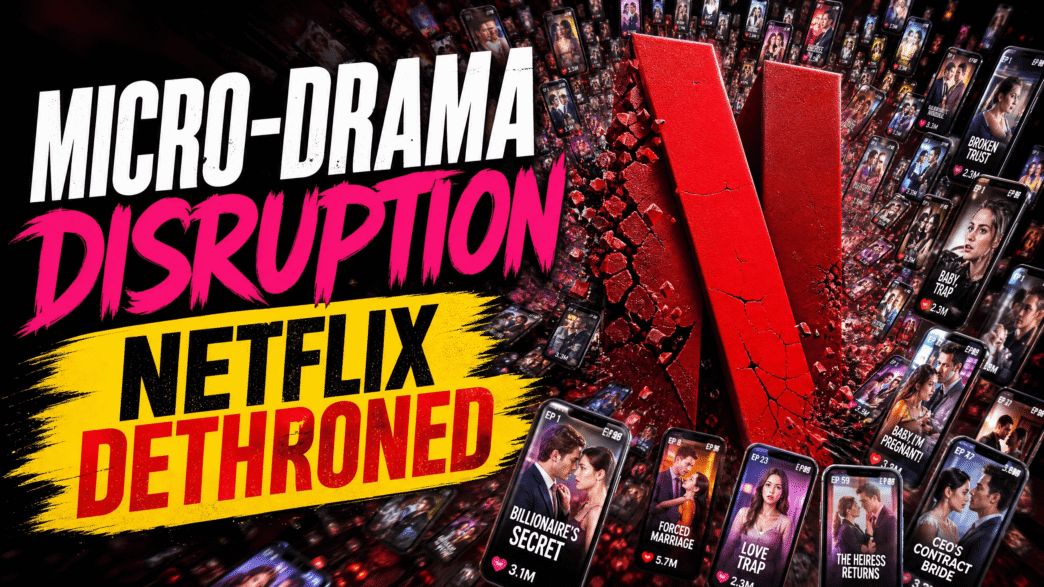
ReelShort users spend 35.7 minutes daily in the app. Netflix mobile users? Just 24.8 minutes. That’s a 44% engagement gap—and it’s growing wider every month as short drama apps’ viral growth reshapes how audiences consume serialized content.
While Netflix executives debated password sharing, a new category of mobile-first entertainment apps quietly captured 26% of Google Play’s Top 50 Entertainment revenue slots. Thirteen micro-drama platforms now generate more combined daily engagement than Disney+, HBO Max, and Paramount+ mobile apps combined.
This isn’t another streaming war. It’s a complete format revolution that nobody in traditional media saw coming.
Part 1 — The Trigger: When Gaming Psychology Met Soap Opera Structure
The vertical drama explosion started with a simple behavioral insight: mobile users don’t want 42-minute episodes. They want emotional payoff in under two minutes.
DramaBox launched its freemium model in late 2023, treating fiction like a mobile game. Users get 3-5 free episodes daily, then pay $0.99-$4.99 per “chapter pack” to continue cliffhanger storylines. The format worked because it solved mobile entertainment’s core monetization problem—how to drive repeat purchases from audiences who expect free content.
“We studied Candy Crush’s retention curves more than we studied Netflix,” admitted DramaBox’s former head of product in a February 2024 Reuters interview. “Episode cliffhangers create the same dopamine loops as level completion. Users aren’t binge-watching—they’re addiction-watching.”
The psychological engineering was deliberate. Episodes end mid-conversation, mid-kiss, mid-revelation. Users face an immediate choice: wait 24 hours for the next free episode or pay $1.99 for instant continuation. Viral engagement patterns show 67% choose to pay rather than wait.
The Content Formula That Hooked Millions
Vertical dramas follow a rigid emotional structure: setup (15 seconds), conflict escalation (60 seconds), cliffhanger (15 seconds). Every 90-second episode delivers one emotional peak. Traditional TV spreads that same emotional density across 22 minutes.
The most successful shows focus on aspirational themes: CEOs falling for assistants, fake marriages between billionaires, revenge plots involving corporate dynasties. The content feels familiar because it borrows from Korean webtoons, Chinese web novels, and Latin telenovelas—but compressed into mobile-native vertical video.
ReelShort’s “Double Life of My Billionaire Husband” generated 847 million views across 156 episodes. Each episode cost roughly $2,000 to produce. Total production budget: $312,000. Revenue: $18.7 million. That’s a 60x return on content investment.
Netflix spends $15 billion annually on content. These apps spend $50,000-$200,000 per series—and achieve higher per-minute engagement rates.
Part 2 — The Amplification Engine: Freemium Addiction Meets TikTok Discovery
The growth engine behind short drama apps viral growth combines three psychological triggers: cliffhanger addiction, social proof, and algorithmic discovery.
Unlike Netflix’s monthly subscription model, micro-drama apps use freemium gaming mechanics. Users start free, get emotionally invested through 3-5 episodes, then face a paywall at the season’s emotional climax. The average user conversion rate hits 23%—nearly triple typical streaming trial conversions.
“We’re not competing with Netflix for attention,” explained DramaBox CEO Jennifer Liu during a May 2024 industry panel. “We’re competing with Instagram Reels and TikTok for micro-moments. But instead of 15-second clips, we’re delivering 90-second emotional experiences that users can’t stop buying.”
The TikTok Discovery Loop
User acquisition happens primarily through TikTok, where 15-30 second drama clips function as trailers. The most viral clips show dramatic moments without resolution—a woman discovering her husband’s affair, a CEO’s secret identity reveal, a revenge plot’s climactic confrontation.
These preview clips don’t reveal the storyline’s resolution. Instead, they direct viewers to download the app for “the full story.” Bloomberg reported that successful TikTok teasers drive 12-18% install rates—significantly higher than traditional app marketing.
The discovery mechanism creates a viral loop: users discover dramas through TikTok clips, download apps for full episodes, then share their favorite moments back to TikTok, creating new discovery touchpoints.
Paid User Acquisition at Scale
While traditional streamers rely on brand marketing, micro-drama apps built growth through performance marketing. AppsFlyer data shows short drama paid installs increased 155% globally year-over-year through Q1 2026.
DramaBox’s customer acquisition cost averages $8.50 globally. Average revenue per user hits $47 over 90 days. That 5.5x LTV-to-CAC ratio enables aggressive paid acquisition across Facebook, TikTok, Google, and regional platforms.
The unit economics work because users aren’t paying for monthly access—they’re paying for emotional continuation. Each purchase decision feels small ($0.99-$2.99) but creates habit formation that traditional subscriptions can’t match.
Part 3 — The Numbers at Peak
By May 2026, the micro-drama category reached unprecedented scale across engagement, revenue, and market penetration metrics.
Revenue Growth: DramaBox generated $323 million in 2024 revenue with $10 million net profit. Industry projections estimate $7.8 billion total category revenue for 2026, representing 340% year-over-year growth. ReelShort alone generates approximately $80 million quarterly revenue, while DramaBox contributes $35 million quarterly—together controlling roughly 70% of global vertical drama in-app purchase revenue.
Engagement Supremacy: Users spend 35.7 minutes daily in ReelShort versus 24.8 minutes in Netflix mobile. That engagement gap widens during peak usage hours (6-9 PM), when vertical drama apps see 89% higher session frequency than traditional streaming platforms.
Market Share Explosion: Thirteen short drama apps now occupy 26% of Google Play Entertainment Top 50 Grossing rankings, up from approximately 6% in early 2024. This represents the fastest category penetration in mobile entertainment history.
Geographic Expansion Patterns
India became the breakout growth market, with downloads surging 403% year-over-year in Q1 2026. Regional platforms targeting Hindi, Tamil, and Bengali audiences combined for over 140 million installs. The localization strategy focuses on cultural adaptation—corporate romance themes adjusted for Indian family dynamics, traditional festivals incorporated into storylines.
Latin American markets show similar trajectory patterns. Mexico-focused drama apps generated $89 million combined revenue in 2025, with per-user spending averaging $31 monthly—comparable to US engagement levels.
The Programmatic Advertising Milestone
May 2026 marked a category maturation milestone when DramaBox partnered with The Trade Desk, becoming the first short drama app to access global programmatic advertising inventory. This partnership signals the category’s evolution beyond pure in-app purchases toward hybrid monetization models combining freemium mechanics with premium advertising placements.
The advertising integration maintains user experience integrity by placing 5-second skippable ads between episodes rather than interrupting content mid-stream. Early tests show 12% revenue uplift without affecting user retention rates.
Part 4 — The Aftermath
Traditional streaming platforms initially dismissed vertical dramas as a mobile gaming fad. That changed when short drama apps viral growth started affecting their core engagement metrics.
Netflix’s mobile engagement declined 8% quarter-over-quarter in Q4 2025—the first sustained mobile usage drop in company history. Internal data showed users aged 18-34 spending 23% less time in Netflix mobile while increasing time in micro-drama apps by 67%.
Disney responded first, launching Disney Moments in February 2026—a vertical drama platform featuring Marvel and Star Wars characters in soap opera formats. Early episodes featuring “The Real Housewives of Wakanda” and “Love Island: Jedi Edition” generated 45 million views but struggled to match authentic drama apps’ emotional intensity.
Hollywood’s Scrambling Response
By March 2026, three major studios announced dedicated vertical drama divisions. Warner Bros created WB Micro, Paramount launched Vertical+, and Sony Pictures established Sony Stories. Each division received $50-$100 million initial budgets—massive investments for 90-second content.
The challenge became talent acquisition. Successful micro-drama creators understand mobile-native storytelling, cliffhanger psychology, and freemium monetization. Traditional TV writers struggle with the format’s emotional compression requirements.
“We’re hiring TikTok creators and mobile game designers, not screenwriters,” admitted a Warner Bros executive in an off-the-record conversation. “Traditional narrative structure doesn’t work when you have 90 seconds to create addiction.”
Creator Economy Disruption
The vertical drama boom created unexpected opportunities for actors and writers. Creator economy dynamics shifted as micro-drama studios began hiring talent at higher per-minute rates than traditional productions.
Successful drama apps employ actors for $500-$1,500 per episode (90 seconds of content). Daily shooting schedules produce 8-12 episodes, generating $4,000-$18,000 daily earnings for lead actors. Supporting roles earn $200-$500 per episode.
Writers specializing in cliffhanger structures command premium rates. Top micro-drama scriptwriters earn $2,000-$5,000 per episode, with successful series generating $300,000-$800,000 total writing fees across 100+ episodes.
Part 5 — The Transferable Lesson
The short drama apps viral growth phenomenon reveals three critical insights for founders, marketers, and creators building in the attention economy.
Lesson 1: Emotional Density Beats Content Volume
Traditional streaming optimizes for watch time. Micro-dramas optimize for emotional impact per minute. Each 90-second episode delivers one specific emotional peak—revelation, betrayal, romantic tension, power reversal. This emotional compression creates stronger psychological attachment than hour-long episodes that spread emotional beats across extended runtime.
For creators: audiences don’t want longer content; they want higher emotional density. A 2-minute video that delivers complete emotional satisfaction outperforms 20-minute content that feels emotionally diluted.
For marketers: attention capture requires emotional peaks, not information peaks. Products that solve emotional needs in compressed timeframes build stronger user loyalty than comprehensive solutions that require extended engagement.
Lesson 2: Freemium Psychology Applies Beyond Gaming
Micro-drama apps proved freemium mechanics work for content consumption, not just gameplay. The key insight: users will pay small amounts repeatedly for emotional continuation rather than large amounts upfront for content access.
This model works because each purchase decision feels emotionally urgent rather than rationally calculated. Users aren’t buying entertainment access—they’re buying relief from cliffhanger anxiety.
For founders: consider how your product can create “emotional cliffhangers” that drive repeat engagement. SaaS platforms, educational content, fitness apps, and social platforms can benefit from freemium mechanics that gate emotional payoff rather than feature access.
Lesson 3: Mobile-Native Formats Require Mobile-Native Monetization
Netflix’s subscription model assumes desktop-like engagement: planned viewing sessions, multiple-hour consumption, household sharing. Mobile consumption follows different patterns: spontaneous viewing, micro-sessions, individual usage.
Vertical dramas succeeded because they designed monetization around mobile behavior: impulse purchases, social sharing integration, discovery through short-form preview content.
For platform builders: mobile-first audiences require mobile-first business models. Products designed for desktop usage patterns often fail on mobile, even with perfect technical adaptation.
Implementation Framework
Apply these insights through the “Emotional Vending Machine” framework:
Step 1: Identify your product’s emotional peak moments. What specific feelings drive user attachment?
Step 2: Compress emotional payoff into the shortest possible timeframe. Cut unnecessary setup, eliminate emotional dilution.
Step 3: Gate emotional resolution behind micro-purchases. Create natural pause points where users choose between waiting or paying for continuation.
Step 4: Design discovery content that previews emotional peaks without revealing resolution. Use platform-native formats (TikTok, Instagram, Twitter) to create viral preview loops.
Step 5: Optimize for emotional urgency rather than rational consideration. Users should feel compelled to continue, not convinced to subscribe.
The micro-drama revolution shows that traditional entertainment assumptions—longer content equals higher value, subscription models ensure stability, premium production quality drives engagement—don’t apply in mobile-first markets. Digital trend analysis suggests similar disruptions will emerge across education, fitness, news, and social platforms as mobile-native behaviors reshape every content category.
Frequently Asked Questions
How do short drama apps viral growth patterns differ from traditional streaming growth?
Short drama apps grow through viral discovery mechanisms rather than brand marketing. Users discover content through TikTok clips, convert through emotional urgency rather than rational subscription decisions, and spread through social sharing of dramatic moments. Traditional streaming relies on catalog breadth and exclusive content—micro-dramas succeed through emotional compression and freemium conversion optimization.
What makes vertical drama monetization more effective than Netflix’s subscription model?
Vertical dramas use “emotional urgency” monetization where users pay small amounts ($0.99-$2.99) to resolve immediate cliffhangers rather than monthly fees for content access. This creates higher per-user revenue because each purchase decision feels emotionally necessary rather than rationally optional. Users typically spend $30-$50 monthly across multiple series versus $15.99 for Netflix subscription.
Can traditional media companies successfully compete in short drama apps viral growth markets?
Traditional studios struggle because successful micro-dramas require mobile-native content creation, freemium psychology understanding, and cliffhanger writing expertise that differs completely from traditional screenwriting. Disney’s early attempts show brand recognition doesn’t translate to emotional addiction mechanics. Success requires hiring TikTok creators and mobile game designers rather than traditional entertainment talent.
How sustainable is the short drama apps viral growth trend long-term?
The category shows strong sustainability indicators: improving unit economics, successful geographic expansion, and evolving monetization beyond pure in-app purchases toward programmatic advertising. The format addresses fundamental mobile consumption patterns rather than temporary trends. Industry projections estimate continued growth as production costs decrease through AI integration and regional markets achieve monetization maturity.
What role will AI play in future short drama apps viral growth?
AI will primarily reduce production costs and increase content velocity. Current per-episode costs of $2,000-$3,000 could decrease to under $500 through AI-generated scripts, virtual actors, and automated editing. This cost reduction enables 10x content production volume, allowing apps to test more storylines, personalize content recommendations, and expand into niche genres without significant financial risk.
How do short drama apps viral growth metrics compare to social media engagement?
Micro-drama apps achieve higher session duration (35.7 minutes daily) compared to TikTok (29.1 minutes) or Instagram (28.3 minutes) while maintaining similar addiction-like engagement patterns. The key difference: users pay for continued engagement rather than consuming advertiser-supported content. This creates more sustainable business models with higher lifetime value per user than traditional social platforms.