








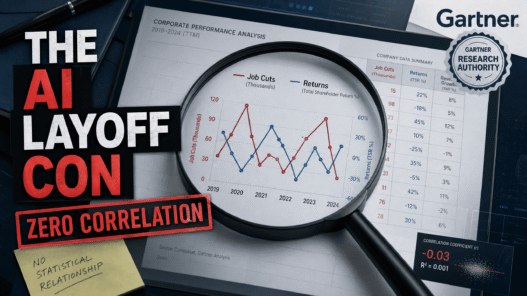
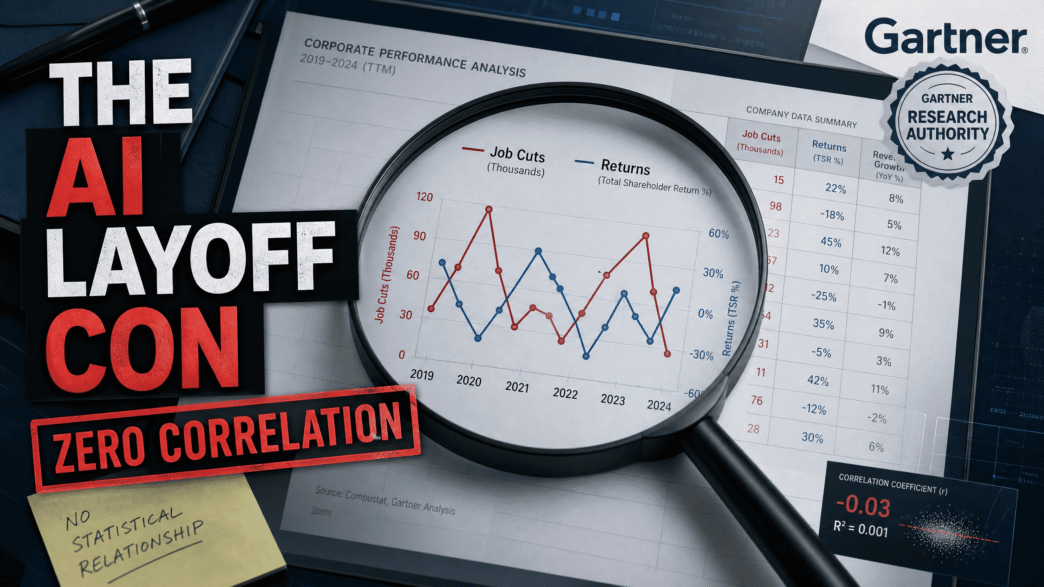
On May 5, 2026, Gartner released the most damning corporate study of the decade. After analyzing 350 large enterprises, researchers found that 80% of companies piloting AI had cut their workforce—yet there was zero statistical correlation between layoffs and actual returns on investment.
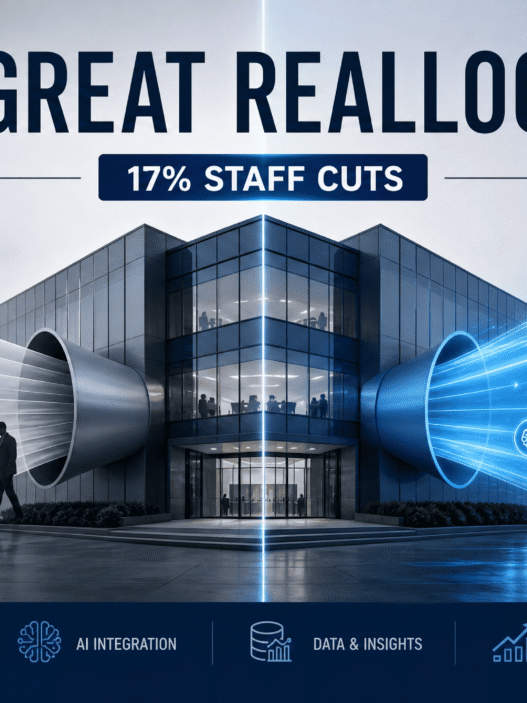
That same month, Meta announced 8,000 cuts. PayPal slashed 20% of staff. Cloudflare eliminated 1,100 roles. Coinbase downsized 14%. LinkedIn dropped 875 employees. All justified by “AI transformation.”
The timing wasn’t coincidental. It was catastrophic.
Gartner’s hard data exposed what many suspected: companies aren’t laying off workers because AI makes them more productive. They’re using AI as cover for old-fashioned cost-cutting while praying margins hold.
This isn’t just a business strategy failure. It’s a leadership credibility crisis that’s destroying entry-level career pathways and burning organizational trust—all while failing to deliver the promised returns.
Part 1 — The Trigger: When Data Destroys Narrative
The breaking point came when Gartner researcher Helen Poitevin published findings that shattered Silicon Valley’s favorite story. Companies reducing staff showed nearly identical layoff rates whether they reported higher ROI or negative outcomes from AI initiatives.
Roughly 80% cut workers across all ROI tiers.
“The assumption that workforce reduction leads to AI productivity gains is fundamentally flawed,” Poitevin stated in the report. “Organizations are making strategic decisions based on narrative rather than evidence.”
The May 2026 Bloodbath
May’s layoff wave painted a clear picture of corporate groupthink. Here’s the damage:
- Meta: 8,000 positions eliminated, citing “AI efficiency gains”
- PayPal: 20% workforce reduction in phases
- Cloudflare: 1,100 roles cut despite strong revenue growth
- Coinbase: 14% staff reduction for “operational streamlining”
- LinkedIn: 875 employees laid off from talent acquisition
- Wix: 20% workforce cut
- BILL: 30% reduction
- Upwork: 24% staff eliminated
Total: 28,000+ jobs lost to the AI narrative in a single month.
Every announcement followed the same script: “We’re investing in AI to transform productivity.” But Gartner’s research revealed these companies were cutting first and hoping for transformation later.
The Psychology Behind the Con
Why did so many executives fall for the same narrative? The answer lies in how AI became a socially acceptable excuse for difficult financial decisions.
Traditional layoffs trigger investor skepticism about business fundamentals. But AI layoffs signal “forward-thinking leadership” and “operational sophistication.” The psychological play: we’re not cutting costs desperately—we’re positioning for the future.
CFOs discovered they could slash expenses while maintaining market confidence by framing cuts as strategic AI investments rather than reactive cost management.
Part 2 — The Amplification Engine: How Hype Became Strategy
The AI layoff narrative spread through three amplification mechanisms that transformed wishful thinking into accepted business strategy.
Consultant-Driven Validation
Management consulting firms accelerated the narrative by selling “AI transformation roadmaps” that invariably included workforce optimization. McKinsey, Deloitte, and BCG published studies suggesting 30-40% productivity gains from AI adoption—but buried the timeline and implementation complexity in footnotes.
Executives heard “productivity gains” and translated it to “fewer people needed.”
These firms had powerful incentives to sell transformation narratives. Multi-million dollar AI consulting engagements generate more revenue than incremental process improvements.
Earnings Call Theater
The quarterly earnings cycle created perverse incentives for AI storytelling. Analysts rewarded companies that demonstrated “AI leadership” with higher multiples, even without evidence of returns.
CFOs learned to package layoffs as AI investments during earnings calls. The language became standardized:
- “Realigning our workforce for the AI era”
- “Optimizing human-AI collaboration”
- “Positioning for autonomous operations”
Wall Street analysts, lacking technical expertise to evaluate AI claims, accepted these narratives at face value. Stock prices rewarded the story, not the substance.
Peer Pressure at Scale
Once Meta and other major platforms announced AI-driven layoffs, smaller companies felt pressure to follow suit or appear behind the curve.
Board meetings shifted from “Should we cut staff?” to “Why haven’t we optimized for AI yet?”
The fear of missing out on AI transformation became stronger than the fear of making operational mistakes. Companies that maintained stable workforces were questioned about their “digital readiness.”
Part 3 — The Numbers at Peak
Gartner’s May 2026 study included brutal specifics that demolished the AI productivity narrative.
ROI Reality Check
Among companies surveyed:
- 28% of AI use cases in operations succeeded and met ROI targets
- 20% failed outright with negative returns
- 52% remained in pilot purgatory with unclear outcomes
More damaging: companies that cut the most staff showed identical success rates to those that maintained workforce levels.
“We found no correlation between workforce reduction and AI ROI across any metric—revenue growth, margin improvement, or productivity gains,” the study concluded.
The Agentic AI Disaster
Gartner’s April and June 2026 reports revealed even more concerning trends. Over 40% of “agentic AI” projects—autonomous systems meant to replace human workflows—are expected to be canceled by end of 2027 due to escalating costs and unclear value delivery.
Companies that bet heavily on AI agents to justify layoffs found themselves understaffed with non-functional automation.
Financial Impact Assessment
The numbers exposed a brutal truth: AI layoffs created short-term margin improvements without sustainable productivity gains.
Companies reported average severance costs of $150,000-$300,000 per eliminated role, plus recruitment expenses when automation failed to deliver. Many organizations found themselves rehiring contractors at higher rates to fill capability gaps.
The net result: temporary margin boost followed by operational chaos and inflated labor costs.
Part 4 — The Aftermath
By summer 2026, the cracks in the AI layoff strategy became impossible to ignore.
Execution Gaps Emerge
Companies that cut deep began experiencing delivery failures. Customer service response times increased. Product development cycles extended. Sales processes broke down.
Meta faced criticism when several core products experienced outages due to reduced monitoring staff. PayPal’s transaction processing times increased as automated systems couldn’t handle edge cases previously managed by human operators.
The promised AI productivity gains weren’t materializing fast enough to compensate for reduced human capability.
Talent Market Backlash
The AI layoff wave created a secondary crisis: talent scarcity. Experienced professionals became skeptical of companies that had justified cuts through AI narratives.
Top performers began avoiding organizations with recent AI-driven layoffs, viewing them as unstable employers that prioritize narrative over operational reality.
Recruitment costs spiked as companies competed for talent that could actually implement AI solutions rather than just evangelize them.
Investor Skepticism Returns
By Q3 2026, investors began questioning AI transformation timelines. Companies that promised productivity gains through workforce reduction faced pressure to demonstrate actual returns.
Earnings calls shifted from AI storytelling to ROI accountability. Analysts started asking harder questions about implementation costs, timeline delays, and capability gaps.
The narrative protection that AI layoffs initially provided began evaporating as financial results failed to materialize.
Part 5 — The Transferable Lesson
The AI layoff crisis offers crucial insights for founders, operators, and business leaders navigating technological transformation.
Narrative vs. Evidence
The biggest lesson: transformative technology narratives can become dangerous when they substitute for operational evidence.
Companies that succeeded with AI focused on augmenting human capabilities rather than replacing them. They measured productivity improvements before making workforce decisions, not after.
The organizations that avoided the layoff trap asked different questions:
- Where does AI actually improve our processes?
- What human skills become more valuable with AI assistance?
- How do we measure productivity beyond headcount reduction?
Strategic Patience Pays
Companies that maintained workforce stability while gradually implementing AI solutions outperformed those that cut first and automated later.
The winners invested in “people amplification”—training existing employees to work with AI tools rather than planning their replacement.
This approach took longer to show returns but created sustainable productivity improvements and maintained institutional knowledge.
The Trust Factor
Organizations that were transparent about AI limitations and focused on human-AI collaboration retained employee trust and attracted better talent.
Companies that oversold AI capabilities and justified layoffs through transformation narratives damaged their credibility with both employees and customers.
Trust, once lost, proved expensive to rebuild.
Frequently Asked Questions
What did Gartner’s study actually find about AI layoffs and ROI?
Gartner found zero correlation between workforce reduction and AI returns across 350 large enterprises. Companies that cut staff showed identical ROI outcomes to those that maintained workforce levels, with only 28% of AI implementations meeting success targets regardless of layoff decisions.
Why did so many companies fall for the AI layoff narrative?
AI provided socially acceptable cover for cost-cutting decisions. Traditional layoffs signal business problems, but AI layoffs signal forward-thinking leadership. Management consultants and Wall Street analysts reinforced this narrative, creating peer pressure to optimize for AI or appear behind the curve.
How many jobs were lost to AI layoffs in May 2026?
Over 28,000 tech jobs were eliminated in May 2026 alone, with major cuts at Meta (8,000), PayPal (20% reduction), Cloudflare (1,100), Coinbase (14%), LinkedIn (875), and others—all justified through AI transformation narratives that Gartner’s data shows don’t correlate with actual returns.
What happened to companies that made deep AI-driven layoffs?
Many experienced execution gaps, increased operational costs, and talent acquisition problems. Severance expenses ($150-300K per role) plus contractor rehiring often exceeded short-term savings. Customer service and product development suffered as automated systems couldn’t handle complex scenarios previously managed by humans.
Which companies succeeded with AI without massive layoffs?
Organizations that focused on human-AI collaboration rather than replacement showed better long-term results. They invested in training existing employees to work with AI tools, measured productivity improvements before workforce decisions, and maintained institutional knowledge while gradually implementing automation.
What does this mean for the future of AI and employment?
The failure of AI layoffs suggests successful AI adoption requires augmenting rather than replacing human capabilities. Companies that maintain workforce stability while implementing AI thoughtfully will likely outperform those that cut first and automate later. The narrative is shifting from “AI replaces workers” to “AI amplifies capable workers.”