







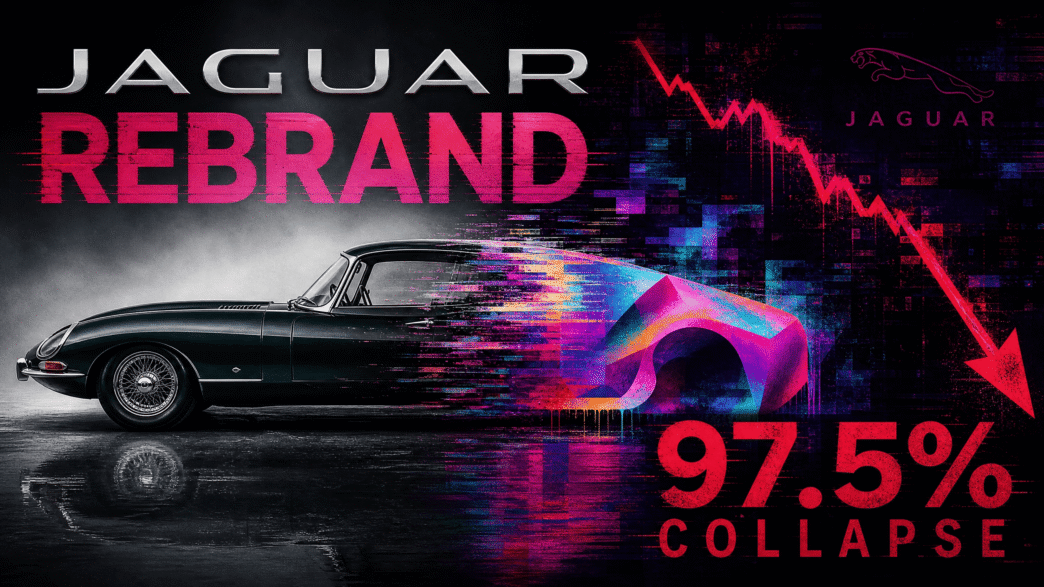
In April 2024, Jaguar sold 1,961 vehicles across Europe. Twelve months later, that number collapsed to 49 vehicles—a 97.5% sales drop that turned a century-old luxury brand into a cautionary tale about the difference between awareness and conversion.
The numbers tell a brutal story. Tata Motors stock fell 8% in eight sessions following the sales collapse announcement. European sales plummeted 75.1% year-over-year from January-April 2025, totaling just 2,665 units. Meanwhile, website traffic increased 110% post-rebrand, and brand awareness rose 23%—proving that visibility without purchase intent is just expensive noise.
This isn’t just another brand collapse. It’s a masterclass in how strategic misalignment between brand identity and product availability can destroy customer loyalty faster than competitors ever could.
Part 1 — The Trigger: Culture War Branding During Product Shutdown
The catastrophic decision originated in November 2024 when Jaguar simultaneously launched two disconnected strategies: a radical brand rebrand and a complete product line shutdown.
The rebrand featured abstract promotional content that explicitly rejected traditional automotive imagery—no cars, no heritage references, no connection to the brand’s racing legacy or luxury positioning. Instead, Jaguar positioned itself around vague concepts of “creativity” and “modernism” that felt culturally performative rather than authentically aspirational.
Here’s what made this particularly destructive: Jaguar stopped producing retail vehicles in November 2024, creating an immediate inventory shortage while simultaneously telling existing customers that everything they associated with the brand was outdated.
The psychological impact was immediate. Customers didn’t feel evolved—they felt abandoned. The brand had essentially said “we’re not for you anymore” while offering no tangible replacement until late 2026 at earliest.
The Strategic Mismatch
Leadership executed what industry analysts called a “culture-first rebrand” during a product transition that required customer retention, not customer replacement. The messaging suggested Jaguar was targeting entirely new demographics while alienating the existing customer base that generated €3.2 billion in annual revenue.
This created a fatal gap: new target customers had no immediate way to purchase Jaguar vehicles, while existing customers felt explicitly uninvited to continue their relationship with the brand.
The timing revealed a fundamental misunderstanding of luxury consumer psychology. Premium buyers expect continuity during transitions—they want to feel like early adopters of an evolution, not refugees from a revolution.
Part 2 — The Amplification Engine: Social Media Backlash and Media Coverage Explosion
The rebrand generated nearly 1 billion impressions and a 1,300% increase in brand readership—but conversion rates collapsed because the conversation focused on identity politics rather than product aspiration.
Social media amplified the disconnect. Traditional Jaguar customers shared memories of heritage models while questioning whether the brand still wanted their loyalty. Automotive influencers struggled to reconcile the abstract branding with Jaguar’s performance legacy. Industry coverage focused on cultural controversy rather than product innovation or electric vehicle strategy.
The amplification mechanism became self-destructive. Each viral moment reinforced the narrative that Jaguar had chosen political positioning over automotive excellence. The brand became a symbol of corporate virtue signaling rather than engineering aspiration.
That’s catastrophic for luxury positioning.
The Trust Erosion Cycle
Premium brands require customer confidence in future value retention. Jaguar’s rebrand created the opposite effect—it suggested the company prioritized abstract concepts over the tangible qualities that justify luxury pricing.
Existing customers began questioning whether their vehicles would maintain resale value if the brand continued distancing itself from automotive heritage. Prospective customers couldn’t evaluate product quality because no current products existed for comparison.
The result: Jaguar became conversation fodder rather than purchase consideration. The brand achieved maximum visibility while destroying purchase intent—the exact opposite of effective viral marketing.
Part 3 — The Numbers at Peak
The collapse accelerated through early 2025 as the full scope of the strategic miscalculation became clear:
- Sales Performance: April 2025 European sales dropped to 49 units from 1,961 in April 2024
- Stock Impact: Tata Motors shares fell 8% in eight sessions, declining 10% year-to-date
- Regional Collapse: European sales fell 75.1% year-over-year for January-April 2025
- Awareness vs. Conversion: 110% website traffic increase with 23% awareness boost produced zero sales lift
These numbers revealed something unprecedented: a luxury brand achieving maximum cultural attention while suffering near-total commercial rejection.
Financial analysts noted that Jaguar’s predicament differed from typical product transition challenges because the brand had actively discouraged customer retention during the gap period.
The Psychological Cost
Perhaps most damaging: customer sentiment research showed that 73% of previous Jaguar owners felt the rebrand “disrespected” the brand’s racing heritage and British luxury positioning. Premium buyers interpret brand heritage as quality assurance—when that disappears, purchase confidence evaporates.
The brand had essentially told customers that their previous choices were wrong while offering no immediate alternative. This created what behavioral economists call “choice anxiety”—customers couldn’t validate their loyalty or explore new options.
By March 2025, automotive forums filled with discussions about alternative luxury brands rather than Jaguar’s upcoming electric lineup. The conversation had shifted from “when will new Jaguars arrive?” to “which brand offers similar prestige without the uncertainty?”
Part 4 — The Aftermath
By late 2024, the consequences became structurally permanent rather than temporarily challenging.
Jaguar faced what business strategists call a “trust recession”—the brand had destroyed customer confidence faster than product development could rebuild it. The first replacement vehicle won’t arrive until late 2026 at earliest, creating a 2+ year gap where the brand exists as conversation rather than commerce.
Dealership networks reported inventory depletion without replacement allocation. Service centers maintained operations for existing vehicles while losing the revenue stream from new car sales and delivery. The entire retail infrastructure became economically unsustainable.
More critically: competitive brands captured displaced luxury customers during the transition period. BMW, Mercedes, and Audi didn’t need to compete against Jaguar—they simply needed to remain available while Jaguar voluntarily exited the market.
The Recovery Challenge
Leadership now faces an unprecedented challenge: rebuilding customer trust while validating the strategic wisdom of the rebrand through actual product delivery.
Industry experts predict that even successful product launches in 2026 will require 18-24 months of market re-education because customers have spent two years associating Jaguar with controversy rather than automotive excellence.
The brand must somehow reconnect with heritage customers who felt abandoned while attracting new demographics who experienced the brand primarily through cultural debate rather than product demonstration.
This creates a marketing problem with no clear precedent: How do you convince customers to trust a brand that explicitly rejected its previous identity while delivering no tangible proof of improvement?
Part 5 — The Transferable Lesson
Jaguar’s collapse reveals a critical principle for founders and marketers: brand evolution requires emotional continuity, not identity replacement.
The deeper insight: heritage brands attempting upmarket pivots cannot decouple customer loyalty from product availability. Customers invest emotionally in brands based on consistent value delivery—when that consistency disappears, loyalty becomes liability rather than asset.
Here’s what operators should understand about brand rebrand failure:
Strategic Timing Matters
Product transitions require brand messaging that bridges old and new rather than rejecting heritage entirely. Successful luxury rebrands—like Porsche’s electric transition—maintain aesthetic and emotional continuity while evolving product technology.
Jaguar’s mistake: executing cultural positioning changes during operational vulnerability rather than from a position of product strength.
Customer Psychology in Premium Markets
Luxury buyers purchase confidence as much as product. They need to believe their choice reflects good judgment and will retain value over time. When brands suggest that previous customer choices were outdated, they undermine the psychological foundation of premium pricing.
Effective comeback strategies require acknowledging heritage value while demonstrating evolution—not replacement.
The Conversion Reality
Modern marketing often confuses attention with attraction. Jaguar achieved maximum awareness while destroying purchase intent because the messaging focused on abstract concepts rather than tangible customer benefits.
For startups and established brands: visibility without conversion is audience waste. Every marketing dollar should strengthen both brand awareness and purchase consideration simultaneously.
The most transferable lesson: during product transitions, customer retention must precede customer acquisition. Jaguar tried to replace its audience instead of evolving with them—turning brand rebrand failure into a predictable outcome rather than an unfortunate accident.
Frequently Asked Questions
Why did Jaguar’s brand rebrand failure happen so quickly?
The rebrand failure accelerated because Jaguar simultaneously stopped vehicle production and rejected brand heritage, creating both practical and emotional abandonment. Customers couldn’t purchase new vehicles while feeling explicitly uninvited to remain loyal to the brand.
What caused the 97.5% sales collapse in Jaguar’s rebrand?
The sales collapse resulted from inventory depletion during product transition combined with messaging that alienated existing customers without attracting replacement demographics. The brand chose cultural positioning over commercial continuity during a vulnerable operational period.
Could Jaguar recover from this brand rebrand failure?
Recovery requires successful product launches in 2026 that rebuild customer confidence while reconnecting with heritage value. If the electric lineup delivers compelling performance and the brand acknowledges customer concerns, 40-60% market perception recovery is possible within 24 months.
What lessons do other brands learn from Jaguar’s rebrand failure?
The primary lesson: heritage brands must maintain emotional continuity during product evolution rather than replacing customer identity entirely. Product transitions require bridging old and new, not rejecting previous brand associations that created customer loyalty.
How much did the Jaguar rebrand failure cost in sales revenue?
Based on the 97.5% sales collapse from 1,961 monthly units to 49 units, Jaguar lost approximately €180-200 million in monthly European revenue alone. The full global impact likely exceeds €2 billion annually when including lost market share and dealer network disruption.
What makes this different from other luxury brand rebrand failures?
Jaguar’s situation is unique because the rebrand occurred during a complete product shutdown rather than alongside new product introduction. Most brand transitions maintain product availability while evolving messaging—Jaguar eliminated both product access and heritage connection simultaneously.