








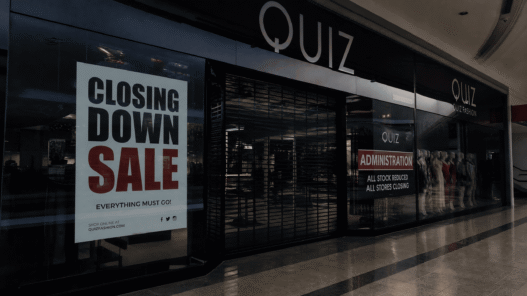
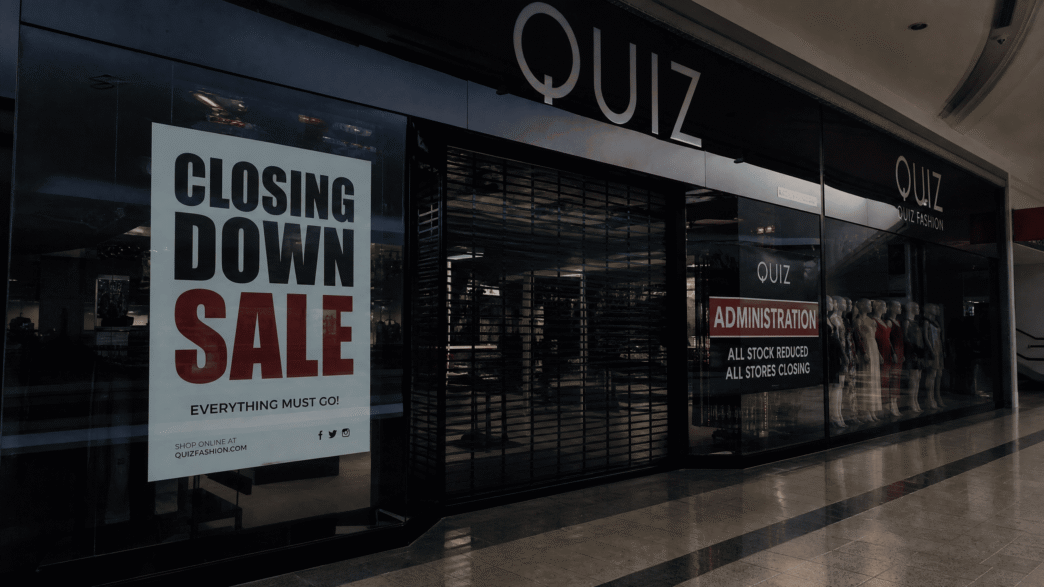
On February 5, 2026, Quiz fashion administrators announced all 37 remaining standalone stores would close by June 30. The Glasgow-based retailer had entered its third administration in six years—a record that exposed how repeatedly using insolvency as a restructuring strategy had become its own death sentence.
This wasn’t just another high street casualty. Quiz’s collapse reveals a dangerous pattern where brands treat administration like a quarterly earnings call—routine, expected, survivable. The numbers tell a brutal story: 565 employees, 109 immediate redundancies, and equity holders completely wiped out after a 2017 IPO that raised over £100 million.
Here’s exactly how serial administration killed a once-promising fashion brand.
Part 1 — The Trigger: Failed Christmas 2025 Exposes Structural Weakness
Quiz’s final collapse began during Christmas 2025 trading. The company reported a devastating 7.6% year-over-year revenue decline in its H1 2025 results, but the holiday season delivered the knockout blow.
Internal sources revealed that Quiz couldn’t secure adequate inventory for peak trading periods. Suppliers, burned by previous administrations in 2020 and 2025, demanded cash-on-delivery terms the company couldn’t meet. Store managers reported empty rails in prime selling locations during December’s crucial shopping weeks.
The Christmas failure wasn’t about consumer demand—it was about supplier trust collapse. When manufacturers in Turkey, Bangladesh, and China stopped extending credit terms, Quiz lost its ability to stock seasonal collections. Fast fashion lives or dies on inventory velocity, and Quiz had effectively been blacklisted by its own supply chain.
The Credibility Crisis
Quiz’s previous administrations had created a credibility death spiral. Each restructuring eliminated supplier debts, allowing the company to emerge with clean balance sheets but destroyed relationships. By 2025, Quiz was paying 40-60% higher prices than competitors for identical products because suppliers factored in default risk.
Taha Bouqdib, CEO of Quiz since 2019, later admitted the company had become “uninvestable” due to its administration history. Private equity firms and fashion investors viewed Quiz as a serial restructurer rather than a legitimate retail operation.
The final trigger came when Quiz’s largest clothing supplier, Turkish manufacturer Tekfen Tekstil, refused to fulfill a £2.3 million spring 2026 order without 100% upfront payment. Quiz couldn’t secure the working capital, leaving stores with winter clearance stock during peak spring selling season.
Part 2 — The Amplification Engine: Serial Administration as Strategic Tool
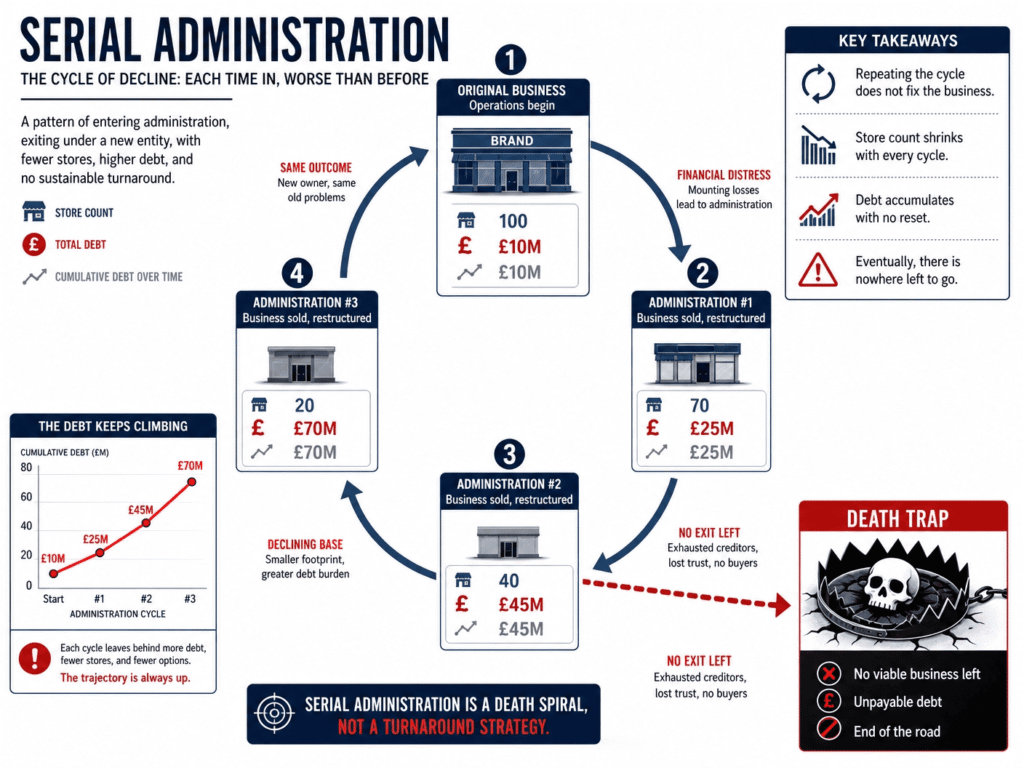
Quiz’s collapse accelerated because management had weaponized administration as a regular business strategy. Between 2020 and 2026, the company entered formal insolvency procedures six times—a frequency that transformed legal restructuring into operational planning.
This approach initially appeared clever. Each administration allowed Quiz to eliminate lease obligations, reduce headcount, and negotiate supplier payment holidays while maintaining trading operations. The company’s share price actually increased 23% following its 2020 administration announcement, as investors viewed debt elimination as positive.
The Administration Playbook
Quiz developed a repeatable administration process:
- File for administration during low-revenue quarters
- Negotiate store closures and rent reductions
- Eliminate supplier debts through legal restructuring
- Emerge with reduced costs and a clean balance sheet
- Resume trading until the next financial pressure point
This cycle worked twice. But each iteration damaged Quiz’s fundamental business relationships. Suppliers began treating Quiz orders as high-risk transactions, demanding premium pricing and restrictive payment terms that made the company structurally uncompetitive.
The amplification came from Quiz’s inability to build genuine competitive advantages between administrations. Instead of using restructuring time to develop better products, stronger customer loyalty, or operational efficiency, management focused on financial engineering. They treated administration as a reset button rather than addressing underlying business model weaknesses.
The Trust Bankruptcy
By 2025, Quiz faced something more dangerous than financial bankruptcy—trust bankruptcy. Landlords refused lease renewals, suppliers demanded cash deposits, and employees began leaving for competitors before formal redundancy announcements.
Industry sources reveal that Quiz’s administration history made it impossible to negotiate favorable terms on anything. The company paid 15-20% above market rates for commercial rent because landlords factored in default probability. This cost disadvantage made Quiz’s business model unsustainable even during profitable periods.
Part 3 — The Numbers at Peak
Quiz’s peak trading period occurred between 2017-2019, following its successful London Stock Exchange IPO. The company operated 162 standalone stores across the UK and Ireland, employed over 2,100 people, and reported annual revenues of £165 million.
The IPO raised £102 million at a valuation of £218 million, making Quiz one of Scotland’s largest fashion retail success stories. Founder Tarak Ramzan retained a 34% stake worth approximately £74 million at listing prices.
The Peak Performance Metrics
At its 2018 operational peak, Quiz demonstrated impressive unit economics:
- Average transaction value: £47 per customer visit
- Inventory turnover: 8.2x annually (industry average: 6.1x)
- Gross margins: 64% on full-price merchandise
- Online revenue: £34 million (21% of total sales)
Quiz’s success came from identifying a specific market gap: affordable occasion wear for 18-35-year-old women. The brand specializes in party dresses, wedding guest outfits, and work-appropriate clothing priced between £25 and £85.
The company’s positioning worked because it sat between ultra-fast fashion (H&M, Zara) and premium high street (Reiss, Whistles). Quiz offered trend-led designs with better quality than Primark but remained significantly cheaper than mid-market alternatives.
The Geographic Expansion
Quiz’s store network peaked at 162 locations, with particularly strong performance in Scotland, Northern England, and Ireland. The brand achieved 12.7% market share in Glasgow’s fashion retail sector and operated flagship stores in Edinburgh’s Princes Street and Dublin’s Grafton Street.
International expansion included partnerships in Cyprus, Malta, and the Middle East through franchise agreements. Quiz products were sold in over 400 international locations at peak, generating £23 million in licensing and wholesale revenue.
However, this expansion masked underlying vulnerabilities. Quiz’s growth strategy focused on geographic expansion rather than customer retention or operational efficiency improvements. The company never developed the sophisticated supply chain management or customer data analytics that would later prove essential for competing against digital-native brands.
Part 4 — The Aftermath
Quiz’s third and final administration created a cascade of consequences that extended far beyond the company’s immediate stakeholders. The closure announcement triggered immediate redundancies for 109 head office and distribution center employees, with the remaining 456 store staff facing job losses by June 30, 2026.
Shareholders, including founder Tarak Ramzan, lost their entire investment. Ramzan’s stake, worth £74 million at IPO, became worthless overnight. Institutional investors, including Hargreave Hale and Canaccord Genuity, which had participated in Quiz’s fundraising rounds, faced total write-offs exceeding £45 million.
The Supplier Fallout
Quiz’s collapse sent shockwaves through its Turkish and Bangladeshi supplier network. Manufacturers were left holding £8.7 million in unpaid invoices, with little prospect of recovery through administration proceedings.
Tekfen Tekstil, Quiz’s largest supplier, had to lay off 340 workers at its Istanbul facility after Quiz orders represented 23% of the factory’s total production capacity. The supplier network’s losses weren’t just financial—they faced production gaps that couldn’t be immediately filled by alternative customers.
This supplier damage created broader industry consequences. Other UK fashion retailers found Turkish manufacturers more reluctant to extend credit terms, viewing the entire British fast fashion sector as higher risk following Quiz’s repeated defaults.
The Real Estate Impact
Quiz’s store closures left 37 prime retail locations vacant across the UK and Ireland. These weren’t peripheral locations—Quiz had secured strong high street positions in Edinburgh, Glasgow, Liverpool, and Dublin’s shopping districts.
Commercial property agents reported difficulty re-letting Quiz’s former spaces because the brand had negotiated specialized fitting rooms and changing areas that didn’t suit many alternative retailers. Several landlords faced 12-18-month vacancy periods, losing rental income estimated at £4.2 million annually.
The closure pattern revealed retail real estate’s structural challenges. Quiz’s best-performing stores were in regional shopping centers that struggled to attract replacement tenants, accelerating the decline of already-pressured retail destinations.
The Employee Exodus
The administration history of the quiz had already triggered talent drain before the final collapse. Senior executives, including Head of Design Sarah Chen and Operations Director Mark Thompson, left for competitors during 2025 as Quiz’s restructuring reputation made career advancement impossible.
Former employees report that the constant administration threat created a “crisis culture” where long-term planning became impossible. Marketing campaigns were shortened, product development cycles compressed, and strategic initiatives abandoned due to financial uncertainty.
Part 5 — The Transferable Lesson
Quiz’s collapse teaches a critical lesson about the hidden costs of using insolvency as a business strategy: reputation is the most valuable asset in relationship-dependent industries.
The Quiz fashion collapse reveals how serial administration destroys the trust relationships that make retail businesses viable. Every supplier relationship, landlord negotiation, and employee contract becomes more expensive when counterparties expect default. This “administration premium” eventually makes the business model structurally uncompetitive.
The Trust Tax
Quiz paid what economists call a “trust tax”—premium pricing that reflects default risk rather than product value. By 2025, this tax made Quiz 15-40% more expensive to operate than competitors across every business function:
- Supplier costs: 40-60% above market rates due to risk premiums
- Commercial rent: 15-20% above comparable locations
- Working capital: Impossible to secure trade credit or payment terms
- Talent acquisition: Higher salaries are needed to attract experienced executives
This teaches founders and operators a crucial principle: restructuring strategies that preserve short-term cash flow while damaging long-term relationships create unsustainable competitive disadvantages.

The Strategic Application
For marketers and founders, Quiz’s failure demonstrates why credibility must be treated as a measurable business asset. Companies should calculate the relationship cost of financial engineering strategies, not just the immediate cash impact.
Practical applications include:
- Supplier diversification: Build relationships with multiple vendors to avoid over-dependence
- Communication transparency: Address financial challenges directly rather than creating uncertainty
- Restructuring alternatives: Explore voluntary arrangements and payment plans before formal insolvency
- Stakeholder mapping: Identify which relationships are business-critical and protect them during difficulties
Quiz’s story also reveals how digital-native competitors like Shein gained permanent advantages during traditional retailers’ administration cycles. While Quiz focused on financial restructuring, Shein invested in supply chain technology, customer data analytics, and direct manufacturer relationships that created genuine competitive moats.
The lesson extends beyond retail: any business model dependent on ongoing relationships—from agencies to B2B services—risks structural damage when financial strategies prioritize short-term survival over long-term credibility.
Frequently Asked Questions
Why did Quiz fashion collapse despite multiple administrations?
Quiz fashion collapse occurred because repeated administrations destroyed supplier trust and created unsustainable cost disadvantages. Each restructuring eliminated debts but damaged relationships, making the company structurally uncompetitive. Suppliers began charging premium prices to offset default risk, while landlords demanded higher rents and employees left for more stable competitors.
How many times did Quiz enter administration before final collapse?
Quiz entered formal insolvency procedures six times between 2020 and 2026, including three full administrations. This “serial administration” strategy initially preserved trading operations but ultimately destroyed the business relationships necessary for sustainable retail operations. The frequency of restructuring made Quiz uninvestable and operationally unviable.
What was Quiz Fashion’s peak valuation and revenue?
Quiz achieved a peak valuation of £218 million during its 2017 London Stock Exchange IPO, raising £102 million in new capital. The company’s peak revenue reached £165 million annually in 2018, operating 162 stores and employing over 2,100 people across the UK and Ireland before its decline began.
How did Quiz fashion insolvency affect suppliers and employees?
Quiz fashion insolvency resulted in 565 job losses, including 109 immediate redundancies at the head office. Suppliers faced £8.7 million in unpaid invoices, with Turkish manufacturer Tekfen Tekstil laying off 340 workers after Quiz orders represented 23% of production capacity. The collapse created broader industry trust issues affecting other UK fashion retailers’ supplier relationships.
What lessons can other retailers learn from the Quiz collapse?
Quiz collapse demonstrates that using administration as a regular business strategy destroys the trust relationships essential for retail success. Companies should treat credibility as a measurable asset, calculate the relationship costs of financial engineering, and explore voluntary restructuring alternatives. The “trust tax” from repeated administrations eventually makes businesses structurally uncompetitive.
How did Quiz fashion compete against fast fashion giants like Shein?
Quiz failed to compete effectively against Shein and other digital-native fast fashion brands because it focused on financial restructuring rather than operational improvements. While Quiz underwent multiple administrations, competitors invested in supply chain technology, customer data analytics, and direct manufacturer relationships that created sustainable competitive advantages Quiz couldn’t match.