








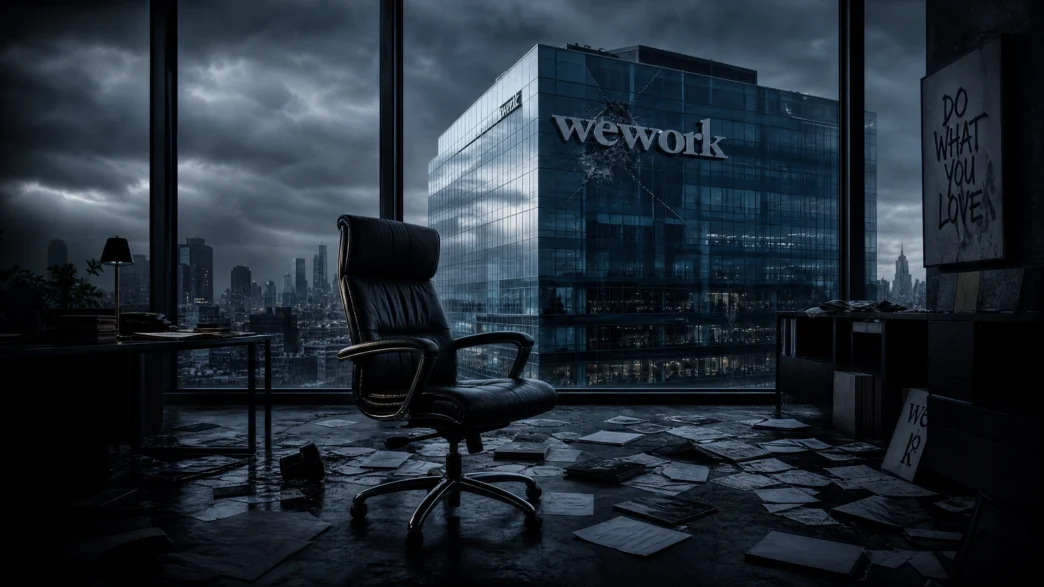
In September 2019, the most valuable startup in America filed for an IPO — and within 47 days, it had withdrawn the filing, fired its CEO, and watched $40 billion in valuation evaporate. No startup in history had fallen faster, harder, or more publicly than WeWork.
This is the complete WeWork collapse autopsy — the trigger, the amplification, the numbers at peak, the aftermath, and the one transferable lesson every founder needs to understand before it is too late.
The Rise Before the WeWork Collapse: What Everyone Got Wrong
Before we perform the autopsy, we need to understand what WeWork actually was — because most people got it completely wrong, including WeWork itself.
WeWork was founded in 2010 by Adam Neumann and Miguel McKelvey in New York City. The core business was simple: lease large commercial office spaces on long-term contracts, redesign them into trendy shared workspaces, then sublet them to startups, freelancers, and enterprise clients on flexible short-term leases.
On paper, it was a real estate arbitrage play. Lease low, sublease high, pocket the spread.
But WeWork was not selling office space. WeWork was selling a feeling.
Neumann had a gift for reframing. He called WeWork a “physical social network.” He described his mission as “elevating the world’s consciousness.” He told investors WeWork was a technology company — not a real estate firm — which, if true, would justify the kind of sky-high revenue multiples that tech companies command.
SoftBank’s Masayoshi Son believed him. In 2017, after an infamous 12-minute meeting, Son wrote WeWork a $4.4 billion check — valuing the company at $20 billion. It was the single largest investment in startup history at the time.
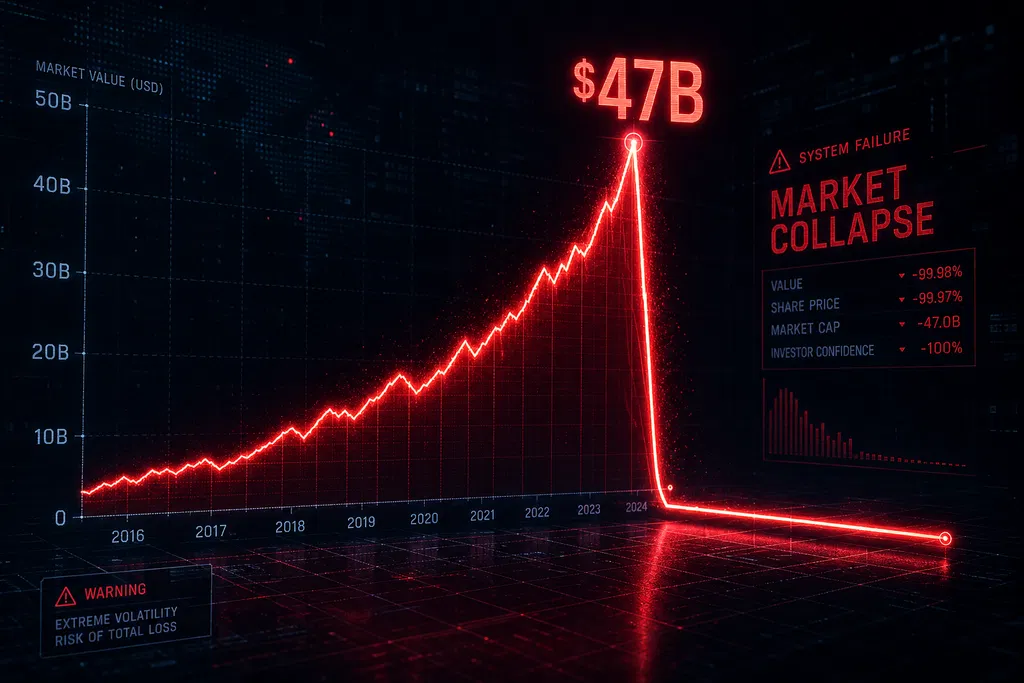
By early 2019, with additional SoftBank funding, WeWork’s valuation had climbed to $47 billion, making it the most valuable private company in the United States. It operated in 111 cities across 29 countries, employed 12,500 people, and was opening a new location somewhere in the world every single day.
Then it filed to go public.
Part 1 — The Trigger: The IPO Prospectus That Broke Everything
The exact moment the WeWork collapse began was August 14, 2019 — the day WeWork filed its S-1 prospectus with the Securities and Exchange Commission.
An S-1 is the document a company submits before going public. It contains audited financials, risk factors, business model explanations, and governance details. For the first time, the public and institutional investors could see WeWork’s actual numbers — not the story Neumann had been selling, but the reality.
What they found was staggering.
WeWork had lost $1.9 billion in 2018. In the first half of 2019 alone, it had lost another $904 million. For every dollar of revenue it generated, it spent $2. The company was bleeding cash at a rate that made even aggressive growth-stage startups look conservative.
But the financial losses were almost secondary to the governance revelations.
The S-1 disclosed that Neumann had personally trademarked the word “We” — and then sold that trademark back to WeWork for $5.9 million. He had taken out hundreds of millions of dollars in personal loans using WeWork stock as collateral. He had structured share classes that gave him 20 votes per share — compared to one vote per share for ordinary investors — meaning he would retain near-total control even after the IPO.
He had also purchased multiple buildings and then leased them back to WeWork, collecting rent from the company he ran.
The Wall Street Journal published a detailed investigation. Then The New York Times. Then Bloomberg. Within days, every major financial publication was running the same story: WeWork was not a technology company. It was a money-losing real estate business with a charismatic founder extracting enormous personal wealth from a company racing toward insolvency.
The IPO was supposed to raise $3–4 billion and cement Neumann’s legacy. Instead, it became the trigger for the fastest destruction of startup valuation in history.
Part 2 — The Amplification Engine: How the Story Spread and Why It Destroyed Everything
The WeWork collapse did not happen because journalists wrote negative stories. It happened because the S-1 gave credible ammunition to skeptics who had been dismissed for years.
The amplification followed a precise chain.
First came the financial analysts. Within 72 hours of the S-1 filing, institutional investors who had been told WeWork was worth $47 billion were recalculating. Using traditional real estate company valuation metrics — price-to-revenue, price-to-earnings, comparable company analysis — they arrived at numbers between $10 billion and $20 billion. Some put it lower.
Then came the media. The governance disclosures were a gift to financial journalists. The trademark story, the self-dealing loans, the multi-class shares — each one was a standalone headline. The coverage was not speculative. It was based entirely on documents WeWork itself had filed with the SEC.
Then came the employees. WeWork had given thousands of staff equity as part of their compensation. The IPO was supposed to be their payday. As the valuation collapsed and the IPO timeline slipped, internal anxiety became external leaks. Stories about Neumann’s erratic behavior — tequila shots on company flights, marijuana on private jets, firing employees on the spot — entered the public record.
Then came the board. SoftBank, which had bet its Vision Fund’s credibility on WeWork, began applying pressure. By mid-September 2019, less than five weeks after the S-1 filing, Neumann had resigned as CEO under board pressure. On September 30, WeWork officially withdrew its IPO.
The speed of the collapse was itself the story. A company that had been valued at $47 billion in January 2019 was, by November 2019, negotiating an emergency bailout from SoftBank at a valuation of $8 billion.
In 11 months, WeWork lost 83% of its paper value — without ever trading on a public market.
Part 3 — The Numbers at Peak: The Scale of the WeWork Collapse
To understand the full magnitude of the WeWork collapse, the numbers need to be laid out precisely.
The peak:
- $47 billion valuation (January 2019)
- 528 locations across 29 countries
- 527,000 members worldwide
- 12,500 employees globally
- $1.8 billion in revenue (2018)
- Opened a new location every 24 hours at peak expansion
The collapse:
- IPO withdrawn: September 30, 2019
- CEO resigned: September 24, 2019
- Emergency SoftBank bailout valuation: $8 billion (November 2019)
- Employees laid off in November 2019 restructuring: 2,400
- Additional layoffs across international markets: 1,000+
- SoftBank’s total investment and commitment in WeWork: $18.5 billion
- SoftBank’s estimated total loss on WeWork: $14 billion
The bankruptcy:
- WeWork filed for Chapter 11 bankruptcy on November 6, 2023
- Total debt at time of bankruptcy filing: $18.65 billion
- Number of leases rejected in bankruptcy proceedings: 100+
- Current valuation: effectively zero
For context: SoftBank’s $18.5 billion commitment to WeWork represented the largest single investment loss in venture capital history. The $47 billion peak-to-bankruptcy destruction of value remains the most dramatic collapse of a private technology-adjacent company ever recorded.
Google Trends data shows “WeWork” peaked in search interest in September–October 2019 during the IPO collapse, spiked again in August 2023 when bankruptcy rumors circulated, and hit its final peak in November 2023 at the bankruptcy filing.
Part 4 — The Aftermath: What Happened to WeWork After the Collapse
The WeWork collapse did not end with the IPO withdrawal. It played out over four more years in a slow, painful unraveling.
2020: Under new co-CEOs Sandeep Mathrani and Marcelo Claure, WeWork executed a brutal restructuring. It closed underperforming locations, renegotiated hundreds of leases, and cut its workforce from 12,500 to approximately 7,000. The COVID-19 pandemic accelerated the crisis — office demand collapsed globally just as WeWork was trying to stabilize.
2021: In a move that felt more like a last resort than a triumph, WeWork went public via a SPAC merger at a valuation of $9 billion. It was a fraction of its 2019 peak, but it finally gave SoftBank a partial exit. The stock traded under the ticker WE. Within months, it had dropped below $5.
2022: WeWork continued to lose money. Revenue recovered, but costs remained crushing. The company’s fundamental problem — long-term lease obligations versus short-term member agreements — was structural, not solvable by any CEO.
2023: After years of warnings in its financial filings about its ability to continue as a going concern, WeWork filed for Chapter 11 bankruptcy on November 6, 2023. It began rejecting lease obligations at hundreds of locations. The stock became worthless.
Adam Neumann’s aftermath: In a twist that captured the absurdity of the venture capital era, Neumann raised $350 million in 2022 to start a new real estate company called Flow — from the same venture firm, Andreessen Horowitz, that had publicly criticized WeWork’s governance. He has not been charged with any crime.
Part 5 — The Transferable Lesson: What Every Founder Must Learn From the WeWork Collapse
The WeWork collapse is not primarily a story about fraud, though self-dealing was involved. It is not primarily a story about bad management, though management was chaotic. It is a story about narrative replacing fundamentals — and what happens when the narrative is forced to confront reality.
The single most transferable lesson from the WeWork collapse is this: a story is not a business model.
Neumann convinced SoftBank, employees, and the market that WeWork was a technology company because technology companies get valued at 10–20x revenue. Real estate companies get valued at 1–2x revenue. The gap between those multiples, on $1.8 billion in revenue, was worth approximately $40 billion in paper value.
That gap was entirely fictional. And the S-1 filing — which requires honest disclosure under penalty of law — is what made the fiction impossible to sustain.
Every founder building a company in a traditional industry with a technology veneer faces this exact risk. The question is not whether you believe your own narrative. The question is whether the underlying unit economics survive the moment that the narrative is tested by public scrutiny.
For WeWork, they did not. A company that loses $2 for every $1 it earns cannot grow its way to profitability at scale. It can only grow its losses faster.
The WeWork collapse is the most expensive proof of that principle in startup history.
Why did WeWork collapse?
WeWork collapsed because its S-1 IPO filing revealed that the company was losing $2 for every $1 of revenue it generated, while simultaneously disclosing serious corporate governance issues, including CEO self-dealing. Institutional investors recalculated the valuation using real estate metrics rather than technology multiples and found the $47 billion valuation completely unjustifiable.
How much did WeWork lose?
At its peak, WeWork was valued at $47 billion. By the time of its bankruptcy filing in November 2023, the company’s equity was effectively worthless — a destruction of approximately $47 billion in paper value over four years. SoftBank alone lost an estimated $14 billion on its WeWork investments.
What happened to Adam Neumann after WeWork?
Adam Neumann resigned as CEO of WeWork in September 2019 under board pressure. He received a $1.7 billion exit package as part of his departure agreement. In 2022, he raised $350 million from Andreessen Horowitz to launch a new residential real estate company called Flow. He has not faced criminal charges.
When did WeWork go bankrupt?
WeWork filed for Chapter 11 bankruptcy protection on November 6, 2023, in the United States Bankruptcy Court for the District of New Jersey. At the time of filing, the company carried $18.65 billion in total debt.
Is WeWork still operating?
WeWork emerged from bankruptcy proceedings in 2024 with a significantly reduced footprint, having rejected hundreds of lease obligations. The company continues to operate in select major cities but as a fraction of its former size.
For more brand collapse case studies, read our full archive at TrendsSpy Brand Collapse.








Hi, this is a comment.
To get started with moderating, editing, and deleting comments, please visit the Comments screen in the dashboard.
Commenter avatars come from Gravatar.